a colorful lyrical alignment

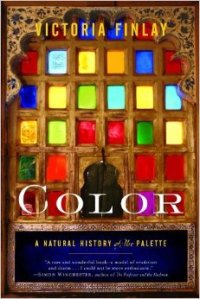
This week’s post features a lyrical alignment of an excerpt from Victoria Finlay’s book Color: A Natural History of the Palette. This is the kind of nonfiction book that tries to break down information through story and personal recollections. Finlay writes of her travels to the places where particular colors are made and goes into the details of their physical and historical make-up.

I read this book back in 2012 and still find myself citing several of its jewels of knowledge with people. One particular moment in the book lends itself to being read on its own like a poem. In the excerpt (lyrically aligned below), Finlay recounts one scientist’s metaphorical explanation of the color of the sky. Enjoy!

The Color of the Sky

a lyrical alignment 

“…to explain the color of the sky, [John Tyndall, nineteenth century British scientist] would use an image of the sea.” (from Color – Victoria Finlay)

Think of the ocean, he would say,
and think of the waves
crashing against the land.

If they came across
a huge cliff
then all the waves would stop;

if they met a rock
then only the smaller waves
would be affected;

while a pebble
would change the course
of only the tiniest waves

washing against the beach.
This is what happens
with light from the sun.

Going through the atmosphere
the biggest wave lengths –
the red ones –

are usually unaffected,
and it is only the smallest ones –
the blue and violet ones –

which are scattered by the tiny
pebble-like molecules
in the sky,

giving the human eye
the sensation of blue.
Tyndall thought

it was particles of dust
which did it;
Einstein later proved

that even molecules
of oxygen and hydrogen
are big enough to scatter

the blue rays
and leave the rest alone.

***

Happy scattering!

José

* stepping into the river with Charles Simic

The stone is a mirror which works poorly. Nothing in it but dimness. Your dimness or its dimness, who’s to say? In the hush your heart sounds like a black cricket.

Charles Simic

*who you calling dim?*

*who you calling dim?*

Since I quoted the man last week in regards to the prose poem, I thought I would share some of Charles Simic’s own work in the genre.

In these excerpts from his book The World Doesn’t End you definitely can catch some of that sense of being caught up and driven to rereading a poem in order to continue grasping what the first reading of it had you start to grasp.

This may be an exasperating way of thinking about reading – you not only read but go over what was read to read into it more – but it’s the kind of thing that poetry teaches you to do and the helps the reading of a poem to be at times both illuminating and, well, exasperating.

Simic himself says in one of his notebooks that poetry and philosophy make slow solitary readers.

I know the feeling.  In the same way you can’t step in the same river twice, so you can’t read the same thing the same way twice.  You change each time.

Stepping into the river with Simic, I always leave surprised.  Here’s more:

***

Things were not as black as somebody painted them. There was a pretty child dressed in black and playing with two black apples. It was either a girl dressed as a boy, or a boy dressed as a girl. Whatever, it had small white teeth. The landscape outside its window had been blackened with a heavy and coarse paint brush. It was all very teleological, except when a child stuck out its red tongue.

*

We were so poor I had to take the place of the bait in the mousetrap. All alone in the cellar, I could hear them pacing upstairs, tossing and turning in their beds. ‘These are dark and evil days,’ the mouse told me as he nibbled my ear. Years passed. My mother wore a cat-fur collar which she stroked until its sparks lit up the cellar.

**

Happy sparking!

Jose