post-workshop thoughts: my eyes from there

Thank you to everyone who was able to show up for Wednesday’s virtual workshop, Look / Mira: On Looking as a Way of Writing. I’m grateful for the generosity and attention folks brought to the space as we moved through prompts on inherited ways of looking, the ways looking can be shaped by place and refusal, and, finally, speculative looking.
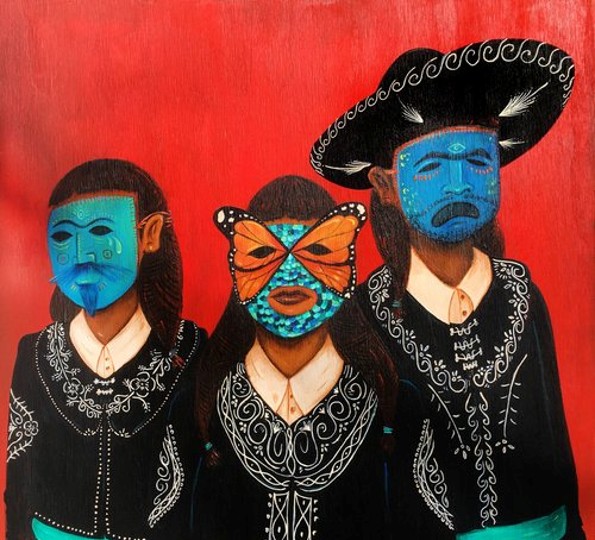

For that last prompt, I briefly shared Karla Rosas’s painting “Hijas sin padre o patria.” The title translates roughly to “Daughters without father or fatherland,” a phrase that I hear as carrying an intentional critique of gendered language and belonging. To name what one is “without” is also to name the structures that have claimed the power to define us: father, fatherland, nation, lineage, authority.

What moved me in the painting, and what I hoped might open something for the prompt, is the way absence does not remain empty. The figures are not diminished by what the title names as missing. Instead, they meet us through masks, color, pattern, and transformation. The masks suggest to me a necessary vigilance, the kind marginalized folks often practice in order to move through the world. But there is also beauty here: the vivid blue, the monarch wings, the ornate clothing, the bright red background. The painting represents lack while at the same time speculating into what can exist beyond (or despite) the terms of lack.

That was the invitation of the final prompt: to imagine a future self, ancestor, spirit, object, animal, place, or other presence watching over a moment from our lives. What might they see that we could not see then? What language might they use for our seeing? What might their gaze loosen, bless, protect, question, or refuse?

During the session, I found myself writing about the “birdbath” visible from our apartment balcony. I say “birdbath,” but what I really mean is the sizeable dip in the parking lot asphalt that becomes a watering hole after rain. Birds gather there for hours, splashing, pausing, lifting off, returning.

The prompts kept asking us to shift perspective, to let looking move from the self to elsewhere and back again. Here’s a haiku that came from that space:

robin in a puddle
my eyes from there
an afterthought

I like that the poem lets the looking happen away from me. The robin does not need to become symbol, messenger, or metaphor right away. It gets to be there first: in the puddle, in the after-rain, in its own attention. My eyes arrive later, almost beside the point.

That feels like one lesson I’m carrying from the workshop: sometimes looking as a way of writing means letting the self become secondary, decentered long enough for the world to look back.
three invitations to look

Last fall, one of my poems, “Confessions of a Former Scarecrow,” was featured as part of Prairie Schooner’s Intern Picks series. I’m grateful to have the poem receive that attention and wanted to share it again here as I continue thinking about looking, attention, and transformation in relation to my upcoming workshop.

You can read the feature here:
Prairie Schooner Intern Picks Fall Feature

And the poem here:
“Confessions of a Former Scarecrow”

Here is a stanza from the poem:

I’m not a man but a wariness,
a warning to keep clear of the field.
I stand, friendless—what friends, tell me,
are apple trees, a trail of leaves,
the wasted weather, these apples worn
to a sun-brown, and then just brown,
a rot and musk—everyone reeks
to me, no man, half-made of air.

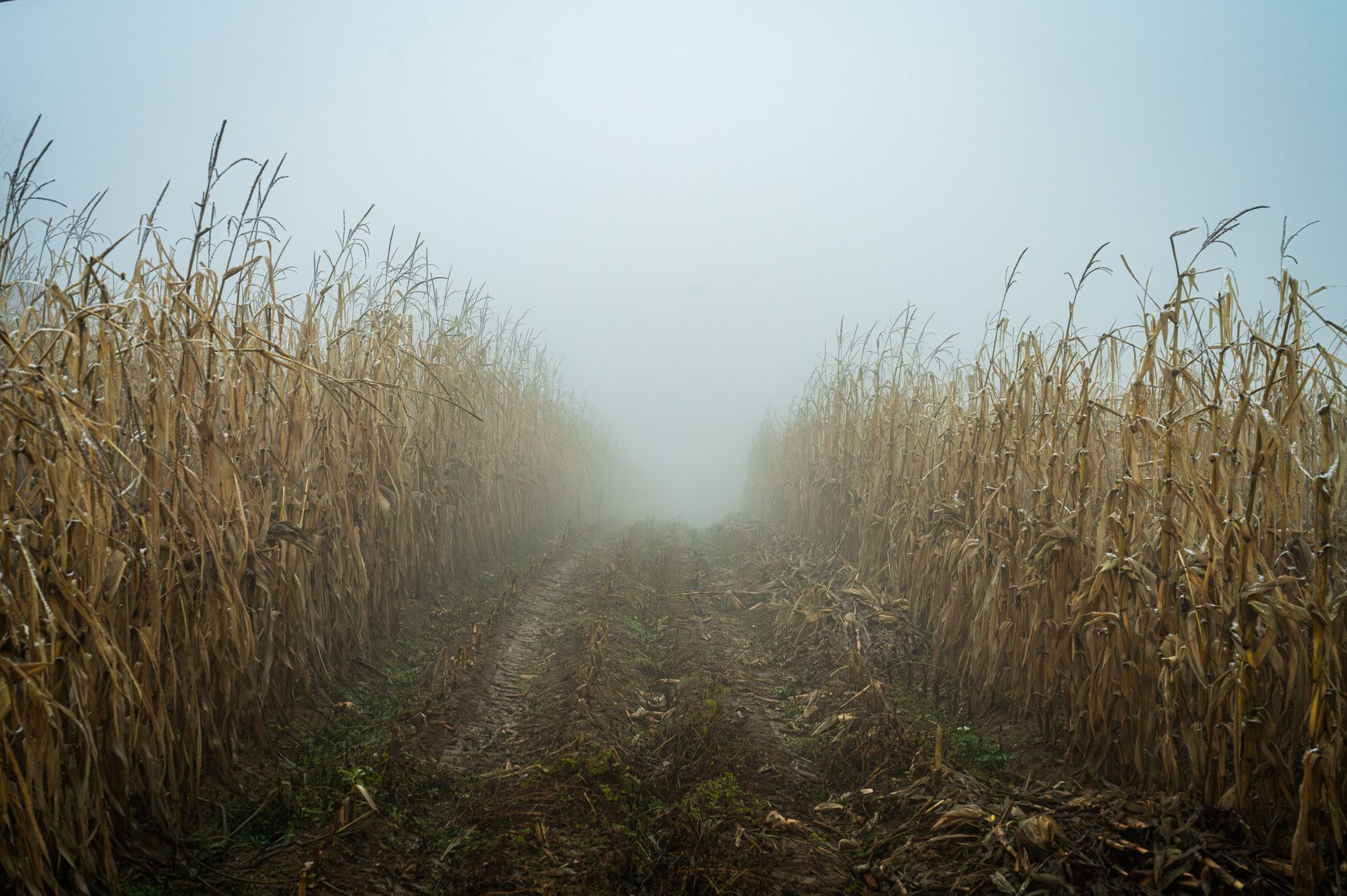
Photo by Septimiu Lupea on Pexels.com

Returning to this stanza now, I’m struck by the way the speaker looks out from a transformed state. The poem does not simply describe a scarecrow; it lets the speaker become a field of wariness, warning, weather, rot, and air. The act of looking here is shaped by estrangement. The speaker sees from the edge of personhood, or from a place where personhood itself feels unstable.

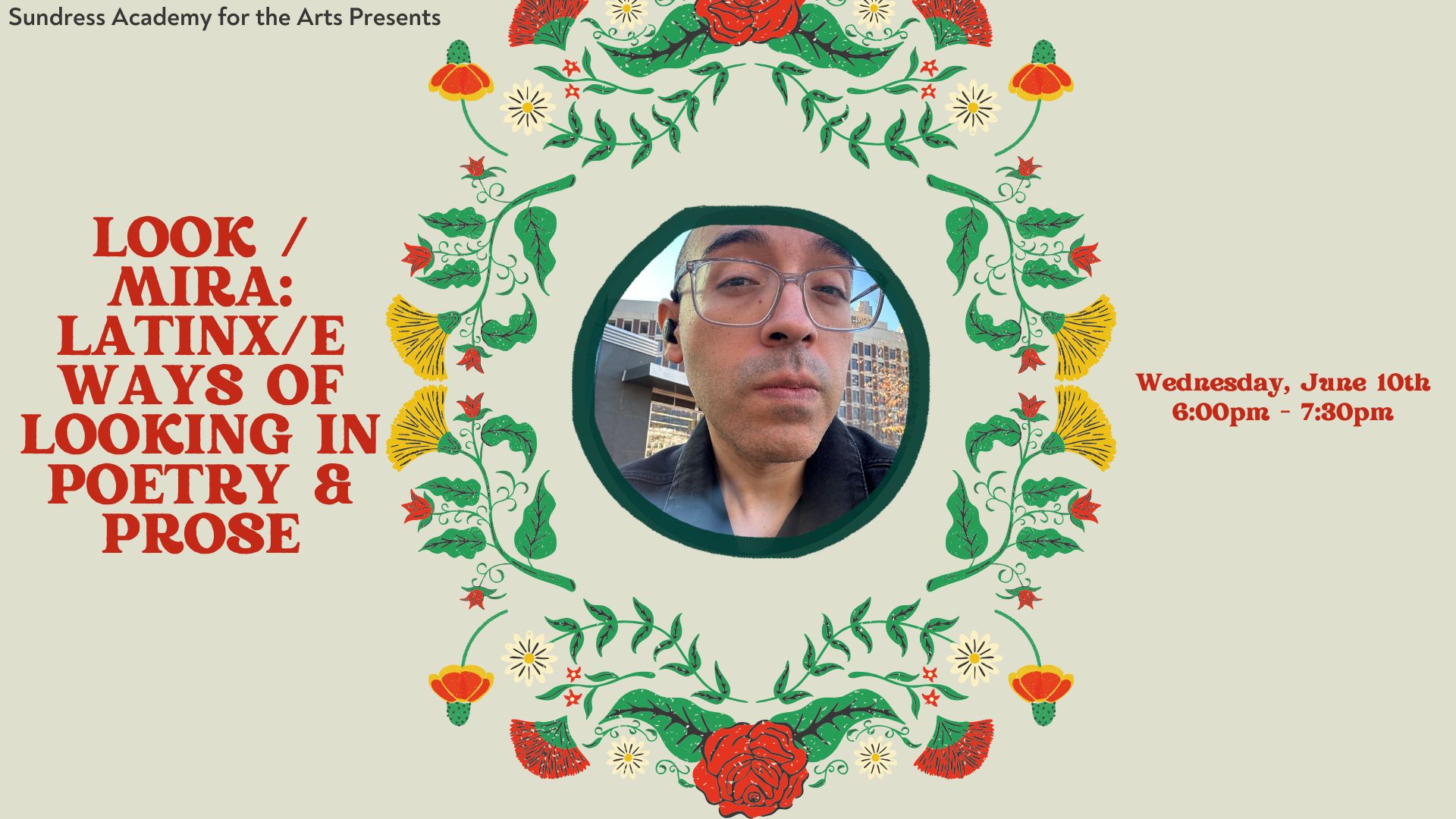
That feels connected to some of the questions behind my upcoming workshop, “Look / Mira: Latinx/e Ways of Looking in Poetry & Prose.” What happens when looking is not neutral? What happens when the gaze is shaped by memory, body, place, fear, language, or transformation? How might a poem or essay allow us to see from a position we could not otherwise name?

I’m interested in writing that lets looking become more than description. Looking can become pressure. Refusal. Witness. Inheritance. A way to survive. A way to change shape.


A Community Event This Weekend

I also want to share information about a literary event happening this weekend in Cambridge:

Be a Phoenix: A Tribute to Gazan Poet Heba Al-Madhoun
Sunday, June 7
3:30–5:30 PM
The Foundry
101 Rogers St, Cambridge, MA 02142

The event invites the Boston-area literary and academic community to gather in tribute to the late Gazan poet Heba Al-Madhoun, whose newly translated poems are being brought to readers here.

Poet and editor Devin Johnston writes of her work:

“These poems are quite lovely and moving. I love their exploratory, searching quality, through matters of feeling. My points of reference for Arabic poetry are all too few, but I do think of Adonis (and a few other Damascus poets) in some of the features here. But Heba Al-Madhoun’s poems are a little less mythic and declamatory, a little more quiet and questioning. … a very worthy project, for the work itself, and for the work it would do for readers.”

Tickets are free, with advance reservation requested.

Register here:
https://givebutter.com/heba-memorial


Workshop Reminder: Look / Mira

Lastly, a reminder that I’ll be leading a free virtual generative workshop next week through the Sundress Academy for the Arts:

Look / Mira: Latinx/e Ways of Looking in Poetry & Prose
Wednesday, June 10
6:00–7:30 PM EST
Online via Zoom

In this workshop, we’ll think about looking as a way of writing: looking as inheritance, looking as refusal, looking through place and body, and looking toward what might still be possible. We’ll read brief excerpts, write from guided prompts, and make space for poetry, prose, fragments, lists, memories, and hybrid forms.

Participants can register and access the free event here:
http://tiny.utk.edu/sundress
Password: SAFTA

I hope to see some of you there.