* hare-brained with yeats

Memory – W. B. Yeats

One had a lovely face,
And two or three had charm,
But charm and face were in vain
Because the mountain grass
Cannot but keep the form
Where the mountain hare has lain.

***

I’ve spent the past week reading through the Collected Poems of Yeats. He’s been a go-to guy since high school; each reading reveals him to be a darker writer than his more famous poems allow.

In the above, not one but three of the women of his life are summed up in a six line poem. And not even summed up, but rather quickly evoked, and just as quickly dissolved into an image. The reader is left looking at an impression of life, which is what the speaker is left with as well.

Without going into the details, I’ll say Yeats was a lonely boy, wronged and wronging in love in his respective way. Being sensitive and bookish has its consequences, good and bad.

On the one hand, Yeats is a technical master. But then there’s the hares, who, in truth, merit the greatest sympathy.

In the poem below, Yeats presents a speaker who would learn to change loves “while dancing,” but finds he can only imagine what that might be like. That it can only happen, even hypothetically, in a mythological realm is the first clue to Yeats’ bluff: for all the dancing and laughing, the speaker remains rather pathetic – both in terms of pathos and general sadness, and pathetic like the kid standing against the wall during a dance.

That the means through which the speaker spies this other realm is the bone of a hare – a collar-bone no less, the bone between the throat (where, in us, the voice lives) and the heart – the bone of a simple if fretful creature, means that something simple in him has died as well.

* say what now? *

* say what now? *

The Collar-Bone of a Hare – W. B. Yeats

Would I could cast a sail on the water
Where many a king has gone
And many a king’s daughter,
And alight at the comely trees and the lawn,
The playing upon pipes and the dancing,
And learn that the best thing is
To change my loves while dancing
And pay but a kiss for a kiss.

I would find by the edge of that water
The collar-bone of a hare
Worn thin by the lapping of water,
And pierce it through with a gimlet, and stare
At the old bitter world where they marry in churches,
And laugh over the untroubled water
At all who marry in churches,
Through the thin white bone of a hare.

***

Happy haring!

Jose

p.s. Please check out the latest issue of Right Hand Pointing – a celebration of 10 years of bringing (Right)eous poetry to the people, starring such riff raff as fellow poets Laura M. Kaminski and Marc Vincenz (and yours truly) – here.

Special thanks to editor & fine poet Dale Wisely!
bolaño: a lyrical alignment

I recently reread Robert Bolaño’s novel “The Savage Detectives.”

I first read it in 2008. I had just moved to Oregon after completing my MFA, two years in NYC that were a combination of awe and awful. To be a young poet anywhere is to be confused and enchanted – and able to use words like “confused” and “enchanted” in regards to oneself without the slightest blush (blogging allows me to hide any possible blushing).

I was elated to find in Bolaño’s world a gang of poets that were as breathlessly falling apart as I felt. Six years later, and the book hasn’t lost its charm. Bolaño’s writing is overwhelming: he goes from inundating you with insider literary namedropping with the air of gossip and conspiracy to creating astounding metaphors that drive home the depths of human despair.

Or something like that.

The aligned below is a secondhand account about the reading habits of Ulises, one of the main characters of the novel whose adventures throughout the book prove him worthy of his namesake.

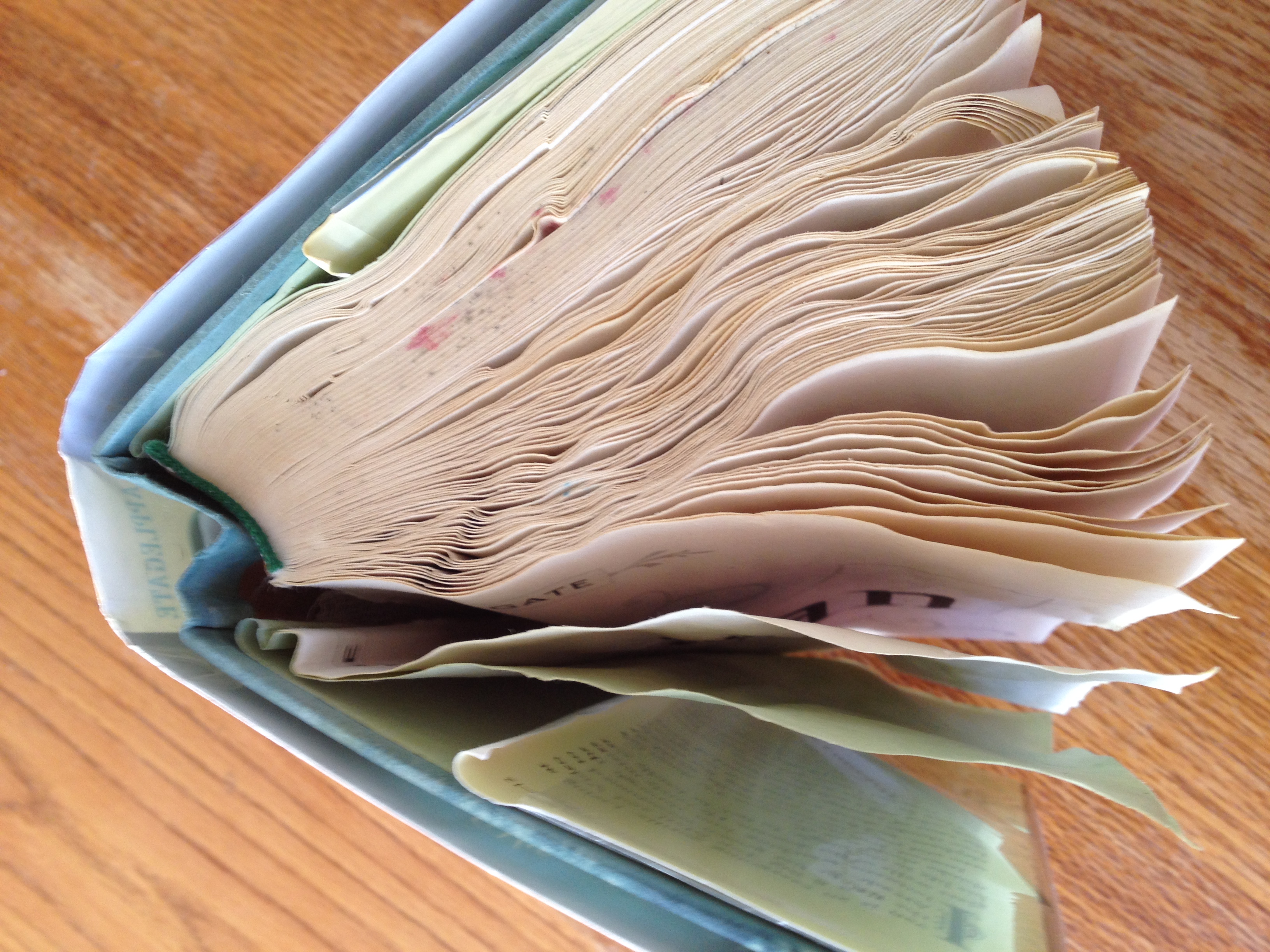
* some books may have been damaged during the making of this novel *

* some books may have been damaged during the making of this novel *

Making the Ink Run

aligned from Roberto Bolaño’s novel “The Savage Detectives”

He was a strange person. He wrote in the margins
of books. I’m glad I never lent him any
of mine. Why? Because I don’t like people
to write in my books. You won’t believe this but he
used to shower with a book. I swear.
He read in the shower. How do I know? Easy.
Almost all his books were wet. At first I thought
it was the rain. Ulises was a big walker.
He hardly ever took the metro. He walked
back and forth across Paris and when it rained
he got soaked because he never stopped to wait
for it to clear up. So his books, at least
the ones he read most often, were always a little
warped, sort of stiff, and I thought it was
from the rain. But one day I noticed that he went
into the bathroom with a dry book and when
he came out the book was wet. That day my curiosity
got the better of me. I went up to him
and pulled the book away from him. Not only
was the cover wet, some of the pages were too,
and so were the notes in the margins, some maybe
even written under the spray, the water
making the ink run, and then I said,
for God’s sake, I can’t believe it, you read
in the shower! have you gone crazy? and he said he
couldn’t help it but at least he only read
poetry (and I didn’t understand
why he said he only read poetry,
not at the time, but now I do: he meant
that he only read two or three pages, not
a whole book), and then I started to laugh,
I threw myself on the sofa, writhing in laughter,
and he started to laugh too, both of us laughed
for I don’t know how long.

****

Happy laughing!

Jose