review by José Angel Araguz

In the note for “Let’s make a dress from these,” from Valerie Wallace’s House of McQueen (Four Way Books), we learn that the poem’s title is a quote from Alexander McQueen himself, spoken “as he walked into his workroom with a handful of red medical slides.” In the same spirit of ingenuity and repurposing, Wallace’s collection presents poems that inhabit similar liminal spaces. Ranging from ekphrasis and collage to engaging with docupoetics with singular purpose, the poems of House of McQueen brings McQueen’s aesthetic vision and humanity to life through its engagement with the observable and imaginative.
The aforementioned poem, “Let’s make a dress from these,” which centers on the dress made from medical slides mentioned in the note above, starts with an objective description: “Stained red medical slides layer vertically on sleeveless sheath, / high-necked and cut away from right shoulder to right hipbone.” The reader is presented strictly with what the eye can see in these lines. The poem then moves from the physically observable, to the suggestive and poetic:
Heavy overskirts of crimson ostrich feathers swish & switch,
thick & deliberate into underskirt of plum-black ostrich feathers.
These skirts obey the law of push. From the slightest pressure they bloom.
In these lines that round out the first stanza, the observable is engaged on two levels. First, there is the evocation of the image through phrasing with the repetition of “ostrich feathers” across two lines; but there’s also a structural echo of the image in the enjambment of “swish & switch, / thick & deliberate.” Here, the repeated use of the ampersand works like typographical stitching joining two descriptions of ostrich feathers. The last line of this stanza furthers this evocation, taking it to an imaginative space through its mention of “the law of push” and “bloom,” language that makes the observable fact of the dress into an active, engaging image.
Another kind of engagement between the observable and imaginative occurs in the poem “Shears,” only this time it is one on the level of craft. Composed out of text found and “occasionally corrupted” by the author from Basil Bunting’s Complete Poems (New Directions), what makes this poem remarkable is how Wallace is able to find and repurpose language outside of the McQueen-centered project and bring it into conversation:
Silk tweed gray felt sable damask flannel
Glory of sharp tool be the lasting part of me
Plip scut slew slew all sounds fall still
Have you seen the fox? Which way did he go, he go?
These opening lines begin with fabric language and quickly go into intimate revelry. The repetition and wordplay here are to different purposes than in the poem discussed above; yet the move on the poet’s part to evoke image and feeling from recovered language remains the equally compelling.
Similarly, the poem “Autobiography of Alexander McQueen,” which is composed of quotes from print and video interviews with McQueen himself, takes the found language approach and creates from it a sense of human voice and presence:
I’m a romantic, really—
I try to protect people.
People say I do it for the shock value
I just like exploring the sinister side of life.
Drawn from McQueen’s lips, these opening lines are haunting in the way they represent isolated moments of self-awareness and aesthetic vision. Despite their repurposing into poetic form, in this case a pantoum, the designer’s unique sense of self-possession and character ring out. When the poem closes and the form repeats the first and third line above, the argument performed through the act of the poem lands for the reader as an argument of being:
Solitude is the blank canvas I work from.
Life is transformation.
People will say I did it for the shock value—
But I’m just a romantic really.
House of McQueen can, in fact, be read as a romantic’s transformation of language materials into aesthetic revelation. The very spirit of high fashion is implied throughout the conceptual and structural narratives explored. Wallace’s deft eye and ear create poems that keep pace with and come close to matching McQueen’s original sartorial creations. What stands out as the book’s highest accomplishment is how Wallace is able to bring readers again and again to the liminal, imaginative space of inspiration.
The poem below, “Council House, 1972,” opens the collection with exactly this note of dwelling on the possibilities inherent between the observable and imaginative. From the feeling of having “never seen anything like it” to “wondering, how to draw that color — sea coast changing to dawn,” the reader is presented with two artists: the artist McQueen was on the verge of becoming, and Wallace now, able to find the words to house them both.
Council House, 1972 – Valerie Wallace
When I was about 3 years old, I drew a dress on the wall. And what dress was it? Cinderella.
When she turned, I’d never seen anything like it.
Dress made for charming prince and fairy.
I could manage the little sleeves, tiny waist rising
out of skirts which laughed as they traveled with her across the ballroom floor.
And they had stars woven in them.
I got caught wondering, how to draw that color — sea coast changing to dawn.
There was trouble, but I didn’t care. I knew it was the dress
that saved her. All the rest was just a story.
*
Influence Question: How would you say this collection reflects your idea of what poetry is/can be?
Valerie Wallace: Thank you so much for this question. I think poetry is a space for great permission, so for me this collection invigorates that idea, because it takes on many challenges at once – persona, ekphrastic, formal, free, a bit of narrative – all in an attempt to make a cohesive emotional . . . welling forth about a singular life.
Influence Question: What were the challenges in writing these poems and how did you work through them?
Valerie Wallace: This is probably obvious, but my primary challenge – which animated all the other challenges – was to stay true to McQueen’s aesthetic and vision. Ultimately I used form and craft in service to his tailoring foundation, and a wide range of source material, as he had, for his collections. I researched Scottish and English history and the history of fashion, learned bespoke terminology, read McQueen biographies, and made use of interviews with McQueen, as well as his close friends and family. I felt my own imagination had permission to be wild. If I thought, Why not? I tried it. If I thought, What if…, I did it.
I’ll just add that at first I thought I was writing a kind of elegy. Then I thought I was writing language poems. At times, I was forcing poems into these categories. Of course, those poems were not very good. I learned that I had to strengthen my listening muscles. I had to listen to what the poems needed to say, wanted to say, find the little soul for each. As that began to happen, the poems and I began to trust each other, and then a collection began to hum.
*
Special thanks to Valerie Wallace for participating! To learn more about Wallace’s work, check out her site! Copies of House of McQueen can be purchased from Four Way Books.
*
 Valerie Wallace’s debut poetry collection House of McQueen (March 2018) was chosen by Vievee Francis for the Four Way Books Intro Prize in Poetry. In their starred review Publishers Weekly said that Wallace created “…a literary seance…serving as a scholar of and medium for the late iconic fashion designer Alexander McQueen….” Her work was chosen by Margaret Atwood for the Atty Award, and she has received an Illinois Arts Council Literary Award and the San Miguel de Allende Writers Conference Award in Poetry, as well as many grants to support her work, for which she is extremely grateful.
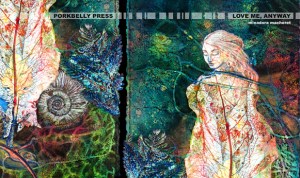 In my recent microreview & interview of Minadora Macheret’s Love Me, Anyway (Porkbelly Press), I spent time unpacking the collection’s interrogation of disbelief and the role it plays in living with disability. From the disbelief of medical professionals too quick to dismiss a person due to age and gender, to the personal disbelief of someone with PCOS struggling through the body and life changing symptoms, Macheret’s poems track the path of coming to terms with this condition. In delving into her experiences with PCOS (polycystic ovary syndrome), Macheret makes use of context and phrasing to create poems whose clarity is charged with human consequence.
 The Influence