 In my recent microreview & interview of Stonelight (Airlie Press) by Sarah McCartt-Jackson, I noted how nature is often used as a lens in these poems to engage with human understanding and feeling. In detailing the narrative of Ora and her family, this lens feels natural, a kind of environmental intuition. Much like in poetry writing, the speakers across these poems scratch out meaning from what they have and are left with.
I say “left with” here specifically to imply loss. One of the things Ora has to reconcile to herself is a series of pregnancies which at times lead to miscarriages. In “Ora names her children (before they are born)” (below), one can see how the act of reconciliation plays out in linguistic and metaphorical richness. McCartt-Jackson’s rich facility with language and phrasing is in full display here as the natural and human world are braided in a way that invokes a soul to one and a wildness to the other.
“Naming” her children after elements of the natural world, Ora’s act of reconciliation is also one of reclaiming. She recovers what is not there – not there either through loss (as elsewhere in the book) or through not having arrived (as in this poem) – by bringing it into communion with what is there. The result is a speaker both haunted by and haunting the world around her. With every loss and possibility, Ora emphasizes her presence through this ability to name. The ending here, ultimately, troubles the certainty of this presence in a way that echoes throughout the whole of Stonelight.
Ora names her children (before they are born) – Sarah McCartt-Jackson
unafraid of the shadow that glides up the mountain
approaching the nest. She names them the too-close sound
of a child’s whisper inside her ear. She names them buds
on splintery sycamore limbs and the buds’ curled leaves.
She names them after river clay and lightning shapes,
after songs she hears from the bucket dropped into the well.
She names them turnip and buckeye and leather and bird-feather hat
and tulip and the yellow color of rooms lit by flame.
She names them loneliness that can be rocked to sleep,
rooms haunted by dust that crawls in between the floorboards,
a thunderstorm of starlings crowding out the light. She names
the fingernails, the knees, pale eyelashes, tiny shoes,
caterpillar inching along the branch hung over the roof.
And when her upturned hands pile up with names, she pours
them onto every pinecone fallen empty of seed split through
the staves, every fur tuft stuck to bark, every quill hollow
poked through the pillow. She plants them until they return
stitched to the ridgeline bones. They tell her not to name them.
*
Copies of Stonelight can be purchased from Airlie Press.
Be sure to consider entering a manuscript for the Airlie Prize.
To find out more about Sarah McCartt-Jackson’s work, check out her site.
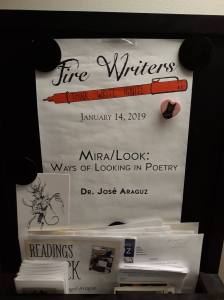 My own workshop was entitled “Mira/Look: Ways of Poetic Looking” and focused on exploring the power of naming, describing, and evoking, framing these acts as forms of “seeing.” The exercise involved reading, and some in the moment writing of haiku. The students in both of my sessions were impressive in their enthusiasm for writing and in their depth of responding to the ideas I presented. I also participated in the haiku writing alongside them, something I don’t normally allow myself to do. Here are two haiku from these sessions:
 The Influence