* gratitude with Marilyn Nelson

* words in the Slipstream *

* words in the Slipstream *

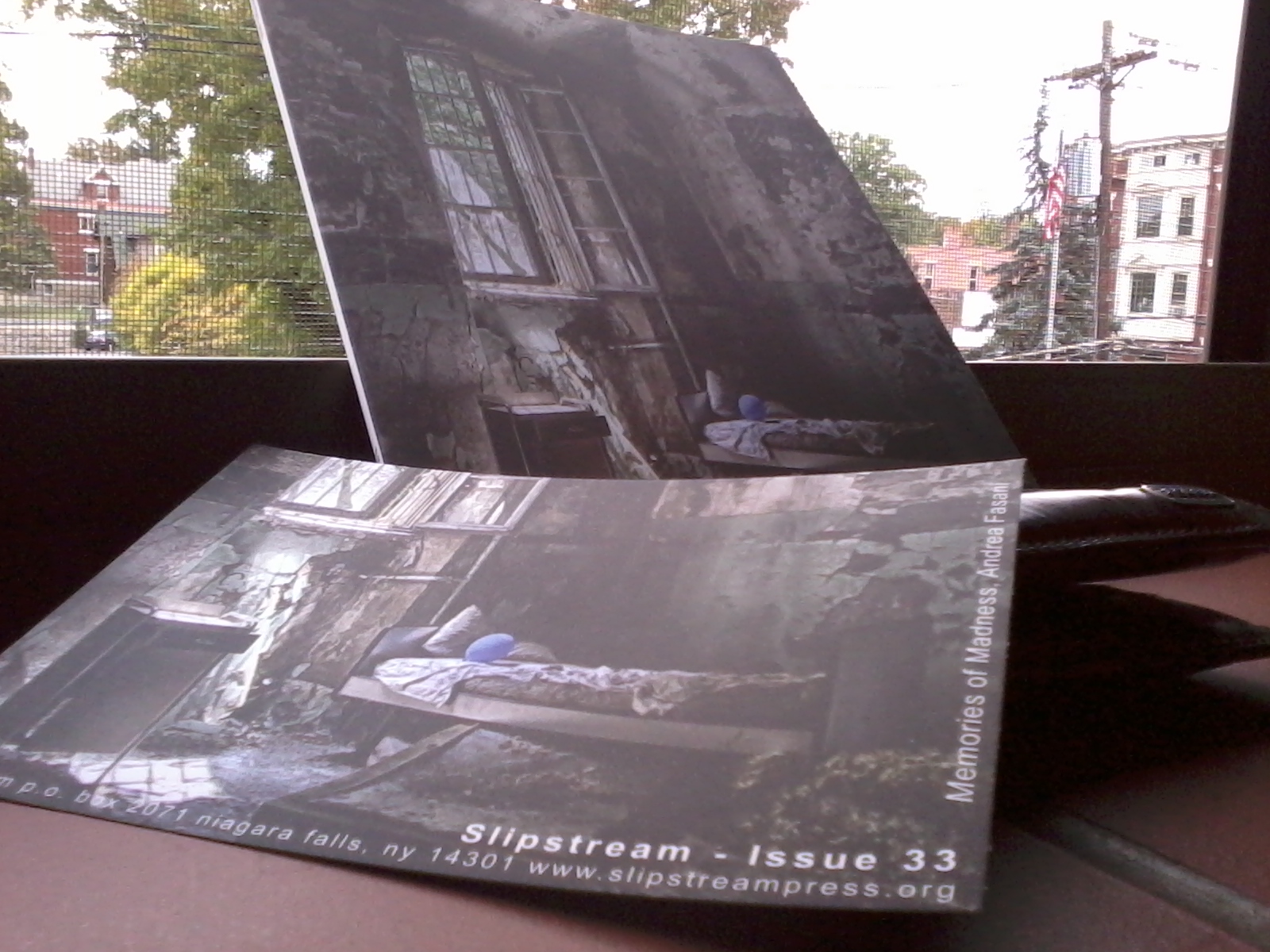
The above is a photo of the latest issue of Slipstream – which I am happy to say includes my poem “Burial Clothes”.  A quick leaf through upon opening the package the issue came in introduced me to fine poems by Terry Godbey and Rita Moe.  I’m waiting until the weekend to dig into the rest.

Contributor’s copies are one of the unique treats of getting a poem published.  You get to see who’s in the neighborhood, whose poem lives next door to yours.  The whole thing is humbling as you realize that every page contains a bit of aspiration and a whole bunch of effort.

In that spirit, this week’s poem is all about gratitude.  Marilyn Nelson takes us from chore to genuflection down on a microscopic level, showing how life takes us where life is.

**

Dusting – Marilyn Nelson

Thank you for these tiny
particles of ocean salt,
pearl-necklace viruses,
winged protozoans:
for the infinite,
intricate shapes
of submicroscopic
living things.

For algae spores
and fungus spores,
bonded by vital
mutual genetic cooperation,
spreading their
inseparable lives
from equator to pole.

My hand, my arm,
make sweeping circles.
Dust climbs the ladder of light.
For this infernal, endless chore,
for these eternal seeds of rain:
Thank you. For dust.

**

Happy thanking!

Jose

* what I don’t know – with Hayden Carruth & Joseph Massey

Swept – Hayden Carruth

When we say I
miss you what
we mean is I’m
filled with

dread.  At night
alone going
to bed is
like lying down

in a wave.  Total
absence of light.
Swept away to
gone.

*sweptup*

*sweptup*

This week I am sharing poems by Hayden Carruth and Joseph Massey.

The thread between them is how nuanced the lines are – both in terms of line breaks as well as pacing – in order to work their magic.  Read Carruth’s poem too fast and you miss the power of like lying down // in a wave – how the stanza break opens up after lying down and places you in a wave as you read.

A similar thing happened for me in the following poem by Massey in the second stanza.  The phrasing of I know/them, not/knowing their/names is tricky.  It took me a few readings to really cotton to what was happening there at the level of language.  More than an admission of not knowing the names of the things in spring, it elevates that not knowing into a knowing all its own.

I feel it in terms of this: what I don’t know could fill libraries – and does!

Hear – Joseph Massey

The field
throbs.  Early
spring splits
a few things

open; I know
them, not
knowing their
names

— my only
company.
Here at the
margins

it’s all said
illegibly.

**

Happy illegibling!

Jose