This past Monday I had the honor of leading a workshop for the Fire Writers conference, a one day series of creative writing workshops conducted for high school students from public and private schools across Yamhill County. The conference was held at the Chehalem Cultural Center in Newberg, Oregon. Workshop leaders included Kate Carroll de Gutes, C. Morgan Kennedy, Fonda Lee, and Kate Ristau.
Alex Dang opened the conference by performing his poem “What Kind of Asian Are You?,” a powerful poetic statement that interrogates the poet’s struggle to define his identity while dealing with problematic stereotypes imposed from the outside. Dang’s presence was important for me, as it made room for my own presence. Performing as a writer of color involves summoning up not only nerve but conscience. How can I best present my work with integrity and conviction? Who will hear it? Teaching is also performance, and these questions come to mind often in my work on and off the page.
Kim Stafford then gave a keynote address entitled “Poetic Testimony for Strange Times.” In this address, Stafford spoke of the importance of embracing what he terms the “3 gifts”: your fire (your own way of kindling self and following “what makes you pay attention”), your truth, and your writing. He also shared stories about his travels as Oregon State Poet Laureate and read poems written by high school students he’s met during his tenure. Hearing Stafford speak is always a lesson in generosity and how the writing life can answer and honor human life one word at a time.
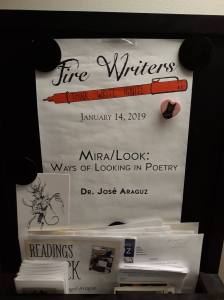 My own workshop was entitled “Mira/Look: Ways of Poetic Looking” and focused on exploring the power of naming, describing, and evoking, framing these acts as forms of “seeing.” The exercise involved reading, and some in the moment writing of haiku. The students in both of my sessions were impressive in their enthusiasm for writing and in their depth of responding to the ideas I presented. I also participated in the haiku writing alongside them, something I don’t normally allow myself to do. Here are two haiku from these sessions:
the space between my front teeth
the air pure
morning observation
resistance
is being tired but alive
winter sunrise
Experiences like this conference always bolster my self-esteem as a writer. Whether it’s engaging in generous conversation about each other’s writing projects, sharing writing tools and strategies with young writers, or simply listening and sharing worries and concerns about the writing life, a gathering like this one strengthens my conviction as both writer and human.
Special thanks to Lisa Ohlen Harris, Deborah Weiner, and everyone else who helped make this conference possible! And a warm thanks to the students who shared their time and writing with me, and to the teachers who continue to guide their way.
*
As part of his keynote address, Kim Stafford shared the following poem by his father, William Stafford, which approaches the idea of “the muse” with tact and purpose, side-stepping the usual problematic tropes around the idea. I suppose what I mean when I speak about experiences like this conference strengthening me, I mean something of salvation. A reminder that, like the one given to the speaker of this poem, one is able to save one’s self.
When I Met My Muse – William Stafford
I glanced at her and took my glasses
off – they were still singing. They buzzed
like a locust on the coffee table and then
ceased. Her voice belled forth, and the
sunlight bent. I felt the ceiling arch, and
knew that nails up there took a new grip
on whatever they touched. “I am your own
way of looking at things,” she said. “When
you allow me to live with you, every
glance at the world around you will be
a sort of salvation.” And I took her hand.
 Below is my own first attempt at Stafford’s practice. Because this first attempt was written at the conference itself, my boring prose is short. As for the poem, I did what I often do, which is pick a number of words per line as a structural guide (here, it’s 4 words per line). I had in mind two new friends of mine that I had just met at the conference.
 The Influence