Dusk in Winter – W. S. Merwin
The sun sets in the cold without friends
Without reproaches after all it has done for us
It goes down believing in nothing
When it has gone I hear the stream running after it
It has brought its flute it is a long way
***
This week on the Influence: W. S. Merwin!
What I love about Merwin’s poem above is how he gets in so much into a few lines. Not only the brevity but the subject matter.
We are told that the best novels throughout history deal namely with family/love relationships, that there is so much to said within those frames of humanity. Equally, poems are said to be about either love, life, or death.
What the stock objects – rain, leaves turning colors, rivers flowing, waiting in line at a grocery store – serve are to open up something everyone can identify with while following along with the poet to see how it is they see it.
That personal take on things – whether it is evoked in turns of phrase or particular images and narrative – is the fingerprint on the poem, the echo of the soul passing through the words (through the world, through the reader), what it is that teaches and awes in a poem. It is the hardest thing to achieve: singularity, an indelible presence.
Merwin’s work in translation (his Neruda’s Twenty Love Poems has been the standard for years) comes through here in the way he turns a sunset into a fable of sorts, works the images down into the emotions they evoke. The starkness created by not having punctuation cues me in as a reader to engage with the poem, to follow the logic of the phrasing as it unfolds, each turn a little surprise along the way.
***
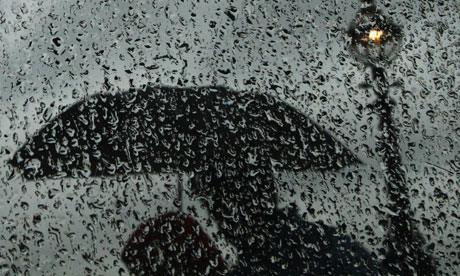
rains, yo
The rainy season has officially begun here in Eugene. In honor, here’s one more by Merwin:
To the Rain – W. S. Merwin
You reach me out of the age of the air
clear
falling toward me
each one new
if any of you has a name
it is unknown
but waited for you here
that long
for you to fall through it knowing nothing
hem of the garment
do not wait
until I can love all that I am to know
for maybe that will never be
touch me this time
let me love what I cannot know
as the man born blind may love color
until all that he loves
fills him with color
***
Happy filling!
J
(photograph found on: http://www.guardian.co.uk/books/booksblog/2008/sep/26/poster.poems.rain.poetry)
 The Influence