poetryamano project: february 2017

This week I’m sharing the second installment archiving my Instagram poetry project entitled @poetryamano (poetry by hand). This account focuses on sharing poems written by hand, either in longhand or more experimental forms such as erasures/blackout poems and found poems.

I’d like to give a quick thank you to Kenyatta JP García for giving @poetryamano a shout out here.

Below are the highlights from February 2017. Be sure to check out the first installment.

Stay tuned next week for more of the usual Influence happenings. For now, enjoy these forays into variations on the short lyric!
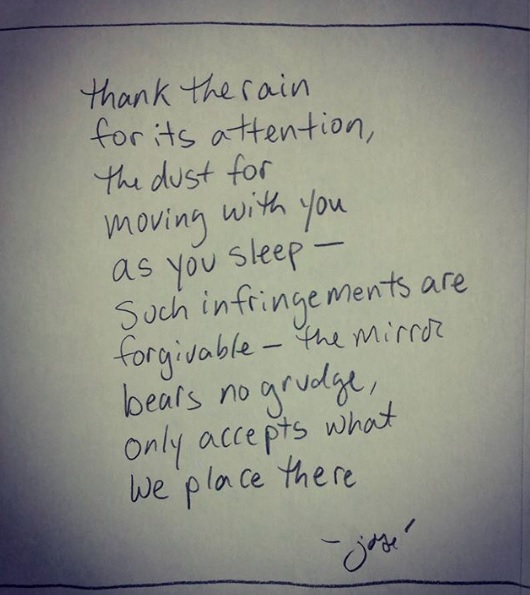
poetryamano feb 2017 2

In February, I had been coming back to rain and mirrors in my free writes. I always worry about retreading, but then some words and images are like worry stones, no?
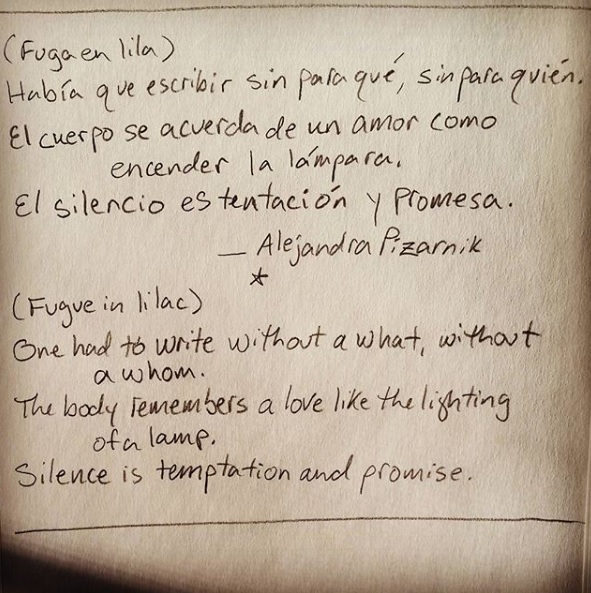
poetryamano feb 2017 3

Translation: Alejandra Pizarnik’s poems are full of a tense intimacy, like each word could say everything, so we gotta be careful with them. The hardest line to translate here was the first, specifically the phrasing of “sin para qué, sin para quién,” which translates as “without a reason, and for no one,” sense-wise. But I like the whimsy of “what/whom” and feel it’s in keeping with Pizarnik’s overall punk vibe.

poetryamano feb 2017 4

True story. I was working on a poem when I came across a draft that had the quoted text above in the middle of some rough writing. The quote stuck with me for a few hours, yet I couldn’t remember the source. So I decided to go the haibun-like route of including this story of the quote while letting the quote shine in its own space. I like the result, despite the poem showing how flawed my own memory is – and again, that could be the point, no, that words last?

poetryamano feb 2017 5

Those fragments on the side are from a hematite ring that broke a month ago. Found out recently that these rings break for two reasons, the brittleness of the metal, and when they have absorbed too much negativity. Words work in the same way, able to hold what they can, until they can’t.
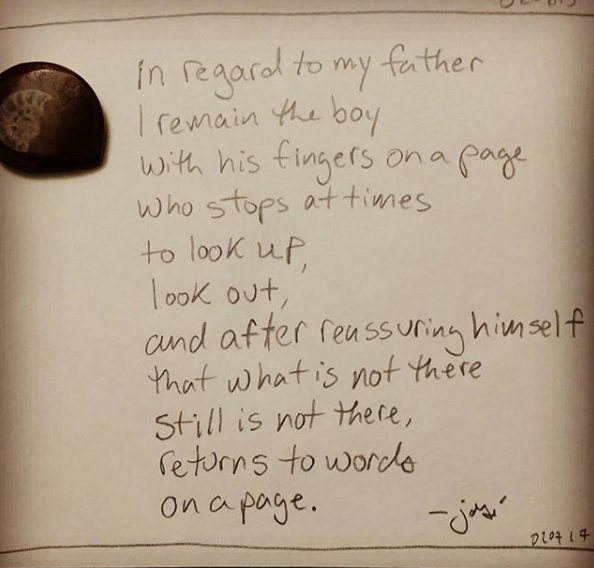
poetryamano feb 2017 7

Talismans: The absence of my father growing up comes in and out of my poems. It’s an influence like weather, which changes. He died when I was six, but left my life earlier. In response to my worries about writing too many poems about this absence, someone called it a talisman of sorts, something I carry in the presence of these words.
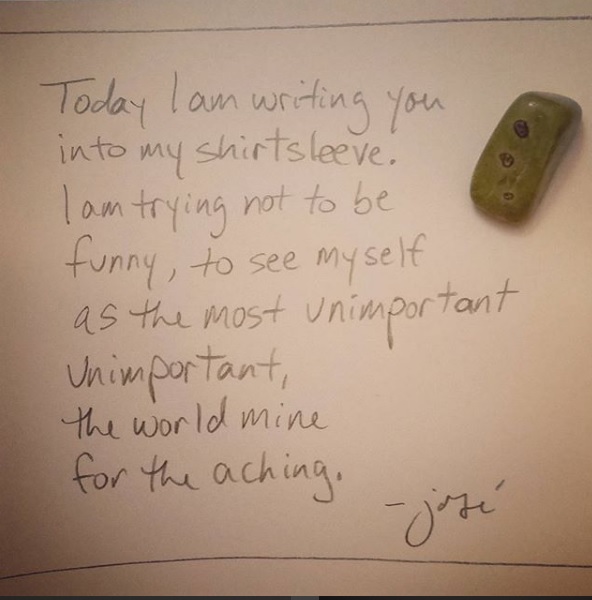
poetryamano feb 2017 8

Throwback to the original version of a line that made its way into my book, Everything We Think We Hear (Floricanto Press). It got revised into: “Stay with me, love, the world is ours for the aching” which is recalled by the speaker of the newer poem as lines he used to say trying to be slick. True story.

poetryamano feb 2017 9

When you write poems in more than one language, you realize quickly how what you are really doing when you write is translating something yet spoken inside you into a shape and expression. Here, I like how the filter places a bit of light in the space between the two versions of the poem, light like a fingerprint itself.

poetryamano feb 2017 10

February brought my first attempts at erasures/blackout poems for the poetryamano project. My first attempts, like here, were done on my phone, using photo studio to mark out words. This one reads: “the real world / dwells in the / absorption of passion, / And / mirrors it” – From The English Renaissance of Art by Oscar Wilde.
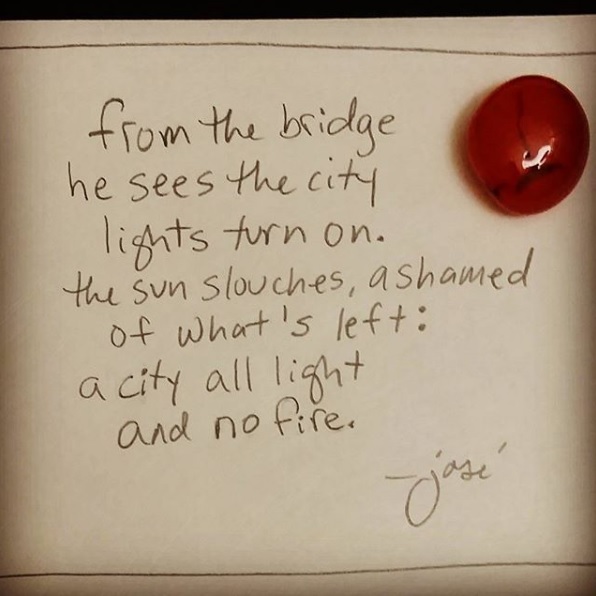
poetryamano feb 2017 11

This last one of the month comes from a time when I’d walk around all poet-lonely, then go home and write poems about walking around being poet-lonely. We all went through that, right?

*

Happy amano-ing!

José


seeing with jennifer met

One of the great pleasures of writing reviews is catching onto things that poems do when they live together in a book. By “things” I mean, of course, the standard fare of themes, symbols, imagery, etc., but also something for which I am learning/discovering the technical terms for. In teaching, I often use the words engine or guiding principle, words that imply the mechanical and structural. Yet, what these words point to in my own use is more in tune with intuition.

galleryIn my recent microreview & interview of Jennifer Met’s compelling chapbook Gallery Withheld (Glass Poetry Press), I center my discussion around two visual poems whose layout on the page become another aspect to explored by reading. Through the visual poem form, one is able to guide text in the same way a spoken word or slam poet is able to command attention via vocal tone and gesture. Because of the presence of visual poems in Met’s collection, I couldn’t help but pay attention to the other poems that were more traditionally lineated. As a reader, these other poems became charged with importance, evoking a number of new questions: How is the vision of the collection different in these non-visual poems versus the visual poems? Where is the line drawn between what is on the surface a visual poem and what is, in my imperfect terms, a more traditionally lineated poem?

In answer to this last question, I present the poem “Collaboration” below whose presence on the page could be said to have a foot in both visual and lineated ideas of poetry. The poem is a complex ekphrastic that sneaks up on you; that is, the speaker goes from contemplating a photograph of the aftermath of an earthquake to the cover of an issue of The New Yorker. This move comes naturally, and what develops in the speaker’s meditation are images of a crack in the ground. These images are evoked, in part, by the visual layout of the lines of the poem. But beyond this, the meditation advances in such a deft manner, that what the reader is left with is not only an image but a way of imaging and imagining. This poem, for me, is at the conceptual heart of the collection because of the way it creates an engine out of seeing with which the reader is invited to see “the flowers float seemingly at random” at the end. These flowers are both an image and a motion. While there is so much seeing done in Gallery Withheld, it is done via poems which invite the reader to “collaborate” in the seeing, an interaction that is its own distinct poetic accomplishment.

Collaboration – Jennifer Met

for Christoph Niemann and Françoise Mouly

When I was young I saw a photograph
of a fence after an earthquake
where its man-made border was interrupted
as one half was heaved forward and
one half was pulled back leaving a large gap
like a warped spring—a latch
that can’t quite be forced close or like someone
painting a line down the right
side of a large and invisible street fell
asleep and when they woke up
they accidentally resumed their drawing
on the left side instead—the width
of a street—a common ground—a public right
of way owned and maintained
by the city—now left unconnected and you
couldn’t see where the earth ground
against itself sliding or where it rippled
like a blanket being shaken
because there wasn’t a mark and wasn’t a rift–
wasn’t a scar in the grass—and I
always associated this image with earthquakes so much
so that now the New Yorker’s cover
illustration reminds me of an earthquake fissure
the leafless cherry branch like lightning
slightly off-centre and striking upon the left-hand
side of the page where trefoils blossom pink
and loose petals drift back and up and I think
how the artist’s editor was right
to change the background color of this dark
crack canyoning up the beautifully clean
white—too obvious—to a new version of a branch
drawn black against black—unseen–

and the flowers float seemingly at random…

*

Happy seeing!

José