Found myself recently turning back to a sonnet by Jorge Luis Borges for an epigraph for a new poem. Below is the original poem in Spanish, followed by my own modest translation.
Two things stood out to me in translating. First, the word clepsydra which, after much maneuvering and reading through information, turns out to refer to a long history of water clocks. The clepsydra of the poem is both clock and music box, and so the gotas/drops work both on a physical level as well as on an aural one (music notes as water drops). So fascinating and strange a word it is, I decided to keep it in the poem, if only to have folks go and do some searching themselves. If you do, you’ll see stuff like this:
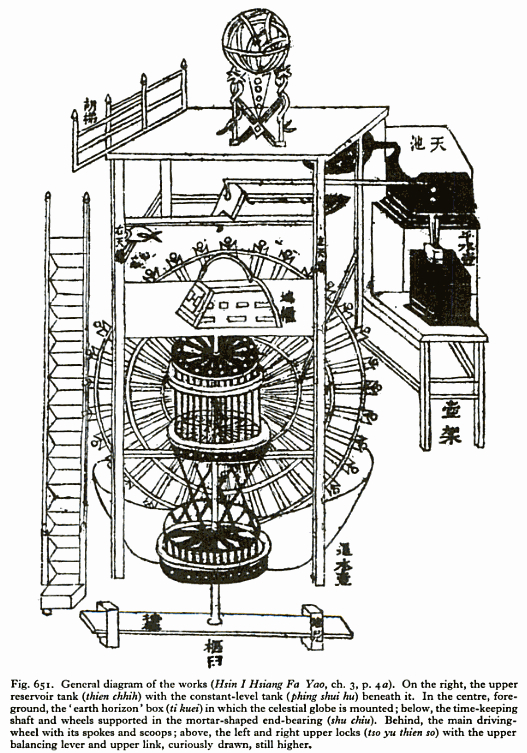
* water clock tower *
The other thing that stood out to me revisiting this sonnet is the long question in the second half of the poem. It is traditional for sonnets to have a turn, and here Borges takes up six lines for an epic, wide turn of argument, amping up the rhetoric and emotional power as he goes.
Caja de Música – Jorge Luis Borges
Música del Japón. Avaramente
De la clepsidra se desprenden gotas
De lenta miel o de invisible oro
Que en el tiempo repiten una trama
Eterna y frágil, misteriosa y clara.
Temo que cada una sea la última.
Son un ayer que vuelve. ¿De qué templo,
De qué leve jardín en la montaña,
De qué vigilias ante un mar que ignoro,
De qué pudor de la melancolía,
De qué perdida y rescatada tarde,
Llegan a mí, su porvenir remoto?
No lo sabré. No importa. En esa música
Yo soy. Yo quiero ser. Yo me desangro.
***
Music Box – Jorge Luis Borges
Music from Japan. Reluctantly,
the drops from the clepsydra fall
in a slow honey, made of an invisible gold
whose pattern over time repeats
eternal, fragile, mysterious and clear.
I fear that each drop will be the last.
They are a yesterday returning. From what temple,
from what meager garden on the mountain,
from what vigils before a sea I’ve never seen,
from what modest melancholy, from what lost
and recollected afternoon do they come to me,
their remote future? I do not know.
It does not matter. In that music
I am. I want to be. I bleed away.
***
Happy desangrandose!
Jose
p.s. Check out a far more competent and eloquent translation by Tony Barnstone here.

 The Influence