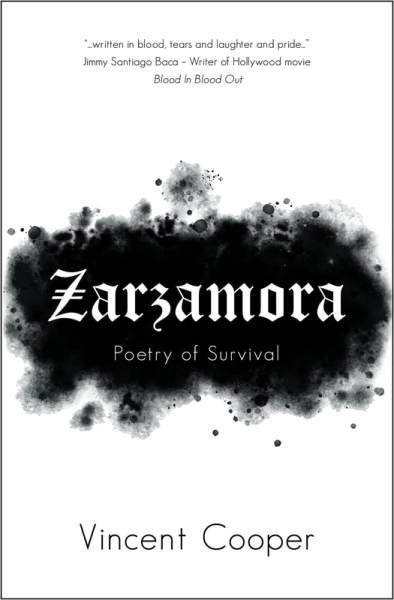
 In my recent microreview & interview of Vincent Cooper’s Zarzamora (Jade Publishing, 2019), I spoke about Cooper’s ability to tap into lyricism that catalogues and captures through immersive narrative. When the subject is family, loss, and memory, taking one’s time with the weight of each detail is necessary and instructive. What matters ultimately, though, is what is evoked.
The poem “Sepia Boys” (below) does a great job of using narrative and poetic techniques to tell a story beyond the story being told. As the narrative develops around a photograph of the title’s “sepia boys,” a tension begins to grow around the chosen details:
Cousin plays with the ashtray lid on the door
The squeak of open. Close. Open. Close.
A slap to that hand.
This stanza is a good example of the way pacing develops through phrasing. As the details here are doled out, a sense of routine weariness is created. The juxtaposition of details, however, sharpens the narrative with tension. It’s a clear moment: the act of playing with an ashtray lid is quickly shut down by a slap. Yet, the emphasis on sound (squeak, slap) makes a simple moment haunting. This narrative push and pull is the main engine of the poem. This mix of pacing and juxtaposition evokes the restlessness behind the lives of the boys in the photograph.
As an ekphrasis, this poem aptly fulfills the job of exploring the imaginative space inspired by the photograph. The poem goes beyond that, however, by taking its time not only with memory details but also meditative ones as well. Cooper’s sense of narrative here goes beyond story in that it seeks to stir up for readers not understanding but the space to understand. In using narrative lyric to hold the lives and deaths of others, this poem holds a clear and engaging impression of the speaker’s inner work to create a space for understanding within himself.
Sepia Boys – Vincent Cooper
The kids today are gone away petitioning the dust
With no one to look up to
Because they’re looking up to us – Bad Religion
Cousins are across the street,
playing in the park.
With concrete turtles to sit on,
steel bars to climb.
A sun-scorched slide with sand at the bottom.
I have ripped jeans at the knees.
Park Police watch brown kids sweat,
laughing with friends.
Grandparents, mothers and fathers
watch their children
play rough.
A mother, concerned, clenches her fist,
yells from the screen door.
Let them learn, he says.
Lunch is on the stove.
Beans …cooking slowly.
The kids come back
holding hands,
reaching for a manguera.
Cool water from the green hose
passed over mouths.
Water dripping from chins.
Primos file into the house.
Boys pee into one toilet together,
and primas go with Ama or tía.
Fingers webbed with black ligas;
picture day for the familia.
All of us rush into the car, after.
Cousin plays with the ashtray lid on the door
The squeak of open. Close. Open. Close.
A slap to that hand.
A warning that some reward will be taken.
Later,
the sepia boys pose with two front teeth exposed.
A brown mound of hair and eyebrows styled with mother’s hands.
A smile held for a momentary snap.
An endearing image forever.
The kids grew up to be high school dropout junky hippies
while others worked hard for the city or served in the military.
And they’d still call each other from pay phones to come over and drink
To spend every second, they could together,
or drive by
with a hand gesture beer signal.
The sepia boys are mostly gone.
Toothy pictures to remember them all
and hot summers that burned the grass brown.
Chicharras in the trees
ranting their rants.
No more empty beers cans scraping across street to the curb
Or cigarette smoke that tears up eyes to a sneeze.
It all ended, and some people want to know why.
It’s because they all finally died.
We chose to let them go.
It was only their body that died that day.
Their spirit still walked the streets to a methadone clinic
–to take away their back pain.
The fellas were still out on the porch drinking.
In your mind as you drove by, memories in sepia tone.
It’s in our DNA to suffer as it is to fight.
If we choose to die, or live in the dark,
sepia tone boys and girls stay in boxes.
They go from the house to the garage,
and those pictures dust up.
They fade.
Spiders and roaches crawl over them,
their bodies in the ground.
They die again.
Do you want them to die again?
Mother is a westside original,
and part of her exists in me
as I write and as I live.
My kids look up to me.
All our kids look up to us.
In adoration.
We are their first heroes.
Their first poets.
Their guides
that try to hide the frustrations of the world.
Behind coffee sips and mass shootings,
we love them.
We find love in the cemeteries of our bellies
and hearts.
We take it all back and have more.
Don’t let them kill you too.

 The Influence