Writing – Octavio Paz
I draw these letters
as the day draws its images
and blows over them
and does not return
It’s suiting to begin this meditation on brevity with Paz who once said that he admired the short lyric for being the hardest kind of poem to write. Anyone who’s worked out a haiku or tanka in earnestness knows something of this difficulty. With haiku and tanka there are at least parameters, a spirit to leap after. Often, the short poem is a surprise, something arrived at when you intuit the right time to leave a poem alone.
Triplet – Yannis Ritsos
As he writes, without looking at the sea,
he feels his pencil trembling at the very tip –
it is the moment when the lighthouses light up.
I came across this gem from Ritsos in Stephen Dobyn’s illuminating book “Best Words, Best Order.” In it, Dobyns speaks of the nuanced work of the last line as a “metaphysical moment,” one that suggests “sympathetic affinities and a sensitivity to those affinities on the part of the poet.” The power of a short lyric can be felt when one is reading and feels something like “lighthouses light up” inside the mind.
haiku – Hayden Carruth
Hey Basho, you there!
I’m Carruth. Isn’t it great,
so distant like this?
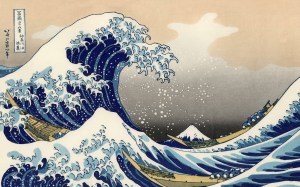
Ultimately, what is at stake in the short lyric is what is at stake in any poem, the translating/transcribing of the human voice. In a longer poem, one can create an argument via imagery and metaphor, what’s being said accumulates like a wave to a crest. The short lyric is the echo of that argument, the sound of foam chisping on the shore. What is compelling about Carruth’s distance is not that Basho feels it, but the reader does.
* wavering *
Happy shoring!
Jose


 The Influence