* throwing things on the floor with Jim Harrison & John Keats

In reading Jim Harrison’s novel The English Major last month, I came across the following and it brought tears – I have been much for tears these days – and mainly because I have been slowly going over poems I have memorized, seeing what stuck and what fell off, and was suddenly surprised to recognize the poem referenced below:

I was saddened by the idea that I might not finish the work before I died, a natural enough fear.  Keats wrote, “When I have fears that I may cease to be before my pen has glean’d my teeming brain…”  That was throwing the raw meat on the floor in a lovely way.

That phrasing throwing the raw meat on the floor – that’s it isn’t it – what it is a poet does no matter the how we use to do it.  We are not in the business of poetry if the raw meat isn’t on the floor.

Realizing I had let the poem slip after a few years, and then coming back to it, memorizing it again – more than an old friend, I felt like a piece of myself was returning, that something understood once was being reconciled in a big, new way.

There’s a lot of history in the poem too: Yeats borrowed the phrasing of high romance, and John Berryman references the end of the poem in the title of his book Love and Fame.  I myself am tempted to borrow and manipulate the phrasing for something called: The Fool-ripened Grain.

Here is the poem below – you can see for yourself how awful and sacrilegious my idea is.
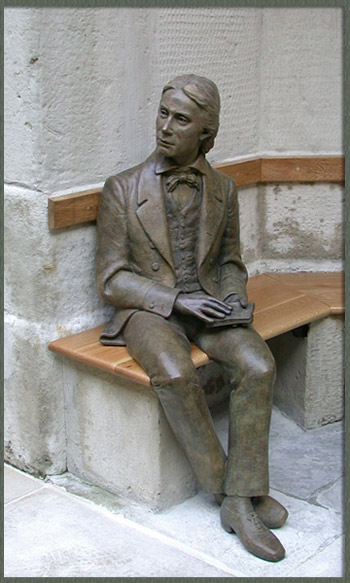
* you let the meat fall where? *

* you let the meat fall where? *

When I have fears that I may cease to be – John Keats

When I have fears that I may cease to  be
Before my pen has gleaned my teeming brain,
Before high-piled books in charactery
Hold like rich garners the full ripened grain;

When I behold, upon the night’s starred face,
Huge cloudy symbols of a high romance
And think that I may never live to trace
Their shadows with the magic hand of chance;

And when I feel, fair creature of an hour,
That I shall never look upon thee more,
Never have relish in the faery power
Of unreflecting love – then on the shore

Of the wide world I stand alone, and think
Til love and fame to nothingness do sink.

***

Happy sinking!

Jose

* the 100th post

Bright star – would I were steadfast as thou art —
Not in lone splendour hung aloft the night
And watching, with eternal lids apart,
Like nature’s patient, sleepless Eremite,
The moving waters at their priestlike task
Of pure ablution round earth’s human shores…

(John Keats, Bright Star)

With those six lines there, poetry had me.

I read those as a kid and was floored.  I mean, first there’s the language: what’s an Eremite?  Steadfa- que?  But you go down into the words waters, priestlike task, ablution, shores and they take you into the ocean with their sounds.  I was hooked.  I didn’t know what I was looking at but I wanted to be around it, be part of it.

Of course, I didn’t realize this til much later, when I returned to Keats in an official I AM NOW GOING TO READ POETRY adolescent way.  Coming across this poem again, I went back to that silence of being a kid with something – can’t name it, don’t know what it is – but something there in these words is soooo cooool.

Eloquent I am not.

That said, I wanted to do a more personal post for this, the 100th post.

And what’s more personal than stars:

* insert crickets sound here *

* insert crickets sound here *

Sure, they’re all the way up there and on a completely different timeframe than us.  Yet, when you look up – or rather, when you let yourself look up and really look up – there’s something…I don’t know, nice about it.

Again, eloquence.

Here’s me trying to say it better:

To a star in Texas – Jose Angel Araguz

Little light weaving through, I cannot
make out much tonight, and I know this here
means nothing to you, so

skin, tell my stories; heart, fill the sky.

**

I don’t know exactly what that last line means but I’ve been kinda living by it ever since I wrote it years ago.  Something about how just being here is enough.

Stars.  The word, plural or singular, is so riddled with cliche, you could be talking about nothing.  And in a way you are.

Stars are, for me, things of persistence, pseudo-Venn diagrams of presence and absence.  They are one of the few things that people will – nearly universally – stop and let me themselves be awed by.

How do I know this?  Through reading poems.

Here’s Rilke’s take on it:

Lament – Rainer Maria Rilke

Everything is far
and long gone by.
I think that the star
glittering above me
has been dead for a million years.
I think there were tears
in the car I heard pass
and something terrible was said.
A clock has stopped striking in the house
across the road…
When did it start?…
I would like to step out of my heart
and go walking beneath the enormous sky.
I would like to pray.
And surely of all the stars that perished
long ago,
one still exists.
I think that I know
which one it is —
which one, at the end of its beam in the sky,
stands like a white city…

(trans. Stephen Mitchell)

**

Happy standing!

Jose