I came across this week’s poem – “Winged” by Valerie Wallace – reading through the latest issue of Rust + Moth.
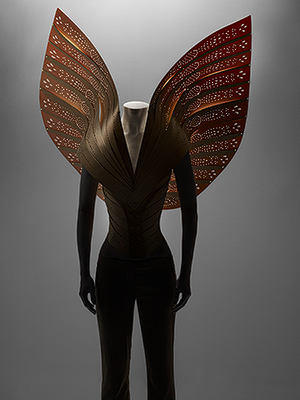
I was taken in by the Auden reference to the “old masters” from his poem Musee des Beaux Arts. I find the reference suiting since the impetus for Wallace’s poem comes from Alexander McQueen, whom I don’t know too much about except that his singular designs had him working with Bjork and Lady Gaga as well as designing Kate Middleton’s wedding dress (more to the point: Alexander McQueen the person didn’t design Middleton’s wedding dress – because he was dead. His label did – more specifically Sarah Burton, the creative director since his death).
In Wallace’s poem, the corset in question is taken on both conceptually as well as visually in the structure of the poem. The couplets themselves work down the poem like stitches as the speaker goes further into breaking and fraying as much meaning from each word “Be/hold balsa ribbons” is an especially powerful revelatory reading moment.
Enjoy the poem below and check out the rest of the issue of Rust + Moth here.
* mid-flight *
Winged – Valerie Wallace
—Corset from the Alexander McQueen collection No. 13, spring/summer 1999
The old masters
got them wrong,
their locations, at
least. Not pinned
at the spine like a moth
or the bone blade spurt.
From the tiny bloom
of sternum I swept
over shoulders, fanned,
arc’d. Slit for heavy arms.
How on earth do you
expect to walk in them? Ha.
Be/hold balsa ribbons
planed, laced, bindings,
not for flight but descent.
How will you care for me,
keep me from fire.
It sings, you know,
Consecration.
Consolation,
a promise to be ever
sewn into the sun.
***
Happy sunning!
Jose
p.s. For more info on the McQueen piece go here.
And for more poems from Wallace’s Be/spoke project, go here.

 The Influence