* new anthology & everything cover art

Oaring – Sam Roderick Roxas-Chua

In a shallow bay, my father is slumped
inside a black raft, arms flung over each side,
fingers flicking the water. I touch the ripple
of sunset and I want to be his fingerprints
and index his lolled years—carry his melody
of back and forth, unlearn the sway
of push and pushing.

Today I wrap the oars in silk,
leave the telephone receiver pendulous
over the oak table where he taught me
to write my name in English—
that round eddy where forgotten things
appear and disappear like those beetles
I tied to strings during a storm.

I remember that table carved from a bend
in my father’s house, how it listened
to the chorus of wings outside our window—
oaring the sky for forgiveness, oaring the sky
for another way home.
* new anthology *

* new anthology *

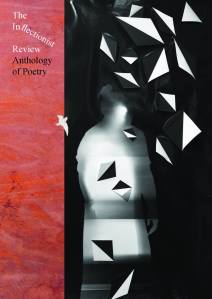
The poem above is just one of many fine poems in the newly released Inflectionist Review Anthology of Poetry. The way in which the word “oar” is used throughout the poem is a great example of what the editors had in mind by “inflectionism.” As defined on their site, “Inflecting suggests grasping what has come before and redefining it, refocusing it, placing it upon a different point in the arc thereby changing its trajectory.” The last two lines “oaring the sky for/another way home” become for me not just a metaphor for the experience of the speaker but also for the experience of writing, which can be seen via the poem as another kind of “oaring.”

The Inflectionist Review Anthology of Poetry features all the poems from issues 1-4 as well as an interview and feature of Distinguished Poet, Courtney Druz along with artwork from Anna Daedalus and Kerry Davis.

I’m delighted to have nine of my own poems in the anthology, including some newer work in the Naos persona. Here is “Naos Explains Memory,” which the editors of the Inflectionist Review were generous enough to nominate for a Pushcart Prize:

Naos Explains Memory – José Angel Araguz

Like gradual blindness: each day, more and more, a mix of less and less.
What you do see, you say remember. What filters through: a voice, car lights,
the ends of a dress. Singular and graphic. A strong whiskey.
A root you cannot shake from your body. The color of the last moon.
In a city you do not remember leaving.

The Inflectionist Review Anthology of Poetry can be purchased here (and make sure to check out the review’s submission guidelines here).

Congratulations to editors John Sibley Williams and  A. Molotkov for putting together such a fine anthology!

***

The countdown to the December 1st release of my full-length collection, Everything We Think We Hear, continues. Since I shared the IR Anthology cover I thought I would share the artwork that will be featured on the cover:

This piece by artist Andrea Schreiber features the kind of dress my mother wore to work at Rosita’s on Baldwin back when I was a kid. As we get closer to the date I plan on sharing the full cover. I did, however, want to share the artwork alone as it is its own special creation. Here are links to the mom-related “Raro” recently published in Compose Journal as well as to The Story Behind “Raro” feature on the piece.

Happy inflectioning!

José

* My Writing Process Blog Tour!

Happy Monday, y’all!

I’ve been invited to participate in the My Writing Process: Blog Tour by poet extraordinaire, Lisa Ampleman. Here’s some info on Lisa:

Lisa Ampleman is the author of a book of poetry, Full Cry (NFSPS Press, 2013), and a chapbook, I’ve Been Collecting This to Tell You (Kent State University Press, 2012). Her poems have appeared or are forthcoming in Poetry, Kenyon Review Online, 32 Poems, Poetry Daily and Verse Daily. Check out her site here.

The tour is focused on sharing a bit about our writing process. Here are my answers to the tour’s questions:

  • What are you working on?

Globally, I just put the finishing touches on two full-length poetry manuscripts. Each has taught me a bit more about learning the character of a project. A little more locally, I am trying some new things in regards to my daily writing, which tends to be form-focused.

  • How does your work differ from others’ work in the same genre?

I believe it’s a lifetime goal to have your work differ from that of others. Or, rather, that we should be pushing ourselves closer and closer to ourselves with each poem. If there’s anything I aim for consistently is vulnerability – whether that comes through rawness of content or pushing myself into a formal structure that makes me uncomfortable and staying with it. Something James Cummins says about writing sestinas applies here, that it is a process of humiliation and perseverance.

  • Why do you write what you do?

I write what comes. When I work on a poem, free write or several drafts in, I see my job primarily as a mover of words, of making choices and reading into the possibilities and consequences of those choices. I suppose it’s like an inner divining rod leading to fresh water 🙂

  • How does your writing process work?

Time is the biggest factor. There’s the time I put in daily, at least half an hour. Merwin describes his daily writing as a listening in to see what can be heard that day. There’s also the time I let pass after I finish a notebook. I’m working on poems at the moment whose first drafts were in 2012. The time away allows me to become a different writer than when I wrote it, to read more, learn more. Anything to help me see past myself.

***

* site-seeing *

* site-seeing *

Tune in a week from now and check out the responses from these fellow poets:

Miriam Sagan founded and directs the creative writing program at Santa Fe Community College. Her most recent collection of poetry is SEVEN PLACES IN AMERICA: A Poetic Sojourn (Sherman Asher Publishing). She recently hung 24 hours of diary entries on a laundry line at Salem Art Works in upstate New York and this winter is headed to The Betsy Hotel in Miami to install a poem on sand. She has been in residence in national parks, sculpture gardens, and in a trailer with Center for Land Use Interpretation at the edge of a bombing range in Great Basin. She has been awarded the Santa Fe Mayor’s Award for Excellence in the Arts and this year’s Gratitude Award from New Mexico Literary Arts. Check out her blog here.

***

Jeannine Hall Gailey recently served as the second Poet Laureate of Redmond, Washington. She is the author of four books of poetry: Becoming the Villainess, She Returns to the Floating World, Unexplained Fevers, and the upcoming The Robot Scientist’s Daughter. Her work has been featured on NPR’s The Writer’s Almanac, Verse Daily, and in The Year’s Best Horror. Her web site is here.

***

Sam Roderick Roxas-Chua has read for Oregon Poetry Association, Windfall Reading Series, Isangmahal Arts Collective, NW Poets Concord, Talking Earth, PoetsWest, Brigadoon Books, Fault Lines and Word Lab in Manila, Philippines. He is published by Vena Cava, Word Laboratories, Mixer Publishing, Concord, and Paw Print Publishing. His most recent work appears in The Inflectionist Review and his three-poem poster to promote his first collection, Fawn Language, is featured in the 25th Anniversary Showcase at Poets House in New York City.Fawn Language is published by Tebot Bach of Huntington Beach, California. His blog is here.