Where last week’s poem by Francisco X. Alarcón evoked ideas of presence, this week’s poem, “Freeway 280” by Lorna Dee Cervantes, is driven by self-exploration and self-seeking. Often these themes are approached in poems in loud ways, in declarative statements and pronouncements. In the poem below, the speaker of the poem meditates on the environment around her.
The listing in the second stanza, in particular, moves in a way that points back to the speaker’s sensibility. Amidst the trees “left standing” in the yards she can see, the speaker observes “viejitas” (old women) who come and collect greens and herbs. This juxtaposition of the natural with the human imbues both with a sense of survival.
 The self-exploration/seeking takes on a literal turn as the speaker scrambles over a fence to get closer to “los campos extraños de esta ciudad” (the strange fields of this city). Once there, the speaker continues to keep an eye on what is present, and, in doing so, evokes their own presence. That this presence is made up of seeking makes it all the more compelling; at the heart of lyric poetry lies such seeking, such presence.
Freeway 280 – Lorna Dee Cervantes
Las casitas near the gray cannery,
nestled amid wild abrazos of climbing roses
and man-high red geraniums
are gone now. The freeway conceals it
all beneath a raised scar.
But under the fake windsounds of the open lanes,
in the abandoned lots below, new grasses sprout,
wild mustard remembers, old gardens
come back stronger than they were,
trees have been left standing in their yards.
Albaricoqueros, cerezos, nogales . . .
Viejitas come here with paper bags to gather greens.
Espinaca, verdolagas, yerbabuena . . .
I scramble over the wire fence
that would have kept me out.
Once, I wanted out, wanted the rigid lanes
to take me to a place without sun,
without the smell of tomatoes burning
on swing shift in the greasy summer air.
Maybe it’s here
en los campos extraños de esta ciudad
where I’ll find it, that part of me
mown under
like a corpse
or a loose seed.
from Emplumada (University of Pittsburgh Press)
*
Happy seeking!
José
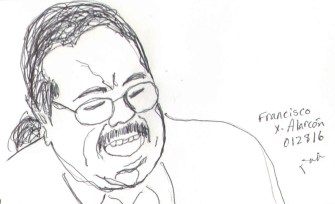 I would have loved to hear what Alarcón would say about our times now. His death almost two years ago now keeps being fresh on my mind as I find myself compelled to engage with the personal and political in my poems for new reasons. Only through such engagement can we reach new understandings. I say “new,” but the new always takes us back to the old, or, as in the poem below, the present. Alarcón’s poem asserts presence as a subversive act; being present with this poem allows me to be present within myself. Such is the gift Alarcón possessed and left for us in his work.
 The Influence