This week I’m sharing another installment archiving my Instagram poetry project entitled @poetryamano (poetry by hand). This account focuses on sharing poems written by hand, either in longhand or through more experimental forms such as erasures/blackout poems and found poems.
Below are highlights from August 2017. This month found me focusing on haiku on short, imagistic haiku. Also included below is a haiga inspired by the 2017 eclipse.
Be sure to check out the previous installments of the archive – and if you’re on Instagram, follow @poetryamano for the full happenings.
Enjoy these forays into variations on the short lyric!

Image description: A handwritten haiku that reads: faces shuffle through the coffee drips its bitter business.”

Image description: A handwritten haiku that reads: “at night lilacs lose their color to the moon.”

Image description: A handwritten haiku that reads: “writing across this blank paper a branch’s shadow.”
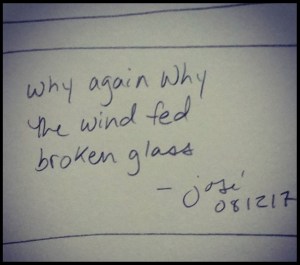
Image description: A handwritten haiku that reads: “why again why the wind fed broken glass.”

Image description: A handwritten haiku that reads: “reading scraps of Sappho years later my ears burn.”

Image description: A handwritten tanka that reads: “the gray cat’s eyes stop to take you in long before you can place them.”

Image description: A handwritten haiga that reads: “after the eclipse same trees under the same moon.”

Image description: A handwritten haiga that reads: “paper clip dash of wire hugs air to itself.”
 This particular community feature post is inspired by a recent development: I’m happy to share that I’ve been named as a member of the Board of Governors for
  Below, I share a sample poem from The Waiting Room Reader II, “The Inheritance” by Myra Shapiro. What moves me most about this poem is how it enters into an elegiac conversation in an unexpected way. The first four lines present the logic of grapefruit-as-talking-baby doll, and then builds from there back into the reality of the moment. This quick invocation of the mother in four lines sets up the rest of the poem in which human presence is acknowledged as being available to us in the actions and habits we learn from our parents. The short lines and images allow the meditation to develop in a way that continues to be surprising precisely by not trying to be. The facts of the speaker’s experience are laid out clearly, and what makes them surprising is the juxtaposition of phrase and image. The speaker moves from the hypothetical “Mama” of the opening lines, to her own mother, to being a mother herself. Here, we see the generations pass, each different yet similar, and each evoking the next in the poem. One returns to the title’s idea of “inheritance” and sees it expanded beyond the material meaning, the speaker realizing their own inheritance in the patterns of everyday life.
 The Influence