* existing with gisela kraft & an update


five-story house in laleli – Gisela Kraft

one lies in rags on the street
and his stomach is empty
and he wishes for death

one sits with friends at tea and backgammon
and his mind is empty
and he wishes for death

one sits in a straight-backed chair at a desk
and his bank account is empty
and he wishes for death

one lies in bed staring out to sea
and the place next to him in bed is empty
and he wishes for death

one flies back with food in its beak
and its nest is empty
and only this one says
we should give it another try

(trans. Laura Leichum)

This short lyric has quickly become a favorite of mine in the past few weeks. I’m charmed by the way the seemingly simple refrain quickly enters into allegory. The repetitions of “empty” and “death” build up an atmosphere of dejection and set up the turn at the end of the poem. The impersonal and non-specific nature of “one” as an address allows for the final stanza’s change in perspective; something “flies” in the heart of the reader and defies the preceding stanzas of emptiness and death, and gives further impetus to exist. There’s also a structural charm to the poem in the way the “five-story house” is played out in the five stanzas of the poem.

***

It has been a week since the official release of my collection Everything We Think We Hear. Since then, I have been humbled and moved by the warm reception and good wishes people have shown the new book. Thank you to all who have shown interest and bought the book!

After some minor issues, the book is available for order on Amazon!

As part of a partly superstitious and partly practical (or so I tell myself) process, I went ahead and ordered myself a copy. Here’s a pic that shows that my little book does indeed exist:
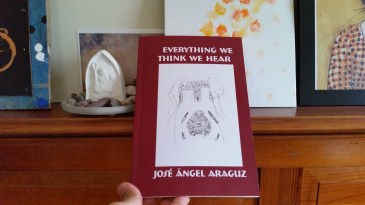
This copy is going straight to mom in Texas. I’ll make sure to post an update here when I receive my own copies for sale.

Happy existing!

José

 

* a revisit, prose poem thoughts, & thanks

Footnote – James Schuyler


The bluet is a small flower, creamy-throated, that grows in patches in New England lawns. The bluet (French pronunciation) is the shaggy cornflower, growing wild in France. “The Bluet” is a poem I wrote. The Bluet is a painting of Joan Mitchell’s. The thick blue runs and holds. All of them, broken-up pieces of sky, hard sky, soft sky. Today I’ll take Joan’s giant vision, running and holding, staring you down with beauty. Though I need reject none. Bluet. “Bloo-ay.”

Tiny_Bluets

A few weeks ago, I wrote a post about James Schuyler’s “The Bluet” which he references in the prose poem above. I just discovered the above poem in a prose poem anthology I’m reading for my exams. I marvel at how much of Schuyler’s human fascination comes through in both his poem and “footnote.” The added information here, both of pronunciation (I’ve been saying it “blue-it” as in I really blew it with that pronunciation) and of Mitchell’s artwork, adds layers to Schuyler’s ongoing meditation on the bluet. Both in lyric and in prose, the flower is turned over, “running and holding” for both Schuyler and reader.

Earlier this week, I posted about the release of my collection Everything We Think We Hear (available for purchase on Amazon). In discussing the project with friend and poet John Sibley Williams on Facebook, I found myself realizing something about the ambition of the project in its turns between prose poetry and microfiction. At one point, I wrote:

So much of what we do in a poem, prose or lineated, is about what’s unspoken, while microfiction lends itself to more narrative completion. The most apt metaphor I can think of at the moment is those jeans and hoodies that come pre-scuffed up and torn, a narrative holding but frayed.

There’s a great quote from Robert Frost about poetry books where he says that if a book of poems has 25 poems, the book as a whole should stand as the 26th. This quote has long been an inspiration behind the strategies I use in putting a manuscript together. This quote also points to the way projects can have pockets of the same idea, varying shades of the same color. In the spirit of Schuyler’s takes on the bluet, I hope variations in form and intent work out an added layer to the reading experience in Everything We Think We Hear.

Thank you to all who have reached out with kind words and good wishes on the recent publication! Thank you to everyone who has bought a copy or plans on doing so (you totally should)! And lastly, thank you to John for getting my brain thinking 🙂

Happy bluet-ing!

Jose

P.S. After all that, it’s still a painting command in my head: “blue it!”