This week, I had the awesome opportunity to participate in a #takeovertuesday on Pretty Owl Poetry’s Instagram account. I posted a series of “a day in a poet’s life” posts in their stories as well as held a poetry reading via Instagram live. I also had the opportunity to field some questions ranging from the writing life to astrology.
I share the question and answers below in the spirit of community. Thank you again to the editors of Pretty Owl Poetry! Thank you as well to everyone who shared space with me on Tuesday, either by asking questions, attending the reading, or simply viewing the stories. In these times where so much of life is affected and different due to the pandemic, I am honored to be a part of such a thriving writing community!
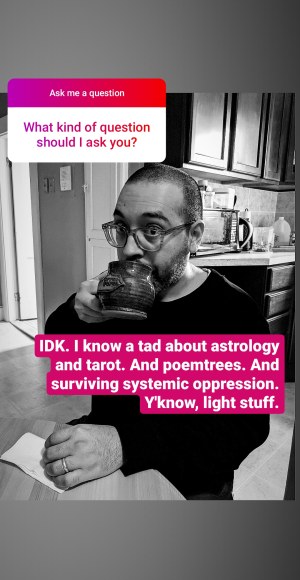
Image description: A man drinking coffee while sitting at a table with the following question and answer imposed: What kind of question should I ask you? Answer: IDK. I know a tad about astrology and tarot. And poemtrees. And surviving systemic oppression. Y’know, light stuff.
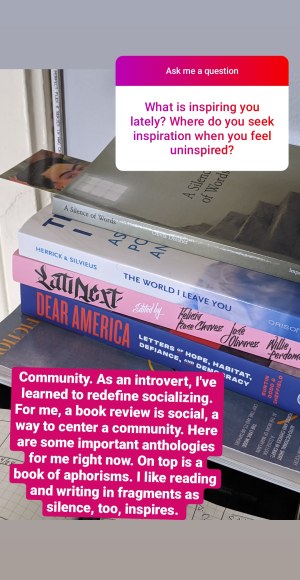
Image description: A stack of books with the following questions and answer imposed: What is inspiring you lately? Where do you seek inspiration when you feel uninspired? Answer: Community. As an introvert, I’ve learned to redefine socializing. For me, a book review is social, a way to center community. Here are some important anthologies for me right now. On top is a book of aphorisms. I like reading and writing in fragments as silence, too, inspires.
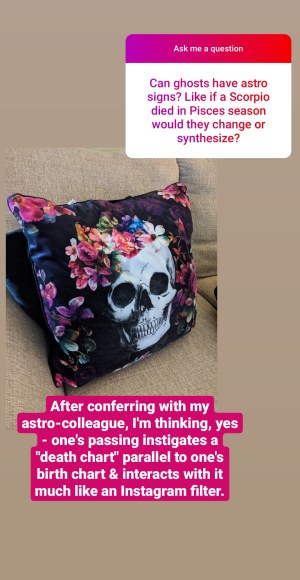
Image description: A couch pillow which features a skull wearing a flower garland with the following questions and answers imposed: Can ghosts have astro signs? Like if a Scorpio died in Pisces season would they change or synthesize? Answer: After conferring with my astro-colleague, I’m thinking, yes – one’s passing instigates a “death chart” parallel to one’s birth chart and interacts with it much like an Instagram filter.
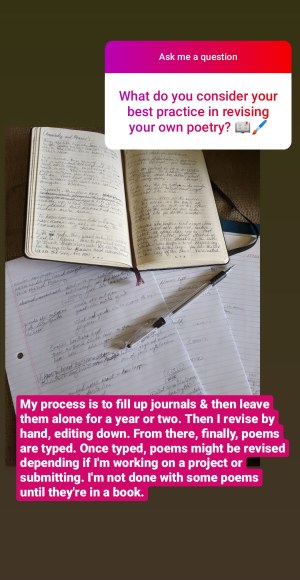
Image description: A journal set atop a set of loose pages with a pen laid across and the following question and answer imposed: What do you consider your best practice in revising your own poetry? Answer: My process is to fill up journals and then leave them alone for a year or two. Then I revise by hand, editing down. From there, finally, poems are typed. Once typed, poems might be revised depending if I’m working on a project or submitting. I’m not done with some poems until they’re in a book.
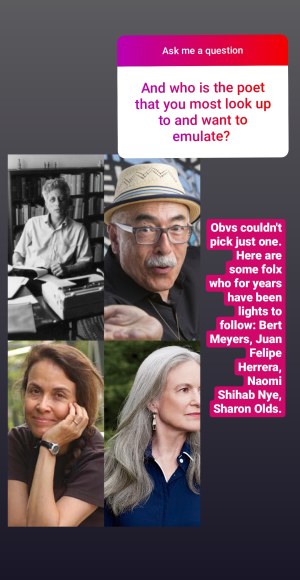
Image description: A collage photo of two men and two women with the following question and answer imposed: And who is the poet that you most look up to and want to emulate? Answer: Obvs couldn’t pick just one. Here are some folx who for years have been lights to follow: Bert Meyers, Juan Felipe Herrera, Naomi Shihab Nye, and Sharon Olds.
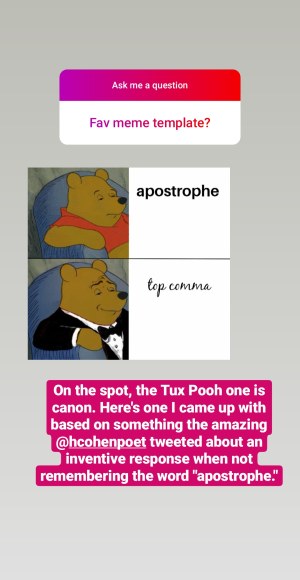
Image description: A meme half consisting of Winnie the Pooh in a red shirt next to the word “apostrophe” and the other half consisting of Pooh in a tuxedo next to the words “top comma” with the following question and answer: Fav meme template? Answer: On the spot, the Tux Pooh one is canon. Here’s one I came up with based on something the amazing @hcohenpoet tweeted about an inventive response when not remembering the word “apostrophe.”
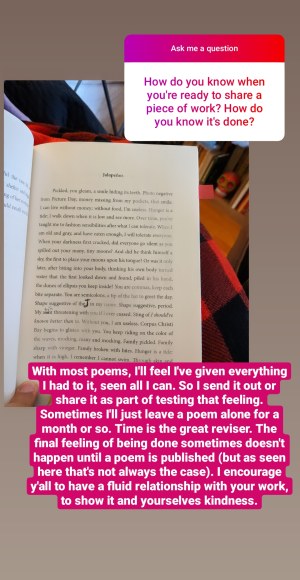
Image description: A book held open to a page where some pen marks have been made on the printed words with the following questions and answer imposed: How do you know when you’re ready to share a piece of work? How do you know when it’s done? Answer: With most poems I’ll feel I’ve given everything I had to it, seen all I can. So I send it out or share it as part of testing that feeling. Sometimes I’ll just leave a poem alone for a month or so. Time is the great reviser. The final feeling of being done sometimes doesn’t happen until a poem is published (but as seen here that’s not always the case). I encourage y’all to have a fluid relationship with your work, to show it and yourselves kindness.
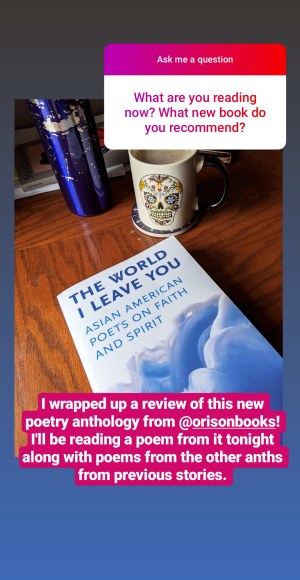
Image description: A book laid on a table next to a mug with a skull on it, all with the following questions and answers imposed: What are you reading now? What new book do you recommend? Answer: I wrapped up a review of this new poetry anthology from @orisonbooks! I’ll be reading a poem from it tonight along with poems from the other anths from previous stories.
 This particular community feature post is inspired by a recent development: I’m happy to share that I’ve been named as a member of the Board of Governors for
  Below, I share a sample poem from The Waiting Room Reader II, “The Inheritance” by Myra Shapiro. What moves me most about this poem is how it enters into an elegiac conversation in an unexpected way. The first four lines present the logic of grapefruit-as-talking-baby doll, and then builds from there back into the reality of the moment. This quick invocation of the mother in four lines sets up the rest of the poem in which human presence is acknowledged as being available to us in the actions and habits we learn from our parents. The short lines and images allow the meditation to develop in a way that continues to be surprising precisely by not trying to be. The facts of the speaker’s experience are laid out clearly, and what makes them surprising is the juxtaposition of phrase and image. The speaker moves from the hypothetical “Mama” of the opening lines, to her own mother, to being a mother herself. Here, we see the generations pass, each different yet similar, and each evoking the next in the poem. One returns to the title’s idea of “inheritance” and sees it expanded beyond the material meaning, the speaker realizing their own inheritance in the patterns of everyday life.
 The Influence