panicked pero pushing

Posting a little later than I’d like this Friday due to staying up late panicked and overworked–which has been technically the norm, ha. While I feel awfully self-conscious just saying it aloud (even here) I thought I’d just say it because we can’t just share the good stuff in life, as doing so wouldn’t be representative of all of who I am.

Moving forward, here are a few highlights from this week:

  • For my comrade bookworms: Ani was just introduced to The StoryGraph an indie, Black-owned alternative to Goodreads. It’s quite pleasing and simple to navigate! She was able to import all her Goodreads info and it gave her what she terms “the sexiest page of stats” she’s ever seen.
  • Here’s an article entitled “9 Ways to Make Long-Haul Quarantine More Sustainable” in which disabled writer and activist, Alyssa MacKenzie, shares tips that have helped her this year. She does a great job sharing tips via the lens of disability and chronic illness (shout out to my spoonie and chronically ill folks out there!) in a way that speaks to everyone. I appreciate MacKenzie’s sharing of personal experience and insight that centers disability and chronic illness first. I feel like the pandemic has been a HUGE privilege check for people, with the narrative of “inconvenience” being dominant and dangerous. MacKenzie shares some of the “unique skill set” held by those who are “no stranger to being ‘stuck’ at home.”
  • Finally, this week was the last week of classes here at Suffolk U. I had a blast with my First Year Writing students and am proud of all the work they did thinking through the complex ideas in their reading and writing on important issues at the intersection of literature and politics.

Also, it was an honor to work and build with my Poetry Workshop students, a rare group of dynamic and insightful individuals. So proud of the breakthroughs they made in their own work and in their relationship with language. We’re even putting together a class anthology!!! One of our last sessions involved writing centos in class. I share the one I wrote below along with a meme by Kenning JP García that checks any airs one may have around the form, ha.

José Angel Araguz

Virgo’s Lament

a cento

there are ruins we witness
beneath a scarf of cirrus

when night throws itself against
layered lost worlds where
some terrible mistake has been made —

here, I am graceless

alone in the myth of one life, I will
have turned into long, quiet rivers
my daily transformation

which is like unbuckling

*

A meme that reads “cento poetry be like” written over a series of photographs of Jim Carrey doing impersonations of other actors.

Lines above sourced from: Oliver de la Paz, Major Jackson, Saeed Jones, Naomi Shihab Nye, Mary Jo Bang, Kaveh Akbar, Tarfia Faizullah, Catie Rosemurgy, Jeannine Hall Gailey, Ross Gay
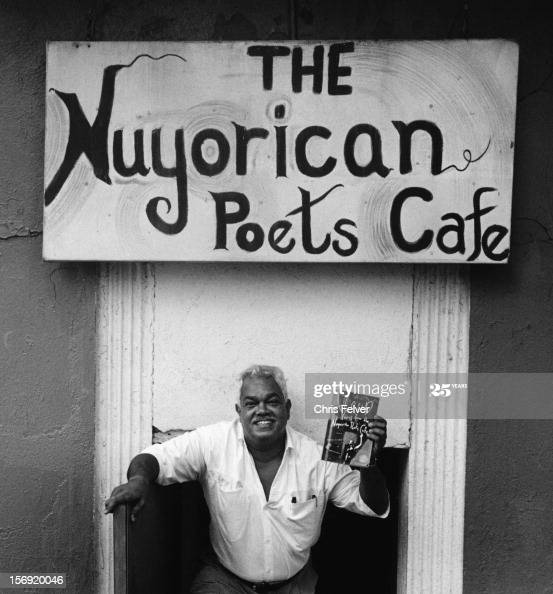
in memory: Miguel Algarín

Portrait of poet Miguel Algarin, New York, New York, 1994. (Photo by Chris Felver/Getty Images)

I’d like to dedicate this week’s post to the memory of Miguel Algarín, Puerto Rican poet, writer, and co-founder of the Nuyorican Poets Café who died earlier this week. Algarín was the embodiment of being a poetic presence on and off the page. His poetry set precedents by holding space for political struggles and literary insights that represented the various communities he worked and taught in. His work through the Nuyorican Poets Café as well as in his teaching showed him as a model for holding space for poets from all backgrounds.

The more I teach, the more I feel that the classroom is a space of confluence, a space where the experiences of my students and those of my own all meet, eddy, and converge, a presence. A stage can be a classroom as can the page. Across these three spaces, Algarín touched a great number of lives, influencing directly through community-minded efforts as well as through a singular understanding of languages.

The poet Rich Villar in a recent set of tweets shared the following sentiments:

I think it’s good to celebrate the Nuyorican Poets Cafe. It’s good to celebrate and mourn Miguel Algarín. It’s also good and important to celebrate Miguel’s IDEA of the cafe, the “poetics” of community, which is genius particularly because anyone can replicate it.

So many spaces and places defined what became known as the Nuyorican movement. None of it required official sanction or 501c3 status. It required two things: need, and audience. Even the old squat on 3rd Street wasn’t necessary at first. Any old space would do.

Villar goes on to share the example of Elisabet Velasquez who, among other things, is conducting a series of stories on Instagram highlighting poets who answer questions asked by her followers. I agree with Villar when he compares Velasquez’s use of social media to hold space in the spirit of Algarín. That when one looks outside the capitalist-driven and prejudice-strained world of literary publishing and awards, one sees that giving and honoring each other is easy. That answering a question on social media or mentoring someone through email correspondence is easy, is community. One of the great joys of running this blog is being able to connect with y’all and create community.

It is an understatement to say that Algarín’s example is not just a literary one but a human one, a political one, a socially aware one. It is one I continue to learn from. To return to teaching: it is a platitude for a teacher to say I learn from my students. But what does that really mean? It means I commune with my students. I listen to my students. I build with them. Again, all one needs to commune, to listen, to build and learn is to hold the space for it.

I encourage y’all to hold space with some of Algarín’s work as well as to share it. Share your own work. Share your voice. If you’re reading this, know that I’m glad you’re here.

2 poems
“Not Tonight but Tomorrow (1978)”
“New Year’s Eve December 31, 1975”

A write-up on Algarín’s life at The New York Times.