I’ve been revising in an odd style lately, keep writing notes to myself like: more of this Objectivist vibe, or: you’re not Williams, sorry. A lot of the poems I’m working on in this way are written in short lines, with close enjambment, definitely in the style of the Objectivists, a group which includes George Oppen, Charles Reznikoff, and Lorine Niedecker. William Carlos Williams (the Williams of my earlier note) is loosely related to the group, his no ideas but in things influencing this group via the work of the Imagists.
I share the above to do two things: 1) To share a bit of the histories/traditions with which I sit down at the page with; and 2) To introduce this week’s poem, “Old Sycamore” by Chuck Wachtel, a poem that takes after Williams’ style in an instructive and illuminating manner.
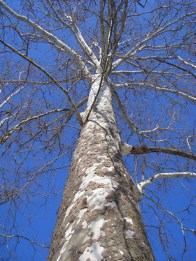 Reading Wachtel’s poem is an exercise in focus; in its own distinct fashion, the poem moves forward in its short lines with a surprising use of enjambment. While the poem’s meditation is straightforward, the enjambment draws the reader’s attention closer to the words in such a way that the meaning builds and blurs alongside the clarity of what’s being said. It’s a favorite poem of mine because the language creates exactly what the speaker fears is unattainable. Lyric glimpses like this one, of possibility and meaning, are a gift.
Old Sycamore – Chuck Wachtel
in memory of Joel Oppenheimer, 1930-88
The slender young
sycamores of Rutherford,
New Jersey, are fat
now, trunks
scarred, half-dead,
no longer
there. The poems
Williams left
behind, always new
in themselves,
are old
too. What I fear
is that our
language,
possessed
of so much
light that it
has filled
the world with
things
we must be
told of,
now
battered by
decades of
persuasion,
can no longer
make a thing
so clear I am
overwhelmed by
its clarity, can
no longer make
a thing into
a word spoken
once and within
that single
utterance
repeated over
and over, until
it reaches, then
exceeds its own
self-meaning
and we lose
sight
of it, begin
to see instead
everything around
it – a whole
world of new
things made from
an old thing
brought into
being in one
single beat
of existence
— the offering,
then, of a
thing
left behind.
*
from Visiting Doctor Williams: Poems Inspired by the Life and Work of William Carlos Williams
 What happens as these intersections are explored is critique via the performance of language. Castillo’s poetic sensibility invites the reader to play close attention not just to line breaks but to choices in capitalization and idiom. The way, for example, in which “Mexico” is capitalized in the third stanza, where as “american” is not in the second stanza, provides a visual cue of what the speaker is wrestling with. However, it is not a simple gesture of dismissal, but rather a nuanced reaching into memory. One gets the impression that for the speaker this “new” Mexico feels “watered-down,” and that the only way to push against this feeling is to emphasize memory in whatever way one can, in this case via typography.
 The Influence