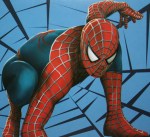
 As the release date of my next poetry collection, Small Fires (FutureCycle Press), approaches, I want to quickly revisit one of the key poems from my book Everything We Think We Hear (Floricanto Press).
Below is the piece “Spiderman Hitches a Ride” along with a short essay about the origins of the piece. The short essay was originally written for the Tahoma Literary Review blog when this piece was published in issue 5.
*
Spiderman Hitches a Ride – José Angel Araguz
My mother compares me to Spiderman, and for a second I like it.
I mean, it’s what I’ve always wanted: to be viewed in the glory of courage and costume; to be super tough and just, a city like a little brother needing me to battle bullies and take back lunch money, a villain defining me by default as a hero, his crooked eyebrows and overheated plans carnival mirror to my calm and valiant stance; to push out of paper bag clothes; to leave my shoes untied, their mouths open in awe; to slip on the muscles and dreams of tomorrow’s headlines; to leave a woman breathless, with a single kiss amazed, her heart pounding at the thought of being in love with a man – in tights – who leaves her without a name or number with which to follow him into the fire.
He is like me, my mother says, because he too wants to do good things for people, but he gets beat up, can’t find a job and his girl ends up dating someone else. He saves people’s lives but is always flaco y vago, vagabond skinny with luck and life.
Is this what it meant for her when at seventeen I boarded a plane and soared out of this city, where if she couldn’t see into my head she could at least put a roof over it. Those years I disappeared into the phone, and was ok in Santa Fe, ok in San Diego, ok in New York but still short and small in words.
M’ijo, no te preocupes, don’t worry. She smiles, then slips off her seatbelt to reach over and wrap an arm around my neck, the other dropping a twenty into my lap. The green paper is wrinkled in waves that shudder and blur as I blink fast, trying once again to be heroic.
*
On “Spiderman Hitches a Ride”
originally published in Tahoma Literary Review issue 5)
This piece is part of my collection, Everything We Think We Hear (Floricanto Press), whose pieces deal primarily with what it meant for me to grow up in and out of South Texas.
The first draft of “Spiderman” was written during the summer of 2004 during which I lived in a house that had no electricity. The house belonged to a dear friend of mine who offered me a place to stay when he heard I was coming back to my hometown, Corpus Christi. “There’s no electricity,” he warned, “but you’ll have plenty of room to sit and write.” Having no job prospects that summer, I happily took him up on it.
Without a job, there was plenty of time to write as well. I spent most days that summer selling my personal library one sad stack at a time at a used bookstore and using the few dollars raised from that to buy coffee. I would take over a table at a café and write and write and write. At night, I would make my way over to the dollar movies and watch just about anything just to be in the air conditioned theater. Corpus Christi summers stay in the high 90s, low 100s, on average, with the nights carrying the heat via humidity.
That summer, I watched a lot of bad movies, keeping my notebook open on my lap and my pen to paper. I blame that summer for the fondness that remains for the train wreck of a movie, Troy, lines from which still come to me when thinking about the Iliad. Similarly, I must’ve watched Spiderman 2 close to a hundred times. Writing in the dark of the theater felt like dreaming; the various narratives and worlds around me began to blur. Peter Parker’s bumbling yet charming bad luck never felt too far off from my own. And while I may never have saved a city from destruction, only myself (barely), you never saw Peter open a letter from Sallie Mae and keep down his lunch.
Going back and forth in (anti)heroic comparisons at night kept me writing at a time when each day I woke to the reality of being young, college-educated, and broke. Broken, too, my ego, my sense of self and of the future. Only poetry braced me; and only family buoyed me.
*
See you Friday!
José
 This week’s poems were originally published as part of the
  To complement these two poems, I present this third poem, “Sheng-yu’s Lament,” an adaptation from the Chinese. Okaji states in the microchap that he calls it an adaptation rather than translations “because I neither read nor speak Chinese, and have used transliterations to produce these versions.”
 The Influence