review by José Angel Araguz
Tesla Writes An Obituary – Michael J. Wilson
I left you New York —
Walked the mountain paths of Colorado — found
a field to plant my bulbs
I’m the tired circus sidekick — arms spread — tied to a wheel
waiting for daggers
The clear dark night steamed with Milky Way and nothing
Here is some patent for a ray gun on a receipt for a hat
now — let me spill anonymous electrons in peace
You have your direct currents to the ears of America
I am not inclined to be king
Quietly — I will build a city of light
capture the sun
drive my fists into the ground until I split the earth in two
I will walk into the sky —
Edison, you have no hobby —
care for no amusement —
disregard the rules of hygiene —
you have
immense blind contempt for learning
knowledge
decency
trusting only good American sense —
Leave me in my empty with Clemens
Forget you ever knew a Nikola Tesla
*
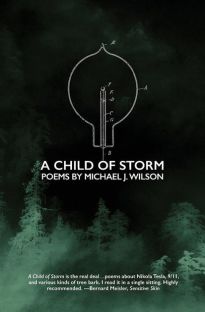
Mirroring the image above of “the tired circus sidekick — arms spread — tied to a wheel / waiting for daggers,” the poems in Michael J. Wilson’s A Child of Storm (Stalking Horse Press) approach their materials from various angles. Whether assuming the persona and mythology of Tesla, providing a sequence of history lessons, or delving into the implications of selfhood juxtaposed against nature and city, these poems take aim at exploring variations. Each turn in a poem is another dagger thrown, not to hit the subject directly, but to create a charged air and impact around it.
In the poem above, the Tesla persona is taken on with a directness capable of epic address (“I left you New York”) as well as pathos (“let me spill anonymous electrons in peace”). The effect of this directness is a commanding lyricism. There is command in the way the voice in this and other Tesla poems feels human; yet the lyricism arises not out of the voice but out of the ambition visible behind each poem, line by line.
This poetic sensibility leads to lines that cascade in meaning and image. In “Faraday Cage,” for example, a sequence ends: “May the echo that is my ghost skip on your page like a frame / of film melting.” The travel here is compelling: from the resonance of “echo” and “ghost,” words that imply sound first then mortality, to the moves of logic within the image of a melting film frame, the ambition here is to both evoke and hold, all the while aware of the transient nature of memory. Another moment of lyrical ambition occurs in “Study (Sand Dune and Tree)” and its image of “These flagellant trees / arms raised mid-cat o’ nine prayer.” These two lines work like a Venn diagram, evoking simultaneously the action of flagellation and the stillness of trees and prayer.
This vision runs through the collection, allowing for moments rich in revelation like the following excerpt from “History Lessons: The Rock Dove”:
The pigeon originates in Europe, northern Africa and southern Asia but is found in nearly every city in the world. One of the first animals to be domesticated, pigeons seen today are feral ancestors of birds raised for food, work, or as pets.
While ostensibly part of the history lesson of the poem, these lines read as possibly being about Tesla as well as the speaker in other poems, these various voices aware of a history that both created and estranged them.
Ultimately, a fruitful estrangement results from the ambition behind these poems. In the poem below, the reader follows a scene between the speaker and another person where the unravelling of a sweater at the end of the poem mirrors the unravelling that can occur between two people. The poem moves, however, with an intimacy that grows with each turn of conversation, sense, and memory.
*
Eastern Red Cedar – Michael J. Wilson
You
smell
like
cedar berries and sawdust
mixed with plastic
You say: The radiator is full of steam
It’s closed system
probably full of some black death
we wouldn’t want to know about :
Remember when we had a stove in the kitchen
the grass comes yellow squared where the woodpile is
remembered
How
did
this sweater get a hole in it
How does a moth get passed all that smell
You mumble
Something about an old dog you used to know
a cold snowy day
a fall by the woods
when you were ten
The radiator punches the air and you look
at the discolored circle on the floor where the stove was
You say these things only comfort on the first cold day
That slipped stitches in sweaters only get bigger
*
 Influence Question: How would you say this collection reflects your idea of what poetry is/can be?
Michael J. Wilson: At its core, poetry should be revelation, it should sear. This could be personal, but it needs to be like a shot of light through the subject. It should clear space around itself. I reference St. Teresa a lot in my work. I’m not remotely religious, but the idea of being penetrated by revelation is one I identify with. I equate revelation with the body and mind.
Nikola Tesla felt science the way Teresa felt God. His vision of science – a great light that infused his being – is as close to actual religious ecstasy that I believe one can get in reality. Tesla saw his creations wholesale in his visions, then he made them to match what he perceived. That’s a description of writing. Poetry can, and should, be complete visions laid bare.
Speaking more broadly about books as objects – I am interested in arcs. Narrative and emotional. I wanted this book to feel like it added up to something. Even if that something is ephemeral and indescribable. I find books that feel like random poems collected to be tiring. There are great examples of this kind of book, but I want more. I want them to feel like the best albums do. An experience to be had. They should cohere. I like to think I did a small bit of that with my book.
IQ: How did you navigate the use of persona/research during the making of this collection and what did you learn from this process?
MJW: Research is ingrained in my process. I will spend months reading, obsessively, on a topic. I’ll buy books. Watch documentaries. I will talk about it to anyone in earshot and get my findings tattooed across my eyeballs.
I’ve always been attracted to the weird details in the “truth” of things. The fact that Tesla’s brother died from a fall off a horse. That the idea that maybe Tesla caused the accident somehow. Those things interest me way more than the particulars of his plans for alternating current. That level of research is where I go. The personal, the tiny. So, in a lot of ways they are inseparable.
When writing in Tesla’s voice I tried to just think about how one would behave if this was how the world was seen. And then I blended in my own world view. I found that this created a Tesla that could also talk about my beliefs and issues.
I found that this helped me work through the deaths of several family members. It was almost like Tesla was doing the thinking. It created a persona for myself to navigate the world in this project. And perhaps beyond it.
*
Special thanks to Michael J. Wilson for participating! To find out more about his work, check out his site. A Child of Storm can be purchased from Stalking Horse Press.
author photo credit: Cameron Gay

 The Influence