This week’s poem, “Empty Pitchforks” by Thomas Lux, does a great job of making suggestion a lyrical engine. Diving off the epigraph “There was poverty before money,” the poem begins an engaging game of evoking poverty and lack through the subjects it engages. In doing so, Lux is able to move poverty from abstraction to concrete reality.
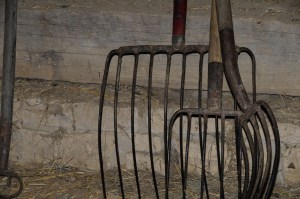 The title phrase, empty pitchforks, begins this work by suggesting a specific image and meaning. To think of pitchforks alone is one thing; to have the added word “empty,” which implies its opposite and brings to mind the states of holding and lacking, is to have the image colored by suggestion. Through the quick work of juxtaposition, the tines of pitchforks become all the more sharply rendered (pun intended via “sharply,” btw).
This work of suggestion gains momentum as the poem continues, down to the action of the last line which drives home poverty as not only a material but spiritual dearth.
Empty Pitchforks – Thomas Lux
“There was poverty before money.”
There was debtors’ prison before inmates,
there was hunger prefossil,
there was pain before a nervous system
to convey it to the brain, there existed
poverty before intelligence, or accountants,
before narration; there was bankruptcy aswirl
in nowhere, it was palpable
where nothing was palpable, there was repossession
in the gasses forming so many billion … ;
there was poverty—it had a tongue—in cooling
ash, in marl, and coming loam,
thirst in the few strands of hay slipping
between a pitchfork’s wide tines,
in the reptile and the first birds,
poverty aloof and no mystery like God
its maker; there was surely want
in one steamed and sagging onion,
there was poverty in the shard of bread
sopped in the final drop of gravy
you snatched from your brother’s mouth.
from New and Selected Poems: 1975-1995
 In light of the complexity of this stanzaic structure, I can’t help but marvel at Hacker’s use of it here in a poem essentially about a hangover. The stress on the first syllable of each line adds a troubled conviction to the speaker’s voice; their ruminations come off in a controlled yet shaky manner. This shakiness is augmented by the form, leading to such lyrical utterances as: “I feel muggy-headed and convalescent, / barely push a pen across blue-lined paper.”
 The Influence