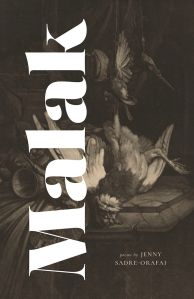
 In my recent microreview & interview of Jenny Sadre-Orafai’s Malak (Platypus Press), I spoke about the collection’s theme of divination and how poetry itself becomes a similar source of insight and perception for the speaker in a number of poems. This week’s poem, “Queen of Cups” also from Malak, is a good example of this poetic perception.
The poem develops through juxtaposition, following a story about where Queen Elizabeth was when her father died with a story of where the speaker’s father was when his mother died. The speaker then details where she was during the latter, the death of her grandmother. The turns within this juxtaposition, the move from historical fact to personal memory, create an intimacy that pulls the reader in while simultaneously disorienting them in a fruitful way. The poem then pivots into its ending, using the created intimacy as an imaginative space.
So far, as readers we are brought into what is happening because of narrative, but we become invested in it because of what is evoked from the images that follow. From hallucination to the comparison to a movie, the speaker’s narrative becomes driven by an urgency to see further into the memory while not dictating or forcing any straightforward understanding. The stakes behind this urgency become apparent in the final lines of the poem as the speaker considers whether Elizabeth was “instructed not to cry.” The return to the image of Elizabeth watching elephants up close parallels that of the speaker trying to see further into the large animal that is grief; this last juxtaposition ends the poem with the emotional tension of being torn between seeing and feeling.
Queen of Cups – Jenny Sadre-Orafai
Queen Elizabeth was with Philip in Kenya
when her father died. She was watching
elephants from her hotel within the trees.
My father was with his three sisters when
his mother died. I was with my bed,
hallucinating a fox. After the fox left,
I called him, but he was taking a shower.
Like a movie, the protagonist crying
surrounded by water, lots of empty cups?
Was Elizabeth instructed not to cry?
It will shake this tree.
The elephants will trample this nest.
*
Find out more about Jenny Sadre-Orafai’s work at her site.
Also, here’s more from Sadre-Orafai on this particular poem.
 One poet who I feel lived and reckoned with this troubled calm is William Stafford. In “Meditation,” Stafford adds his own take on the concept. This short lyric reveals and hides itself like a coin flipped in the air. Both an admission of defeat and of hope, it dwells right where one waits for things like memory, poems, and clarity.
 The Influence