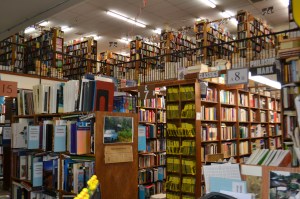
This week’s poem – “The House Was Quiet and The World Was Calm” by Wallace Stevens – takes me back to a conversation I had with a co-worker when I worked at a bookstore years ago. I had been arranging the poetry section for National Poetry Month and positioning a Wallace Stevens book to face out from a eye-level shelf. My co-worker happened to pass by and say: Stevens! Cool! I know one poem by him. “The House Was Quiet and The World Was Calm.” It’s rad!
I hadn’t read the poem but I was intrigued, as Stevens is often not the easiest person to follow line by line. Not that I didn’t think my co-worker incapable of following a Stevens poem, but rather that a conversation about Stevens, for me, usually brings in difficulty, his use of ambiguity and lyrical obfuscation, and the way you have to work at following what he has to say. At least that’s been my experience. I usually tell folks that I’ve picked up and put down Stevens’ Collected Poems three times in my life, each time getting a little farther into it, before moving on, not defeated just knotted with questions. And yet, getting through more and more poems of his continues to be a rich experience.
 When I finally read the poem below, it was a double surprise. Not only is it a poem that feels like looking through a beam of light – the clarity of the language and meta-thought is such that I immediately doubted my ability to follow what was being said – but the subject of the poem at the end, the way it honors the reading act, makes it an apt poem to be shared between bookstore employees. I mean, our living was made around reading.
I suppose this post is less about the poem but more about reading acts and reading experiences shared. As this blog began as an effort to share my own reading experiences, it’s nice to come back to those roots as dwell a bit on how they’ve been inspiring me throughout my life. Whether you find the poem below “rad” or not, see what you catch of it. See what you “become” and what becomes of you in the process.
The House Was Quiet and The World Was Calm – Wallace Stevens
The house was quiet and the world was calm.
The reader became the book; and summer night
Was like the conscious being of the book.
The house was quiet and the world was calm.
The words were spoken as if there was no book,
Except that the reader leaned above the page,
Wanted to lean, wanted much most to be
The scholar to whom his book is true, to whom
The summer night is like a perfection of thought.
The house was quiet because it had to be.
The quiet was part of the meaning, part of the mind:
The access of perfection to the page.
And the world was calm. The truth in a calm world,
In which there is no other meaning, itself
Is calm, itself is summer and night, itself
Is the reader leaning late and reading there.
from Collected Poems (Vintage)
 This moment mid-poem has a two-fold effect: it first presents the speaker’s realization after the fact of what was actually happening during the fireworks. There’s the awe of the fireworks; but also the awe (tinged with wonder and sadness) of what was said. This awe resonates further as the comet imagery develops later in the poem.
 The Influence