* Mary Oliver, William Blake & the friday influence

Blake Dying – Mary Oliver

He lay
with the pearl of his life under the pillow.

Space shone, cool and silvery,
in the empty cupboards

while he heard in the distance, he said,
the angels singing.

Now and again his white wrists
rose a little above the white sheet.

When death is about to happen
does the body grow heavier or lighter?

He felt himself growing heavier.
He felt himself growing lighter.

When a man says he hears angels singing,
he hears angels singing.

When a man says he hears angels singing,
he hears angels singing.
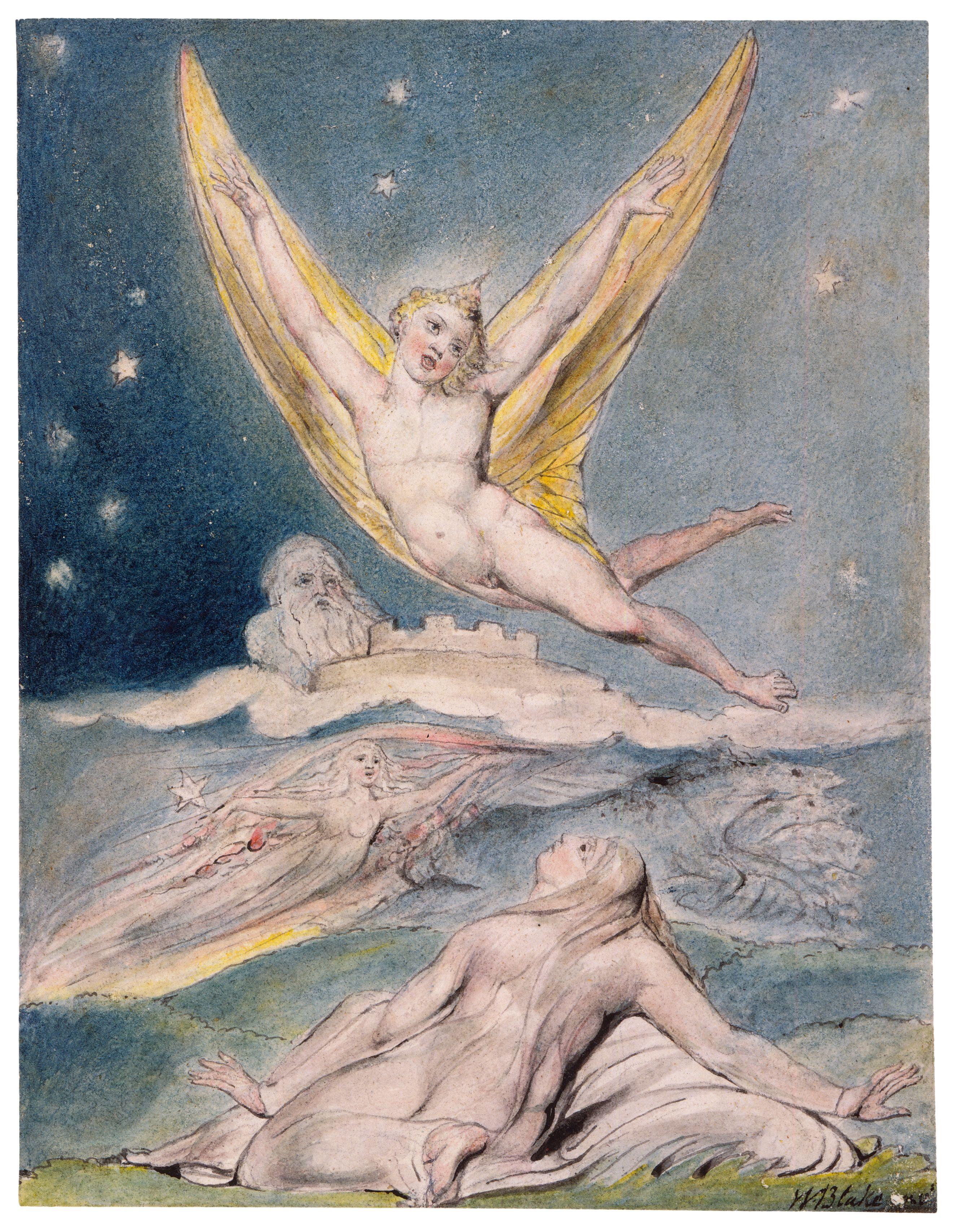
night startled by the lark - wiliam blake

night startled by the lark – wiliam blake

This week on the Influence: Mary Oliver!

I picked this poem up at work while shelving Mary Oliver’s latest book, A Thousand Mornings.  

The words stopped me as I shelved.  There is simplicity in this poem that is akin to still life painting – but a poet’s take on it.  A moment – a dying moment – as still life.

She conjures much with little.  From pearl to space to her choices in colors – all of it culminates into the hanging presence of Blake’s hearing angels singing. 

There’s not much to do once you get into this kind of moment in a poem but acknowledge it.

Blake’s relationship with the angels takes me back to being 18, sitting in Dana Levin’s Form and Theory class, her introducing a Blake poem, prefacing it by saying This guy saw angels in the trees!  

Being, again, 18, I was like – yes, of course, totally – eager to understand and see them too.

Seeing the angels in this poem is another lesson.  Oliver’s repetition in the last two couplets – their very emphasis on Blake’s words – drives home to me how all a poet can do is tell what they see, how they see it.  And all that’s needed to honor this seeing is to listen.

Happy listening!

Jose

* John Ashbery, the pit & the friday influence

Uptick – John Ashbery

We were sitting there, and

I made a joke about how

it doesn’t dovetail: time,

one minute running out

faster than the one in front

it catches up to.

That way, I said,

there can be no waste.

Waste is virtually eliminated.


To come back for a few hours to

the present subject, a painting,

looking like it was seen,

half turning around, slightly apprehensive,

but it has to pay attention

to what’s up ahead: a vision.

Therefore poetry dissolves in

brilliant moisture and reads us

to us.

A faint notion.  Too many words,

but precious.

***

This week on The Friday Influence: John Ashbery.

I continue to be stunned by what is in this poem, about time, about painting, vision, poetry.  How it all swirls on the many meanings of the word “precious” – valuable, sentimental, etc.  The conversational tone at the beginning gets the poem underway swiftly.  This intimacy tags you into the poem.  Ashbery handles heavy things lightly and gets you thinking before you catch yourself thinking.  A good poem by him can move the furniture around in the rooms of your mind.

Ashbery is one of those poets I come back to often, dip my head in to see what I can understand, and walk away when it gets to be beyond me.  He gets a bad rep for being difficult but I don’t think it is deserved.  There’s difficult for difficult’s sake.  Then there’s what you can’t help but write.  Ashbery’s best poems – and here  I mean the ones that have meant something to me as a poet/human being – show him to be always figuring something out, always trying to surprise himself (and the reader) with the poem.

Here’s a Charles Wright quote that I keep with me that taps into this idea:

The problem with all of us as we get older is that we begin writing as though we were somebody.  One should always write as if one were nobody…We should always write out of our ignorance and desire and ambition, never out of some sense of false well-being, some tinge of success.  There is no success in poetry, there is only the next inch, the next hand-hold out of the pit… *

I keep this quote with me because of the connection I feel with what it says, that feeling of writing poetry as a ongoing thing, a horizon you walk towards that grows a little farther the closer you get.  And so you keep walking, never fully arriving, never fully satisfied, but happy to be walking, wanting to see more.  There is always another poem to write.

Happy walking!

J

* Paris Review interview, The Art of Poetry No. 41