A friend of mine shared this week’s poem – “Overnight” by John Yau – printed off Poets.org’s poem-a-day series (a great resource for poetry for those unfamiliar). I had the distinct of experiencing this poem by first reading it aloud in the coffeeshop where we meet.
[If you’d like to try this out at home – which I highly recommend – scroll down and read the poem, then come back to check out my breakdown]
As I read through it, I immediately engaged with the strict, end-stopped lines. Each line hangs like a mysterious non-sequitur and blurs into the next, echoing the humor and depth found in the spirit of Paul Violi’s own work (to whom the poem is dedicated). The ambiguity in the poem evokes the “red herrings” mentioned in the poem, each line seeming to point somewhere and nowhere all at once.
 As I continued reading, I quickly began to take note that the choice to have the poem progress in couplets delayed the realization of how Yau repeats lines. About a third of the way, I realized that the poem was a pantoum (typically written in four line stanzas) in open disguise. Near simultaneously as this realization occurred, I began to be struck by the ways the repeated lines began to change the second time around. In particular, the lines, “The shield you were given as a child did not protect you” and “One by one the words leave you, even this one” swing around the second time in a surprising manner.
What I felt when I finished reading to the end of the poem is that I had just read an elegy that tangoed and fenced and pliéd around being an elegy, side-stepping direct somberness and letting the form and purposeful ambiguity of the lines emphasize mortality. As happens sometimes when I read a good poem, I had to catch my breath.
Overnight – John Yau
In memory of Paul Violi (1944-2011)
I did not realize that you were fading from sight
I don’t believe I could have helped with the transition
You most likely would have made a joke of it
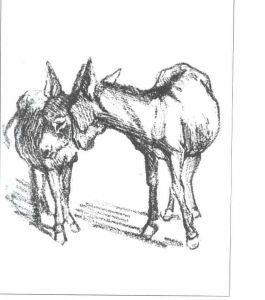
Did you hear about the two donkeys stuck in an airshaft
I don’t believe I could have helped with the transition
The doorway leading to the valleys of dust is always open
Did you hear about the two donkeys stuck in an airshaft
You might call this the first of many red herrings
The doorway leading to the valleys of dust is always open
The window overlooking the sea is part of the dream
You might call this the first of many red herrings
The shield you were given as a child did not protect you
The window overlooking the sea is part of the dream
One by one the words leave you, even this one
The shield you were given as a child did not protect you
The sword is made of air before you knew it
One by one the words leave you, even this one
I did not realize that you were fading from sight
The sword is made of air before you knew it
You most likely would have made a joke of it
*
Check out this link to read more of John Yau’s work.
 Reading Wachtel’s poem is an exercise in focus; in its own distinct fashion, the poem moves forward in its short lines with a surprising use of enjambment. While the poem’s meditation is straightforward, the enjambment draws the reader’s attention closer to the words in such a way that the meaning builds and blurs alongside the clarity of what’s being said. It’s a favorite poem of mine because the language creates exactly what the speaker fears is unattainable. Lyric glimpses like this one, of possibility and meaning, are a gift.
 The Influence