review by José Angel Araguz
from the legends of juan malo (a malologue)
~
(the birth of Guåhan)
“Guam” is now named “Guåhan,” which translates as [we] have. As in [we] have deep water and the U.S. expects [us] to home port 60% of the Pacific fleet. Or [we] have to continue supporting the Navy (one team, no seams). Or [we] have a last place ranking in annual per capita medical spending on Chamorro veterans #islandofforgottenwarriors. St Michael the Archangel, tayuyute [ham]. “Guam” is now named “Guåhan,” which translates as [we] have. As in [we] have resources for the taking. Or [we] have our customers’ needs as our first priority. Or [we] have to change our name after the Obama administration referred to the East Wing of the White House as “Guam, pleasant but powerless.” “Guam” is now named “Guåhan,” which translates as [we] have. As in [we] have many nicknames, including USS Guam, The Tip of America’s Spear, Unsinkable Aircraft Carrier, Superfortress Guam, The Trailer Park of the Pacific, America’s Gateway to Asia, and Micronesia’s Gateway to America. “Guam” is now named “Guåhan,” which translates as [we] have. As in [we] have been tricked out and targeted. Or [we] have tourism 2020 vision when setting forth a plan for the future. Or [we] have a charmingly exotic, endangered look. “Guam” is now named “Guåhan,” which translates as [we] have. As in [we] have to change our name after Mariah Carey appeared on American talk shows with a dog she got in Mexico and named “Guam” : “Here Guam, here Guam, stop hiding Guam, Guam is a good boy.” St. Roch, tayuyute [ham]. “Guam” is now named “Guåhan,” which translates as [we] have. As in [we] have many names for our people, including Chamorro, Chamoru, Tsamoru, CHamoru, Guamese, Guamesian, Guamish, Guamaniac, Guamanian, Guatemalan, Chaud, Indios, Mestizo, and Mexican. “Guam” is now named “Guåhan,” which translates as [we] have. As in [we] have serious identity issues because our original meaning has been translated as “lost.”
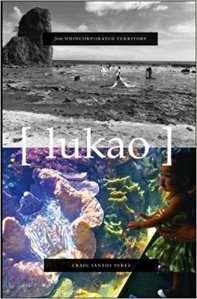
Craig Santos Perez’s from unincorporated territory [lukao] (Omnidawn, 2017) is the fourth book in his series engaging with the history, ecology, and mythology of his homeland Guåhan (Guam) and his current home, Hawai’i. Perez braids these three themes via a variety of poetic modes, making use of the news articles, interviews, and other sources to create a text that gives space to a variety of voices. In fact, voice is at the heart of this collection; whether drawing from his personal experience or making use of a persona as in the poem above, Perez brings an urgency into the voice of each sequence, marking them as political in a way that honors the personal.
This balance is further achieved by the inclusion of a “Sources & Additional Materials” link at the end of the book, a resource that emphasizes the importance of the project as well as its presence beyond the page. A note in this resource informs the reader that:
—Juan Malo is a young, poor Chamorro man who lived in Guåhan during Spanish colonial occupation. His mischievous adventures (reminiscent of other indigenous tricksters) involved outwitting the Spanish governor and other officials with the help of his carabao (water buffalo). In Spanish, malo means bad.
With this framework in mind, one can see the “from the legends of juan malo” series of poems as Perez placing the subversive and fluid energy of the trickster persona at the service of that other equally fluid and subversive entity, human language. In “(the birth of Guåhan),” there is a charged insistence in the repetition of the phrase: “Guam” is now named “Guåhan,” which translates as [we] have. This insistence engages with the plasticity of sound as well as meaning. As the prose poem develops, the juxtaposition of historical facts about Guåhan against Juan Malo’s faux-playful tone works to keep the reader unsettled while simultaneously informing them and keeping them close. One feels the political tug-of-war reflected in Guåhan’s history played out via this poetic insistence. Through the repetition of “tayuyute [ham]” (“pray for us”), however, the poem maintains a human charge as well.
Along with this flavor of intertextuality, Perez also creates “poemaps” which depict such things as the use of toxic chemicals in Guåhan as well as the island’s role in global communication via having more communication cables routed through the land than Hawai’i or California. Like the use and riffing against historical facts in the poem above, the visual subversion in these poemaps work to evoke from the reader an awareness that is only half an awareness. Because this is a book of poems and not a history or anthropology book, there is a sense of being invited into the factual world these poems spring from, but also of being asked to dwell in the complexity of what these facts mean beyond themselves. This unsettled mode is more fruitful than aggressive. More to the point, the book’s multivalent poetic approach demands a multivalent reading. One of the accomplishments of Perez’s project is that it presents its concerns on its own terms.
The reason for such an approach becomes palpable in such moments as this one, drawn from “ginen organic acts“:
as a patgon : child, i never heard the creation story of our first mother, fu’una (whose name translates as first), or our first father, puntan (whose name translates as coconut sapling) // grandma always said “in the beginning was the word and the word was god
her fingers erode
rosary beads // waves erode
coasts \\ words erode
silence
Here, a childhood memory is rendered through a hybridity of form and language. The move from prose to poetic lines evokes the move from memory’s necessarily patchy connection to a moment of focus and understanding. The stanza above drives home the theme of language being subversive and difficult; because language is fluid, it is capable of eroding the meaning it creates. The use of slashes in both directions in the stanza above evokes the waves described while at the same time implying the breaks in meaning this moment represents.
Yet, from these breaks in meaning, further understanding can be wrought. This seems to be the hope of Perez’s book. Nowhere is this hope more evident than in the sequence of poems dedicated to the birth of his daughter. “(first teeth)” (below) renders a scene of his daughter (addressed as [neni] in the poem; the mother is addressed as [you]) during teething. Because even parenthood doesn’t happen in a vacuum, Perez’s poem weaves recent incidents of violence into an ode to what matters most for this poet and this book of poems: life.
from ginen understory
(first teeth)
~
[neni] cries from teething // how do parents
comfort a kid in pain, bullied in school, shot
by a power drunk cop #justiceforkollinelderts
\\ [you] gently massage her gums with your
fingers // count how many children killed in gaza
this hour of siege \\ how do [we] wipe away tear
-gas and blood, provide shelter from snipers,
disarm occupying armies #freepalestine //
[you] recite the hawaiian alphabet song
to [neni] \\ what lullabies echo inside detention
centers and traverse teething borders to soothe
thousands of youth atop la bestia #unaccompanied //
[you] rub her back warm with coconut oil
\\ how do [we] hold violence at arm’s length
when raising our hands up is no longer
a sign of surrender #blacklivesmatter //
[neni] falls asleep in your cradling arms,
skin to skin, against the news \\ how will [we]
teach her to safely cross any body of wter
by believing in her own breath #
*
Influence Question: How would you say this collection reflects your idea of what poetry is/can be?
Craig Santos Perez: To me, poetry is an art form through which I can express my thoughts and emotions about culture, identity, place, the environment, history, and politics. Poetry can capture the deeper meanings of life, expose injustice and inequality, and articulate decolonial and sustainable futures. I believe poetry can educate, inspire, and empower people, as well as dignify and humanize people who have often been denied our dignity and human rights. This new collection, and all my books, are grounded in these foundational beliefs about the power of poetry.
In terms of form, I believe poetry is a dynamic art that can bring together poetry and prose, the visual and the virtual, the real and the fictional. Throughout my work, I interweave narrative, lyric, epic, prose, collage, imagistic, and avant-garde forms/techniques to create a complex and fragmented basket of words. To me, this makes the work multi-formalist and polyphonic.
Influence Question: What were the challenges in writing these poems and how did you work through them?
Craig Santos Perez: One challenge was finding a way to arrange the diverse forms, techniques, and subject matter into a harmonic composition. As fragmented and indeterminate as my work is, I always try to counterpoint with access points symmetry. My other challenge was how to bring together in a compelling way the different discourse of history, politics, environmentalism, culture, memory, and personal experiences. To work through these issues, I revise extensively, and I also experiment with various orderings and “maps” of contents.
*
Special thanks to Dr. Craig Santos Perez for participating! To find out more about his work, check out his site. from unincorporated territory [lukao] can be puchased from Omnidawn.
 Craig Santos Perez is a native Chamoru from the Pacific Island of Guåhan (Guam). He is the co-founder of Ala Press, co-editor of three anthologies of Pacific literature, and the author of four poetry collections. He has been the recipient of the PEN Center USA Literary Award and the American Book Award, as well as fellowships from the Lannan Foundation and the Ford Foundation. He is an Associate Professor in the English Department at the University of Hawai’i, Manoa, where he teaches creative writing and eco-poetry.
 Special thanks to Kelly Davio for participating! To find out more about her work, check out
  The Influence