microreview: Slingshot by Cyrée Jarelle Johnson

review by José Angel Araguz
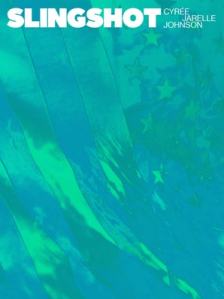
SLINGSHOT

There’s a moment toward the end of the sequence “a machine of mahogany and bronze I” in Cyrée Jarelle Johnson’s debut poetry collection Slingshot (Nightboat Books) where, in the aftermath of a protest demonstration broken up by police brutality, the speaker is asked “You heard about the storm comin’?” which prompts them to meditate on:

The same storm slicing
through every inch of armor
my binder becoming more unbearable as the sun sets.

Yes. I knew about the storm coming.

This admission coming when it does at a moment of reflection and recovery is charged with an awareness that the literal storm of the poem runs parallel to the metaphorical storm of the political moment they are living in. The articulation of this awareness, here and elsewhere, is tinged not with resignation but resolve. This mix of awareness and resolve runs through this collection in stunning and complicated ways.

Whether awareness and resolve play out in expressions of self-presence, as in “false sonnet embroidered w/ four loko empties” which opens the collection and whose ending states: “I’m a full grown / whatever-the-fuck, and I will devour any / attempt to subdue me with monstrous animality,” or in poems troubling current staples of pop culture (as in the poems “a review of Hamilton: An American Musical” and “chewbacca was the blackest part of The Force Awakens“), Johnson enacts a lyric presence that engages through juxtaposition of tone and phrasing. In “chewbacca,” for example, the speaker riffs on the Star Wars mythos, braiding in commentary about race like “When we colonize the stars, everyone will be beige, / white folks sometimes say, or orange” and placing them next to others like “Chewbacca was the blackest part of The Force / Awakens. Always moaning & never understood. Always hunted & never going home.” This braiding makes the speculative nature of science fiction all the more human while also interrogating the implications of George Lucas’ vision. The projection of blackness onto the Chewbacca narrative, which is one of survival, parallels that of the speaker who shares at the end, “…I am just too tired. Too vengeful to go anywhere anymore.” This statement’s honesty is a surprise as it comes at the end of a poem that strips away much of the fiction of the film in order to get at the deeper implications for the speaker.

Awareness and resolve in the service of self-revelation, ultimately, is where Slingshot lives. My sense, though, is that Johnson would have readers be mindful of the difference between self-revelation and traditional ideas of confession in poetry. While the poems evoke the trials and tribulations of sex work and the intersections of being black, disabled, femme, and genderqueer, these poems work toward a visceral clarity. Rather than hold the reader’s hand and explain the complexities of the world they’re drawn from, these poems present themselves on their own terms and trust the reader to keep up. It is in this aspect that the poems point back to the title, in a way, each one a stone shot out to strike at the consciousness who hears it.

To return to the sequence “a machine of mahogany and bronze I”: The line “we will hold the line as a practice of freedom” is said by the speaker mid-protest. This collection shows Johnson holding the poetic line in a myriad of ways that open up the nuances of awareness and resolve. In the poem below, “jersey fems in the philly zoo,” this work is done through image and imagination, each surrealistic turn interrupted by a harsh reality. By the end, it’s clear that fear is one of the many things Johnson holds the line against.

Cyrée Jarelle Johnson
jersey fems in the philly zoo

a flamingo knows,
even without pink lipstick,
fem is a feeling.

black boots. Raritan
tap water memories flow.
murderous brown geese

fly from Johnson Park,
arrive, then turn up their beaks
‘fuck dis sposta be?’

they inquire. I
find cover in the leopard
print fem next to me

because here, always
someone’s looking, someone’s stares
caught in plexiglass

refracting the light
in your life. no. it’s not you.
they look to consume.

especially spring,
and when the ice cream melts
before it’s lapped up.

Philadelphia
is lilac and lightning strike
before a great storm.

electric strangers
cuff biceps unexpected
back draws straight — horror.

they look to consume.
they desire to control.
predatory birds;

eagles, owls, all.
swooping down with catching claws,
no glass to hide you.

I want my armor
an exoskeleton, tough
hewn of crushed velvet

bristling with defense
a kevlar of tenderness
enveloping me.

this is what happens
when the tree blooms: the axeman
runs to chop it down.

this is what happens
when creatures meant for the deep
somehow crawl ashore:

they will be lapped up
by the hot eyes of the sea
pulled tight by strange hands

knives licking their necks
the scent of wisteria
fireworks: flash/bang.

flash fire, roll flame
clip wings from those who maim us
declaw them all, bare.

maybe they will burn
corralled, while lights dance in sky.
steaming macho ash.

and if they must live
then make me invisible.
hide me. erase me.

*

To learn more about Cyrée Jarelle Johnson’s work, visit their site.
To read an interview with Johnson where they discuss the poem above and Slingshot in general, go here.
Copies of Slingshot can be purchased from Nightboat Books.

microreview & interview: Zoom by Susan Lewis

review by José Angel Araguz

susan lewis zoom

In a recent conversation about prose poetry, I found myself tasked with defining what makes a prose poem “poetry” exactly. I fell back on my usual starting point, some riffing on Charles Simic’s idea shared in an interview that “[what] makes them poems is that they are self- contained, and once you read one you have to go back and start reading it again. That’s what a poem does.” What’s great about this quote is that it connects the reading act to the act of rereading, highlighting poetry’s ability to get things said in unique, memorable ways. I say “memorable” here, and feel the need to qualify it as not immediately memorable. That is to say, a phrasing’s distinction comes from the push-pull effect of being familiar enough to make sense, but unique enough to stand out and make us pause.

This movement between familiarity and distinction is one of the driving engines of Susan Lewis’ recent collection, Zoom (The Word Works, 2018). While the collection’s title brings to mind the film technique of zooming in, I find it also applies in terms of speed, in this case, the varying speeds of the reading act. This read on the title is invited, in a way, by the choice of having the individual titles in the collection be the first words of the poems. By having the poem begin with the title, the voice of the poem is engaged from the first words interacted. The opening poem, “Everyone Agreed,” executes this move in a self-revealing way:

Everyone Agreed

this was a thrilling catastrophe. There were the usual photo-ops & spell-checked swoons. Octopeds got the jump on the rest of us, but their webs were useless against the suck. Spare fur was exchanged for sexual favors until the water fermented and all hell broke loose. No one remembered to access their 20:20 hindsight until the razor light blinded us with its odor of inferiority. There was anger and danger beyond our wildest dreams, which stopped coming once the humdrum imploded, divesting us of our history & its discontents.

As I mentioned, having the title be the first words of a poem means the voice is there at the start of the reading act. This move creates an immediacy that propels the reader into the “thrilling catastrophe” of the poetic act. This momentum is then interrupted by Lewis’ choices in diction. The phrasing of “There were the usual photo-ops & spell-checked swoons,” for example, causes a reader to pause; the sentence is structured as a traditional sentence, but the meaning of “spell-checked swoons” causes one to pause and wonder. Yet, the decision to structure this phrase within a prose poem, which builds off the familiarity of the traditional sentence and paragraph, forces the pause to be brief. Were this poem broken into lines, the reader would be given the handhold of line break and stanza break which invite dwelling. Here, the poem marches on through the sense of a paragraph. One reads the rest of the poem propelled by this push-pull effect.

Depending on the reader, one could say that the poems of this collection are read at the mercy of this push-pull effect. Taking this perspective, however, would be to miss out on the rich difficulty available in this lane of poetry, a poetry whose linguistic ambition is to evoke through active sense-making and unmaking. The American tradition of richly difficult poetry runs from Gertrude Stein’s tender buttons to the contemporary lyrically ambitious work J. Michael Martinez. What Lewis adds to the conversation via Zoom is a sequence of poems whose fragmented sensibility become a ride where one catches glimmers of meaning tinged with gloom.

The poem “Dear Sir” continues this work of moving between familiar and distinct phrasing:

Dear Sir

or Madam, until you lose your head, mother its shred, wrapped in mystery & mead. No levity for this, your skid life. No mercy while you bilk your betters, sent flying to spy on your attempts to rise. Across the deep there are many with nary a hook to hang on. & ever & anon those lads with rainbow limbs snaking through the gloom. Another day another dolor. Not to mince woulds, but this sibilance is skilling us. & you who wish upon a stare? Where would you turn & fleetly tumble? The Burning Dervish never knows whereof he’d speak, mute as he is, spinning in his vicious circle, boring his whole through our dank & dappled gaps.

Here, idioms are approached and transformed, refreshed in a way that moves away from the typical reproach one finds in poems. Rather than turn a phrase for some argument or rhetorical stance, the transformation is executed with blunt power. For example, “Another day another dolor” is set as its own sentence, able to color both the previous and following sentence, but also standing as its own moment of distinction. This decision to let the new phrasing stand alone allows the original aphorism “Another day another dollar” to ring like an echo in the reader’s mind. Before one can fully unpack that, however, the prose paragraph structure moves the poem on to “Not to mince woulds, but this sibilance is skilling us,” another set of turns that invite both pause and movement. What is being worked out in this kind of difficulty is a poetry that points elsewhere than itself. The poem’s ending image of a dervish in a trance is telling, evoking a desire for spirituality through activity.

From the sight rhyme of “anger and danger” and the reference to Freud in the phrase “our history & its discontents” (“Everyone Agreed”), to the riffing and subverting of idiomatic phrasing (“Dear Sir”), what these poems offer is an engaged reading act where meaning is only part of the purpose. If narrative poems keep poetry connected to traditions of storytelling, then richly difficult poems like these keep poetry connected to traditions of the lyric voice, that personal, intimate, and engaged perspective whose presence alone gives it purpose and power.

*

Influence Question: What were the origins of this collection?

Susan Lewis: José, thank you so much for your interest in Zoom! The origins of this collection go back to my years-long interest in the prose poem, combined with another interest of mine, which happened to develop at the same time: in poetry as play – which is not, in my mind, inconsistent with addressing dark or serious concerns. One of the things I find interesting is how much play the prose poem allows! I’m drawn to the paradox of this form: poetry that is not lineated, that is, does not advertise itself as poetry. I love the tension this holds – the demand that the reader look beyond the obvious, and engage with what might make poetry be poetry. (A question I think is more important than any particular answer one might suggest). Writing prose poems has only deepened my love for the form: the concentrated punch of a discrete bloc of words floating in a white page; the implication that substantial things come in small packages; the impression these blocs give, of density and compression; the focused attention they ask of the reader.

However, I did not set out, ab initio, to write a book-length project, or suite. It was interesting: after writing some number of what I thought of as free-standing poems, their common concerns started to become apparent, and began guiding the development and features of the rest of the poems in the book. Some of these preoccupations are packed into the title, with its nod towards film technique, as well as velocity. Organized around the substantive and aesthetic potency of point of view, the poems in Zoom borrow from film technique to ‘zoom in’ from the objective/long shot/third person, to the medium shot/second person, to the subjective/close up/first person. All engage the ramifications of subjectivity via bricolage, parataxis, polysemy, and compression. I think of the collection as adding up to a kind of status report for our moment in this world, in which the frame narrows along with the point of view, from the global to the local to the individual. Especially concerned with the need for, and failure of, empathy and decency, as well as with how we perceive and communicate, these poems also amount to a progress report on the state of language itself. The consensus among these poems is that we’re zooming – if not to our doom, than to the brink, where we might still be able to stop ourselves from irreparably despoiling our psyches and our planet.

*

Special thanks to Susan Lewis for participating! To learn more about Lewis’ work, check out her site. Copies of Zoom can be purchased from The Word Works.


SONY DSC*

Susan Lewis (www.susanlewis.net) is the author of Zoom, winner of the Washington Prize, as well as nine other books and chapbooks, including Heisenberg’s Salon and This Visit. Her work has appeared in a number of anthologies, including They Said (Black Lawrence Press, 2018), Resist Much, Obey Little (Dispatches Editions, 2017), and Carrying the Branch (Glass Lyre Press, 2018), as well as in journals such as Agni, Boston Review, The Brooklyn Rail, Web Conjunctions, Diode, Interim, New American Writing, The New Orleans Review, Raritan, Seneca Review, Verse, VOLT, and Verse Daily. She is the founding editor of Posit (www.positjournal.com).