review by José Angel Araguz
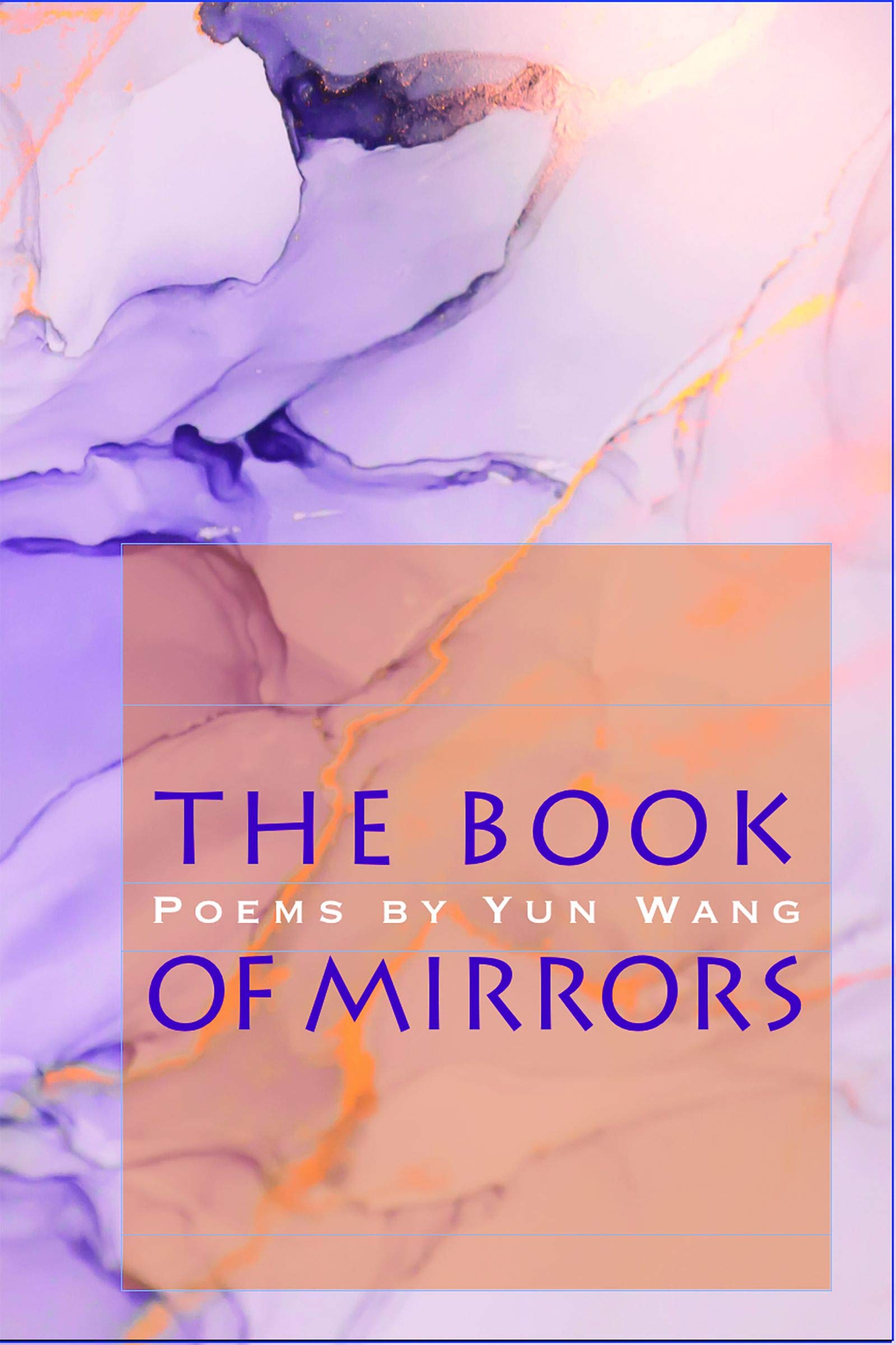
Reading through The Book of Mirrors (Winner of the Twenty-Sixth White Pine Press Poetry Prize, 2021) by Yun Wang, I find myself marveling again and again at her facility with the poetic image. Across poems ranging in theme from feminism, dreams, literary figures, motherhood, and the universe, Wang’s use of the image is nothing short of illuminating while also being instructive. Note how even in this one line from “Sapphire” creates a whole world:
White swans in flight dissolve into a dark sea punctured by stars.
This inversion of color in the move from “white swans” to “dark sea” is masterful and moves imagery beyond mere description. Across the collection’s four sections, Wang incorporates images to suggest, provoke, interrogate, narrate, and elegize the experiences of living in a world where one only has what they can sense and intuit to guide them forward. A good example can be seen in the short lyric “Regret”:
If I were a tree
I would never have shed
all my leaves
for the caress of sunsetand stepped naked
into that moonless
starless nightA trap embraced me
I had no voice
Here, the logic and mutability implied by the word “If” is pursued through descriptions of tree life, a move that juxtaposes the experiences of tree and being human. Through this proximity, tree and human are seen in stark contrast while also embodying distinct vulnerabilities. The poem implies that while the fixed and voiceless tree would naturally be thought of as the more vulnerable of the two, it is the human decisions made by the speaker that have left her, ultimately, “trapped” with “no voice” despite having one. One feels distinctly the weight of the title and how much of it stems from conscious human awareness and human error.
A similar interrogative use of image and binaries can be seen at work in “The Mirror’s Edge.” In this poem, the reader is presented with the narrative of a woman who:
slept with a bear to relieve herself of the burden of purity
to travel the world alone with only a backpack.
The poem develops its narrative, one where the woman is subjugated, and as it does the bear/lover is described more and more in terms of a human man, until the final stanza where we’re told:
Bears do not turn into handsome princes. He turned into a half bald man with a leather bound journal, in which he noted her various imperfections.
The poem’s opening logic of a woman sleeping with a bear already implies a sense of transition, and because the poem alternates between couplets and single imagistic lines (lines such as “White petals were trampled into mud” which precedes the above closing stanza) the idea of transition is already in our minds. This layered sense of transition, then, sets us up for this final transition of bear to man, and of human desire to scrutiny and emotional abuse.
The theme of lovers continues throughout the second section of the collection, imagery playing a role in engaging with figures such as Romeo and Juliet, Frida Kahlo and Diego Rivera. The collection moves into its third section engaged further with the blurred lines of history and storytelling, as evident in “The Visitation”:
The doctor said it was nerve disorder
that caused noises in the ears
Schumann listened and went madThe voices chose him because of his music
A thousand fairies dancing in shoes of flameIt created a riot in their world
They wanted him to stopThey came through the piano’s
black and white doors
They stitched his mind into a maze
Here, we see image as a fabulistic engine. Through the choice of fantastical imagery, Wang is able to juxtapose the history of Schumann with the story and world implied by his music. Yet another binary, it is one that startles and presents a human experience beyond fact. There is also the moving “Children’s Game in Baghdad,” inspired by a news story:
A small boy jumped off corpses for fun. He explained to his mother that they were nothing. Dogs ate them. She told him that every dead man had a mother waiting for him to come home. He fell asleep in her arms.
The sun bled into charred gum trees.
She brought him to work. Photographed the green zone for a newspaper. A bomb sprayed them with shrapnel. She couldn’t stop shaking. He said it’s OK, not his first bomb. His school was shelled the week before.
Once upon a time rose petals rained down.
She couldn’t stop thinking of his lack of feelings. He whispered that all his friends jumped off dead bodies. In her dream, her husband handed her the Sumerian tablet he died protecting. The cuneiforms shifted into a pair of wings.
Here, one can see the use of image doing the work of empathy and reconciliation in the face of recent history’s irreconcilable atrocities. Housed in prose, this poem’s formal shape is that of information, of narrative, no line breaks to interrupt or fancify the narrative. The human content of the story, a mother trying to understand her son, is also straightforward. The inhuman content–war and its human damages–stands between what would be a straightforward act of empathy. The mother and son speak across the distance of different interpretations of the same experiences and facts. Image comes into play not to close the distance to shine light on it. The way, for example, the bomb exploding in the third stanza is followed by the standalone image “Once upon a time rose petals rained down” evokes a stunning image parallel to the shrapnel from the bomb while striking an emotional chord of loss and grief, feelings that both characters in the poem are unable to express. The image here is showing us the limits of the human capacity to reconcile everything the world shows us, while at the same time serving as a space where this limitation can be honored. That the closing image of a tablet whose “cuneiforms shifted into a pair of wings” happens in a dream is telling; even in dreams, another space where one’s capacity for reconciliation and understanding is tested, the only answer–and here I mean answer not as solution but more response to a call–is image.
In the collection’s final section, the speaker of these poems engages the theme of family. It is here where Wang’s use of imagery is put to, perhaps, its most reaffirming purpose, hope. In a series of poems about her son, Wang gifts us with the part spell, part prayer of “Supermoon”:
Pearl eye of the cloud dragon
kindles pink lanterns on the orchid treeMy son’s arms around me
In a beam of liquid lightWe are immortals to mayflies
Let this be enough
In these six lines lies the pulse of this collection. The opening couplet’s vivid imagery is active, the image of one line “kindles” the image of the next. Then the second couplet brings together human and nature, binds them in image. Then the voice of the final couplet strides forth to the brink of what can be expressed–that while our life feels fleeting to us, to other creatures we may appear “immortals”–before expressing that “this be enough.” In the rich worlds presented in The Book of Mirrors, this final conviction of hope is more than enough.
Question: How would you say this collection reflects your idea of what poetry is/can be?
Yun Wang: This collection reflects my idea of poetry as a unique way of perceiving reality and interacting with the world. It’s a mode of existence so essential to me that I would find life meaningless without it.
I grew up breathing poetry — my father recited ancient Chinese poems to me to calm me when I cried as a baby. We were poor, and my father was a persecuted political dissident who was banished and seldom came home. Fortunately, however, our humble home was located in a breathtakingly beautiful place, surrounded by blue mountains, on a rural plain green with crops and a crystal river running across it.
When I was a child, I went running on a path by the river each dawn. One morning, I was mesmerized by the clouds blooming from the mountains, the mist rising from the river, and the open green field shimmering with early light. I composed my very first poem in my head, in the ancient style. I was twelve. I think I became me that moment. A lot has happened since then, but I remain that child who connected with nature, and nature made her a poet, changing her forever.
Question: There seems to be a distinct conversation happening through your engagement with the image. What would you say is your relationship with the image?
A new poem usually begins as an image to me, an image so compelling that it haunts me, drawing me into it, in which I find an irresistible narrative, or even an entire lifetime unimagined before. The image sometimes comes from nature, as an epiphany when everything snaps into focus, and I can suddenly see beyond the confines of space and time. Sometimes it’s a mental image, which somehow has occupied my mind, and refuses to go away until I address it by writing the poem, which excavates its hidden emotions and makes sense of its larger meaning.
I am also a dreamer who has very vivid dreams, some of which have ended up in my poems. I interpret my dreams based on my own intuition, trying to explain them somehow. This may have something to do with my training as a scientist. I like searching for answers, and finding solutions to seemly impossible problems. In poetry, this makes me adventurous in exploring an alternative level of existence, one that transcends life, yet is a mirror of it.
Perhaps I see an image as a mirror, in which there is always something new and even exhilarating, if I dare to look, and keep on looking until it makes sense. I insist that my poems make sense, at least on some level. This again has to do with my dual identity as poet and scientist.
Special thanks to Yun Wang for participating! To keep up with Yun’s work, check out her Author Central page. Copies of The Book of Mirrors can be purchased from Amazon.

Yun Wang is the author of poetry books The Book of Mirrors (Winner of the Twenty-Sixth White Pine Press Poetry Prize, 2021), The Book of Totality (Salmon Poetry Press, 2015), The Book of Jade (Winner of the 15th Nicholas Roerich Poetry Prize, Story Line Press, 2002), and the book of poetry translations, Dreaming of Fallen Blossoms: Tune Poems of Su Dong-Po (White Pine Press, 2019). Wang’s poems have been published in numerous literary journals, including The Kenyon Review, Prairie Schooner, Salamander Magazine, Cimarron Review, Valparaiso Poetry Review, Green Mountains Review, and International Quarterly. Wang is an astrophysicist at California Institute of Technology, currently focusing on developing NASA space missions to explore the Universe.

 The Influence