microreview: Year of the Murder Hornet by Tina Cane

review by José Angel Araguz
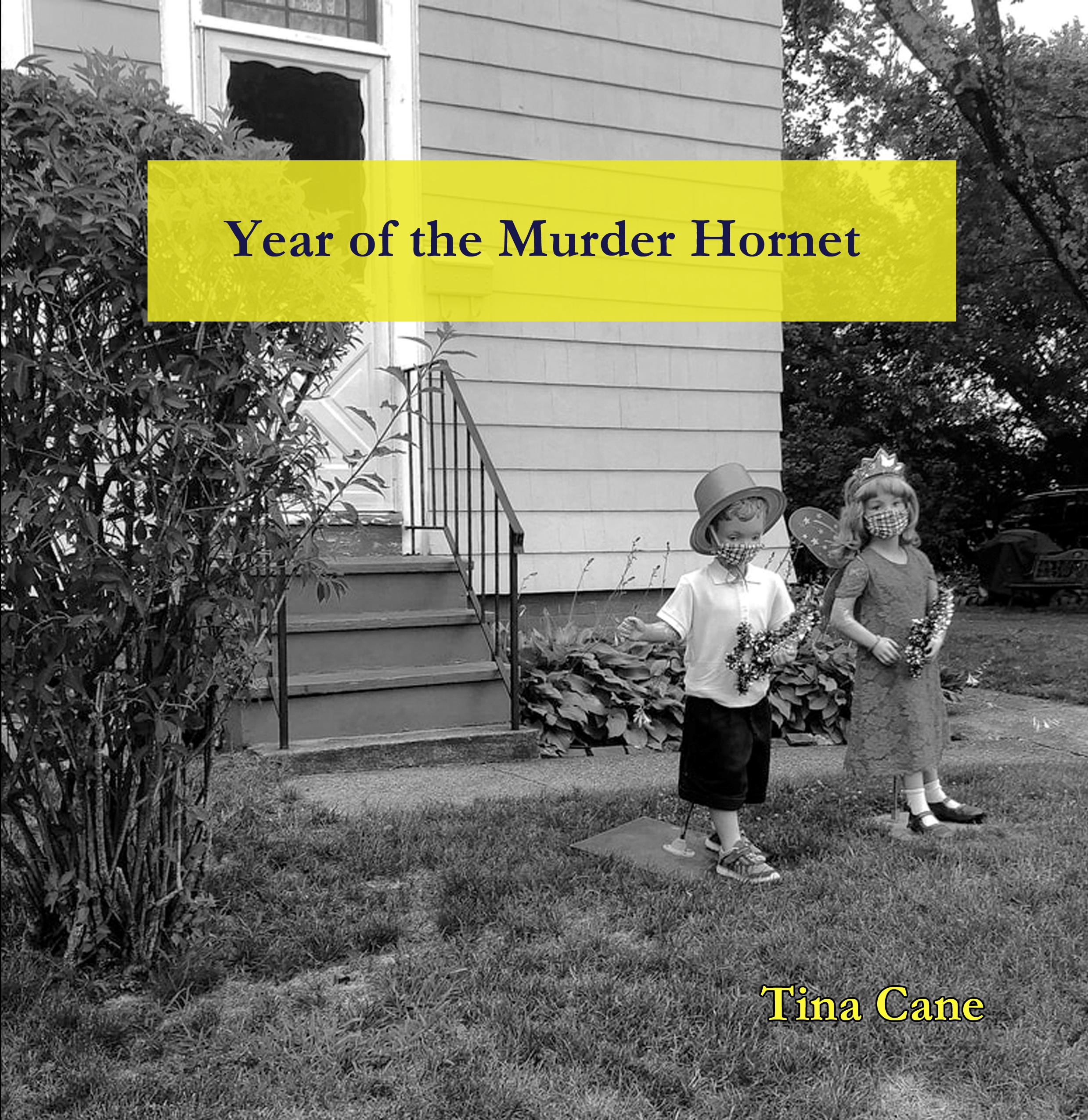
As the pandemic continues being an ongoing, consistent crisis killing 4,000 people a week in this country* — this despite the current administration’s plan to call an end to it as a health emergency — it feels more urgent than ever to honor and bring attention to work that lives up to poetry’s possibilities as archive of our present moment and lived experience.

Enter Tina Cane’s Year of the Murder Hornet (Veliz Books, 2022). This poetry collection is a dynamic enterprise. Cane’s distinct vision in this project is executed through poems and formal choices that reflect a disjointed, urgent reality.

The poem “Shelter in Place,” for example, begins:

Schools are shuttered     everything is cancelled       and my body has become     
an extension of my house      this shift is strange       but not entirely unfamiliar

Here, Cane’s engagement with the pandemic as subject matter moves it from the headlines and statistics that framed our lives at the start of the pandemic and brings it into the house and the body. This choice to ground the poem in the “strange” aspects of the moment conveys how it is “not entirely unfamiliar.” The pandemic has us reassessing and rethinking our lives, from our societal understanding of the systemic oppression felt across class, race, sexuality, and ability to the way we live our day to day lives. “as the architects of our days,” the poem posits at the end, “[our] nature will continue    to amaze us    in ways we don’t expect.” This closing underscores the sense of autonomy troubled by the uncertainty we continue to live under.

Throughout my reading of Year of the Murder Hornet I kept marveling over Cane’s ability to linger over the spaces in between things. Specifically, the choice to include additional white space within the lines of each poem emphasizes both how stalled shifts in the pandemic can make us feel as well as how necessary it is to take our time. By take our time I mean in terms of reading the situation — whether it be assessing what the reality behind phrases like “the new normal” actually is like, to preparing (mentally, physically) for the changes brought on by decisions at our jobs or by the government which we have no say in.

The poems “Essay on Gentrification” and “Minority Report” also work in this vein and are good examples of how this collection takes its time interrogating the nuances of life during a pandemic, nuances that are often lost in debates and political discourse.

This collection also includes the sequence “What We Talk About When We Talk About Paths: A Narrative in Captions,” a deviation from the formal choices in the poems discussed so far (an excerpt can be read here). In the physical collection, this poem lives in the middle of the page, a rectangle path of words that catalogues captions from social media and brings them into a poetic space. This sequence is striking for the way it allows this list of captions to establish presence, a presence similar to what is achieved in our use of social media.

In the end, presence is what matters: that we are still here present, that we acknowledge, mourn, and celebrate those no longer physically present. This sense of mortality charges the edges of each poem in this collection as much as it influences the decisions of those in power. The gift that Tina Cane has given us in Year of the Murder Hornet is a sense of who we were, while the poems themselves remind us of who we are and could be.

*

Copies of Year of the Murder Hornet can be purchased from Veliz Books.

*For those looking for trustworthy, transparent information on the pandemic, I encourage y’all to check out the People’s CDC website.

microreview: Villainy by Andrea Abi-Karam

review by José Angel Araguz

Book cover for Villainy by Andrea Abi-Karam.

“Bodies fray at their limits. At their limits, they become indistinguishable.”

Tiqqun

This quote from Tiqqun “a French-Italian ultra-left anarchist philosophical journal or zine, produced in two issues from 1999 to 2001” is one of four quotes that open Andrea Abi-Karam‘s Villainy (Nightboat Books) and also the most telling one. Telling because–as this collection was written in the wake of the 2016 Ghost Ship warehouse fire and the 2017 Muslim ban–this book is about navigating grief as much as about being present in a marginalized existence. The bulk of this collection is comprised of lyric sequences that critique capitalism, fascism, colonialism, and racism with a vulnerability and awareness that is palpable.

Palpable: what else to call poems with lines such as “I RUB MESSAGES INTO THE WALL B/C I KNOW / SOMEDAY I WILL BE DELETED.” The urgency implied in the typographical choice to use all caps (here and consistently throughout the collection) brings with it the implication of presence. Words in all caps are emphasized, given more presence before the eye. Such emphasis and presence are more often associated with brand slogans, protest signs, even text messages–a set of seemingly incongruent examples that yet are totally in line with the world interrogated by Abi-Karam. Only that these are poems, and the poetic space is flexible enough to hold a human pulse despite these implications, and resilient enough push back, to voice and be a voice.

This voice persists despite the mortality and the risk of “indistinguishability” implied in the Tiqqun quote (its words as much as the Tiqqun name, as the writings published in the journal were written by a number of different people but all published under the anonymous moniker of Tiqqun). This idea of the collective, the crowd, is engaged with throughout Villainy. Crowds are here in the tragic fire being elegized; in the riots and street protests that are described; and in the spaces of queer community and building.

Reading this collection, one senses the need to risk becoming indistinguishable because of the fraying that happens at the body’s limits. The oppressive forces that push bodies to these limits are a kind of death, so, in pushing back on those forces one is pushing back on death as well. The power inherent in this thinking can be seen in these lines from “Small / Medium / Lust”:

the problem is
when u get arrested
with an X on yr id card
where do they put u?
actually
the problem is prisons
what if instead of collecting separate lonely individualities
we set them free 2 sink back into the collective

Here, the first four lines depict a dehumanizing scenario that nonbinary individuals have to face, that of standing out from the binary system in which people are processed and imprisoned. The following four lines continue on the theme of dehumanization by placing it as a problem inherent in prisons themselves. By reframing prisons as places populated by “separate lonely individualities” a little more humanity is imbued on these individualities. The last line’s use of the word “collective” further humanizes them, reframing the word in the process. This nod to prison abolition is in keeping with the politics of the collection and also underscores the ways in which Abi-Karam would have us thinking about the collective in society.

I used the word “risk” above more in a conceptual way, as the lived experience is different from what is implied. Within a marginalized existence, one doesn’t have the privilege to take risks; it can’t be called a risk if there is no other choice available to one. While I speak in the conceptual here, those who exist in the margins read the real world implications of what I am stating here. That it is not a choice to go homeless when capitalism shows your labor (and, consequently, your life) as being “expendable.” When a queer individual is attacked merely for existing in public, they have not made a choice and assumed a risk–they are just existing, and, in the mind of the oppressor, have been deemed not an individual but a signifier for something they hate. In these hurtful ways, society abuses the idea of the collective by using it to take away an individual’s humanity.

Reimagining political poetry in the 21st century is long overdue. Long overdue is the communal act of redefining what it means beyond the old arguments: on one side, the privilege of those who can make a distinction (or at least think they can make a distinction) to not write politically, and, on the other side, the very real circumstances of the marginalized communities who cannot do anything but be political (again, no choice).

It could be that in the 21st century the political poem is something that does not need to be defined because it is the standard. As the world devolves under a global pandemic framed by the persistent oppression and ecological destruction inherent in racist, capitalist structures, political poetry is evolving. Collections like Claudia Rankine’s Citizen, Cyrée Jarelle Johnson’s Slingshot, and now Villainy show us the ways in which the lyric can interrogate and speak to our collective mortality while honoring our individual imaginations and existences.

*

Copies of Villainy can be purchased from Nightboat Books.