* w. s. merwin & the friday influence

Dusk in Winter – W. S. Merwin

The sun sets in the cold without friends
Without reproaches after all it has done for us
It goes down believing in nothing
When it has gone I hear the stream running after it
It has brought its flute it is a long way

***

 This week on the Influence: W. S. Merwin!

What I love about Merwin’s poem above is how he gets in so much into a few lines.  Not only the brevity but the subject matter.

We are told that the best novels throughout history deal namely with family/love relationships, that there is so much to said within those frames of humanity.  Equally, poems are said to be about either love, life, or death.

What the stock objects – rain, leaves turning colors, rivers flowing, waiting in line at a grocery store – serve are to open up something everyone can identify with while following along with the poet to see how it is they see it.

That personal take on things – whether it is evoked in turns of phrase or particular images and narrative – is the fingerprint on the poem, the echo of the soul passing through the words (through the world, through the reader), what it is that teaches and awes in a poem.  It is the hardest thing to achieve: singularity, an indelible presence.

Merwin’s work in translation (his Neruda’s Twenty Love Poems has been the standard for years) comes through here in the way he turns a sunset into a fable of sorts, works the images down into the emotions they evoke.  The starkness created by not having punctuation cues me in as a reader to engage with the poem, to follow the logic of the phrasing as it unfolds, each turn a little surprise along the way.

***
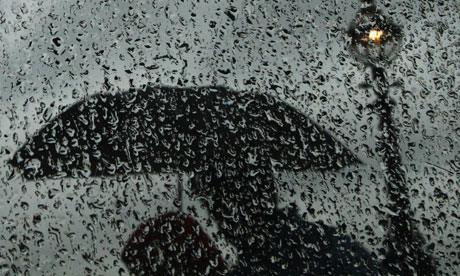
rains, yo

The rainy season has officially begun here in Eugene.  In honor, here’s one more by Merwin:

To the Rain – W. S. Merwin

You reach me out of the age of the air
clear
falling toward me
each one new
if any of you has a name
it is unknown

but waited for you here
that long
for you to fall through it knowing nothing

hem of the garment
do not wait
until I can love all that I am to know
for maybe that will never be

touch me this time
let me love what I cannot know
as the man born blind may love color
until all that he loves
fills him with color

***

Happy filling!

J

(photograph found on: http://www.guardian.co.uk/books/booksblog/2008/sep/26/poster.poems.rain.poetry)
* Beautiful & Pointless by David Orr – a quick review

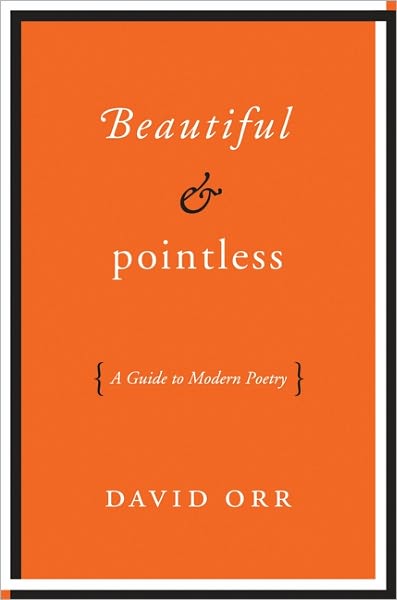
Just finished reading David Orr’s lovely book: Beautiful & Pointless, a marvelous and sly book.

now to think of another title for my autobiography

Marvelous because Orr is able to navigate through the realm of contemporary poetry – both the writing of it and the living of it – in a charming and knowledgeable manner.

Sly because his essays have forced me to take a long, hard look at myself and my aspirations as a poet while making me chuckle.

Damn.

David Orr is the poetry columnist for The New York Times Book Review.  I have been enjoying his columns for years now.

The biggest risk taken in this book is Orr’s breaking down of the mystique surrounding the business and writing of poetry while at the same time showing how the public and private realms are inseparable and *gasp* often beneficial to each other.

(*gasp* because I am a bit of a poet hermit in terms of the outside poetry world.  I mean, it’s scary.  They should send chocolate with rejection letters.)

The charm of the book is how, by breaking down the mystique, Orr makes a fair argument for how poetry is like sports or travel or any other activity that gives pleasure and meaning on an individual level, first and foremost.  By putting it in this context, poetry’s mystique – the revelations, the idiosyncratic fascinations, its intimate tones – is simply part of its appeal.  It is an art not for everyone, but no less worthwhile and valuable to people.

Overall, it is a reaffirming book and worth checking out.

Here’s a sample of why:

…much of life is devoted to things that in the don’t matter very much, except to us.  Time passes whether we like it or not, and its too-quick progress is measured out in private longings and solitary trivialities as much as in choices we might defend to a skeptical audience…I can’t tell you why you should bother to read poems, or to write them; I can only say that if you do choose to give your attention to poetry, as against all the other things you might turn to instead,  that choice can be meaningful.  There’s little grandeur in this, maybe, but out of such small, unnecessary devotions is the abundance of our lives sometimes made evident…

Check out more from David Orr at his website: http://davidorr.com/

Happy evidenting!

J