* jamming with Yosano Akiko

Around the same time that I read Takuboku Ishikawa (see last week’s post), I also delved into the work of Yosano Akiko – famed tanka poet and friend to Ishikawa.

I was so taken up by her work that I couldn’t help but respond to her in several tanka.  Here’s one:

she speaks of the River of Stars
outside her window
and I cannot
but listen
on the other side

*
* Miya Masaoka *

* Miya Masaoka *

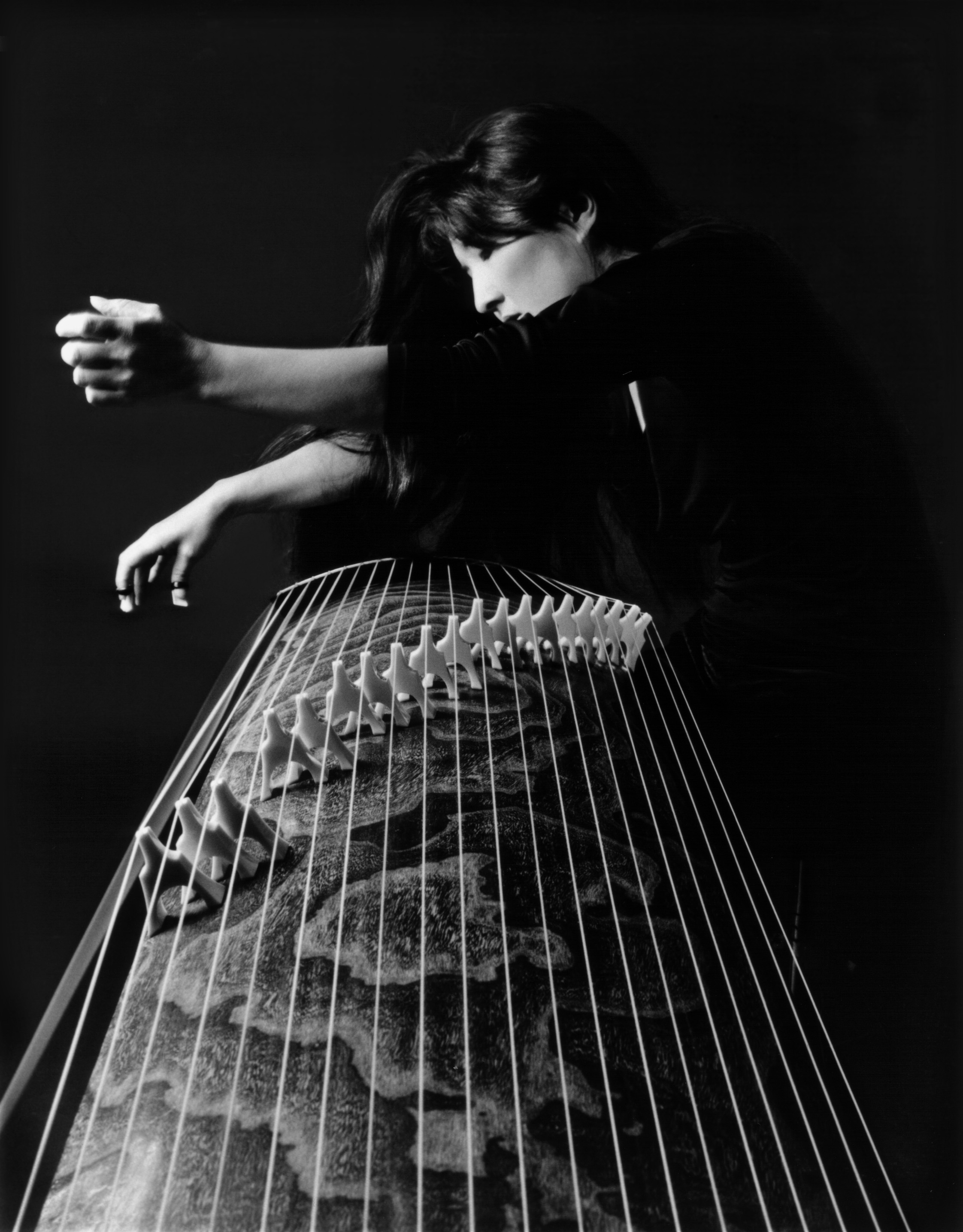
In the selections below, Akiko refers to an instrument called a koto (see photo).  I got to hear someone play one of these in the evenings while I waited for my train back when I worked in New York City.  Like most stringed instruments, its power is derived from tension.  When Akiko talks of destroying one with an ax, it is more than a metaphor – it is music.

*

from River of Stars – Yosano Akiko

While mother begins
chanting a deathbed sutra,
beside her, the
tiny feet of her infant,
oh so beautiful to see.

*

From her shoulder,
falling over the sutra,
a strand of unruly hair.
A lovely girl and a monk.
The burden of early spring.

*

The gods wish it so:
a life ends with a shatter –
with my great broadax
I demolish my koto.
Oh, listen to that sound!

*

And now you must ask
whether I’ve written new songs.
I am the mythic
koto with twenty-five strings,
but without a bridge for sound.

***

Happy sounding!

Jose

* photo found here.
* one year later & three chinese poets

[the lyric poet] always says “I” and sings us through the full chromatic scale of his passions and desires – (Nietzche)

*duly noted*

*duly noted*

Think what you will of Nietzche, he goes overlooked as a poet – and I don’t mean his actual poems but more the spirit with which he approached his writing.  Like the quote above shows, the big N had a way with the aphoristic insight, a lyric way of understanding the world that showed in everything he said.

It is in this spirit that I started this blog a year ago.

Along with having a place for people interested in my work to find me and connect, I wanted a forum with which to share some of what feeds me creatively with fellow readers and writers.

In the past year, I have shared not only poems I admire but other things as well (philosophy, songs, etc.) that have stirred me and made me think – always with an eye towards how it relates to poetry, the writing of it, the spirit of it.

I recently admitted to fellow poet and blog buddy Miriam Sagan that only now, a year later, have I begun to understand what an ever-evolving animal a blog can be.  The Influence has more and more come out of my notebooks, out of my thoughts on a given week.  This approach feels right.

This blog, ultimately, is a reader’s blog.  The enthusiasm that drives me to share is that of a reader, and what insights I stumble upon are due to reading well.  I hope to continue appealing to the reader in all of you.

Lyric poetry is often defined as short and personal.  In many ways, our very lives can be defined as such.  Reading is where these two worlds – where many worlds – meet.

*this, too, is reading*

*reading*

Here are three poems from Vikram Seth’s book Three Chinese Poets – translations from the work of Wang Wei, Li Bai, and Du Fu.  Each poem in its own way pays attention to the short and personal world we live in.

***

Birdsong Brook – Wang Wei

Idly I watch cassia flowers fall.
Still is the night, empty the hill in Spring.
Up comes the moon, startling the mountain birds.
Once in a while in the Spring brook they sing.

*

In the Quiet Night – Li Bai

The floor before my bed is bright:
Moonlight – like hoarfrost – in my room.
I lift my head and watch the moon.
I drop my head and think of home.

*

Thoughts While Travelling at Night – Du Fu

Light breeze on the fine grass.
I stand alone at the mast.

Stars lean on the vast wild plain.
Moon bobs in the Great River’s spate.

Letters have brought no fame.
Office?  Too old to obtain.

Drifting, what am I like?
A gull between earth and sky.

***

Happy drifiting!

Jose