I recently read an insightful essay by Lisa Knopp on the idea of “perhapsing” as found in creative nonfiction. Perhapsing is a move that allows a writer to speculate in the face of the facts; that is, not make things up, but to come to terms with the limits of what is known, and to reflect on what is known around it and, perhaps, beyond it.
I see a similar gesture in the poem “climbing” by lucille clifton below. Within her classic and ever-surprising lyric mode, clifton begins a narrative of following another woman in climbing a long rope. The poem then begins a series of “maybe”s, each a glimpse at a decision the speaker contemplates in hindsight. This listing of maybe’s and should’s creates a lyric suspension, placing the reader alongside the speaker in a speculative space.

The metaphor of climbing returns in the third to last line to cut off this speculation, moving the narrative back to action. The poem ends where it started, in the act of climbing, but the act itself is charged with the energy of speculation and a sense of its meaning.
climbing – lucille clifton
a woman precedes me up the long rope,
her dangling braids the color of rain.
maybe i should have had braids.
maybe i should have kept the body i started,
slim and possible as a boy’s bone.
maybe i should have wanted less.
maybe i should have ignored the bowl in me
burning to be filled.
maybe i should have wanted less.
the woman passes the notch in the rope
marked Sixty. i rise toward it, struggling,
hand over hungry hand.
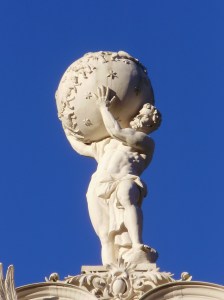 A similar theme arises in this week’s poem in which the late great lucille clifton takes on the story of Atlas. In clifton’s poem, the speaker is Atlas himself detailing how he has gotten “used to the heft of it.” Two things in particular move about this interpretation of the mythological figure. First, how, through the details of “forest,” “sea,” and “odor of flesh,” clifton’s Atlas conveys a familiarity and endearment for the human earth.
 The Influence