Continuing sharing excerpts from my Sundress Publications interview with Izzy Astuto. Here, a question about identity has me opening up about the transformative nature of writing this book. That the literal acceptance of the manuscript sparked in me the possibility of accepting myself. Also some friendly shout-outs and thoughts on community.
Do consider pre-ordering Ruin & Want if you’re able, or suggest it to your local library. Stay tuned for one more set of interview slides!
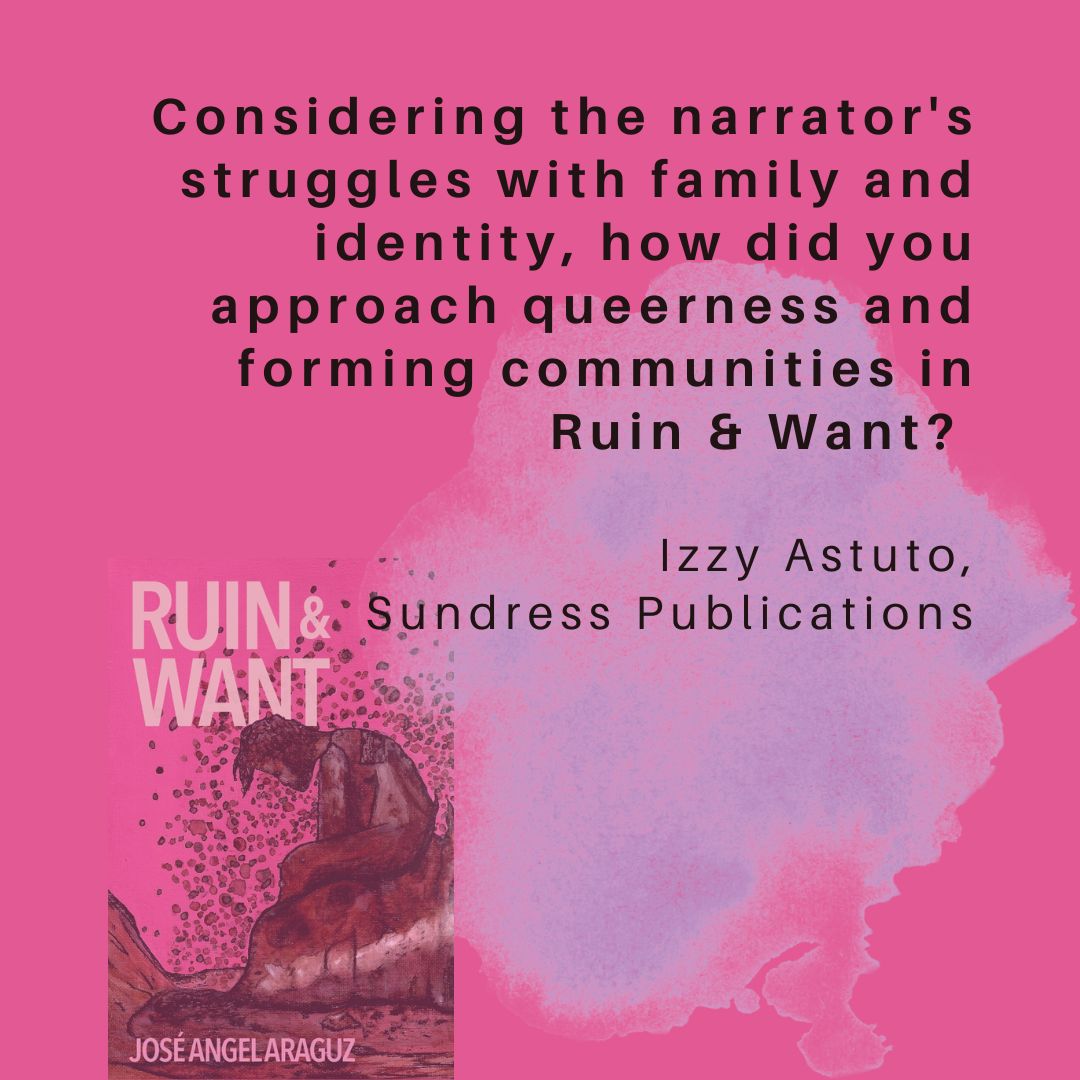



Izzy Astuto: Considering the narrator’s struggles with family and identity, how did you approach queerness and forming communities in Ruin & Want?
José: I’m noting that there’s a theme in my responses, that of unpacking and de-obfuscating what the story/stories of this manuscript were. As I spoke of earlier, my queerness wasn’t part of the original mix, not really. I did try to include some vague gestures toward queerness early on, but it fell flat, not honest enough. Not until I was able to acknowledge within myself that I am queer was I able to own the experiences and the relevant narratives.
A lot of the block for myself—both in my life and on the page—was formed by violence. I spoke earlier of the homophobia in my family and the Latinx/e community, but there were also harmful interactions with supposed friends, would-be partners. Lots of blurred lines and toxic denial and judgment. When Sundress Publications picked up the manuscript, that acceptance led to a whole other chunk of the book coming into being. Literally, SP’s acceptance gave me permission to accept myself.
There were countless times when I almost shelved this manuscript for good. I would have these thoughts in my head: Does the world need another man writing about his sex life? Does the world need a man taking up space talking about his survival of sexual abuse when there are more dire, more legitimate cases of abuse that need to be discussed? The publishing world as well as academia give you plenty of opportunity for self-erasure. If not careful, you can edit yourself and your manuscript out of existence.
It was only after I took the time to realize what the story was that I was telling—that it was a queer narrative, that I was a survivor—and let myself see myself in those terms, and see my family, and see L—only because of all that work was I able to keep going and see this manuscript through. The acceptance by Sundress sparked a deeper revision. It also let me know community was out there.
I want to give a shout-out as well to Elizabeth J. Colen who gave an encouraging response to the manuscript early on. Like, they seriously said some constructive things that I took to heart because they took the time to see the manuscript and give the vision a chance. Meant the world to me. Another thing about community: so much of the road to writing to the end of this book has been realizing not just that I’ve been queer this whole time, but that I’ve been creating community along the way. I have another poet and dear friend, Temple Loveli, who recently encouraged me not to discredit my queerness.
For the longest time I thought in terms of not wanting to take up space, that even if I was queer, I didn’t belong, that there were others more deserving of that space than me. See again how we can erase ourselves long before anyone can try to erase us? I hadn’t thought of my family erasing me in this way, that whenever they were homophobic I just took it as cultural, the way of the world, but that my unease in those moments was a sign of being erased, of something being wrong, which there was socially, but also that there was something wrong happening personally to me.
More tomorrow!
José


 The Influence