* living, dreaming & apples

Between living and dreaming
there is a third thing.
Guess it.

— Antonio Machado

I look at this quote and see much of the poetic craft summed up in it.

There is the living of everyday life – work, chores, relationships, food, tying your shoelaces – all the things that make up routine, the background to who we are.

Then there’s dreaming – both the idealizing of the future as well as the literal act of what is seen when we sleep.  The unspoken times.

Between these two things – the background and the unspoken – we do our best to do the guessing that Machado encourages.

*manzananza*

*manzananza*

In the poem below, Jay Leeming takes an everyday thing – in this case, an apple – and pushes it into dream.  The image of the apple’s core as a “little room” is a guess towards what the act of eating an apple suggests beyond the everyday.  You get the usual connotations of Adam and Eve, the Fall – but there’s something more to it.

The turn for me here is at the end, how the poem leaves you with enough image to keep on talking inside of you.  Just watch what happens when you get to the powerful compound word “tear-shaped.”

Apple – Jay Leeming **

Sometimes when eating an apple
I bite too far
and open the little room
the lovers have prepared,
and the seeds fall
onto the kitchen floor
and I see
that they are tear-shaped.

***

Happy appling!

Jose

p.s.  Jay Leeming is also the editor of Rowboat: Poetry in Translation, a great journal you can find out more about here.

* photo found here.

** published in the book Dynamite on a China Plate, The Backwaters Press.
* w. s. merwin & the friday influence

Dusk in Winter – W. S. Merwin

The sun sets in the cold without friends
Without reproaches after all it has done for us
It goes down believing in nothing
When it has gone I hear the stream running after it
It has brought its flute it is a long way

***

 This week on the Influence: W. S. Merwin!

What I love about Merwin’s poem above is how he gets in so much into a few lines.  Not only the brevity but the subject matter.

We are told that the best novels throughout history deal namely with family/love relationships, that there is so much to said within those frames of humanity.  Equally, poems are said to be about either love, life, or death.

What the stock objects – rain, leaves turning colors, rivers flowing, waiting in line at a grocery store – serve are to open up something everyone can identify with while following along with the poet to see how it is they see it.

That personal take on things – whether it is evoked in turns of phrase or particular images and narrative – is the fingerprint on the poem, the echo of the soul passing through the words (through the world, through the reader), what it is that teaches and awes in a poem.  It is the hardest thing to achieve: singularity, an indelible presence.

Merwin’s work in translation (his Neruda’s Twenty Love Poems has been the standard for years) comes through here in the way he turns a sunset into a fable of sorts, works the images down into the emotions they evoke.  The starkness created by not having punctuation cues me in as a reader to engage with the poem, to follow the logic of the phrasing as it unfolds, each turn a little surprise along the way.

***

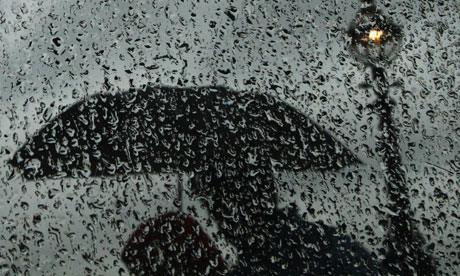
rains, yo

The rainy season has officially begun here in Eugene.  In honor, here’s one more by Merwin:

To the Rain – W. S. Merwin

You reach me out of the age of the air
clear
falling toward me
each one new
if any of you has a name
it is unknown

but waited for you here
that long
for you to fall through it knowing nothing

hem of the garment
do not wait
until I can love all that I am to know
for maybe that will never be

touch me this time
let me love what I cannot know
as the man born blind may love color
until all that he loves
fills him with color

***

Happy filling!

J

(photograph found on: http://www.guardian.co.uk/books/booksblog/2008/sep/26/poster.poems.rain.poetry)