review by José Angel Araguz
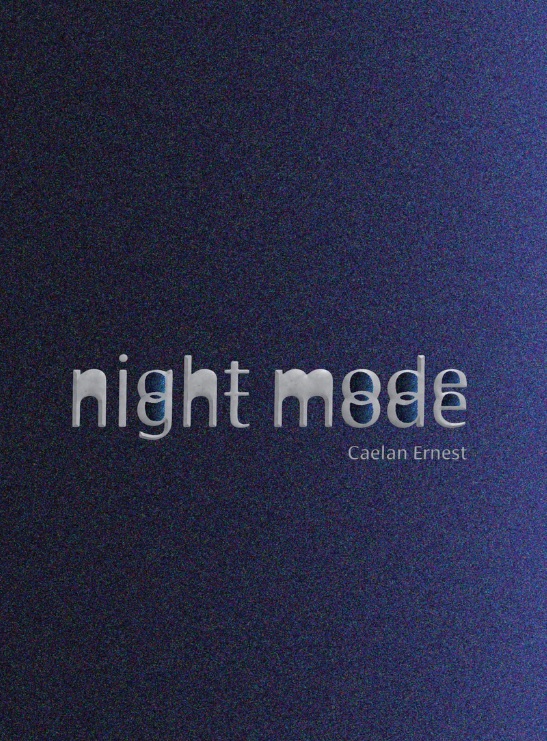
Reading through Caelan Ernest’s night mode (Everybody Press) I kept coming back to the idea of movement. There’s the movement of words across the page, the page here treated less like a field and more like a smartphone screen where text placement and white space engage the eye on a level that creates nuance and multiplicity of meaning. Like the decision in “somewhere a cyborg is taking note of the event that will transform it” to break lines around the syllable trans, a move that creates rich linguistic moments like “somewhere a cyborg is being trans / formed by the event.”
This move here nods to multiple meanings: there’s the trans of transgender as well as the enjambment into transformed that the eye completes in reading. Further, seeing the white space between trans and formed isolates the words in a way that evokes the personal isolation explored throughout the collection. The movement of the eye and of thought created by such breaks–this is what pulses at the core of these poems.
I see movement reflected again in the way these lyric sequences stretch across pages, at times with varying typographical choices and sizes, at other times with a single line on a page. Early in the collection, the line “at what point does night mode rupture into sky?” lives on one page across from the line “it’s been so long since the sun on my skin” on the facing page. A decision like this, which allows for time to be spent and for language to be dwelled on, evokes the similar engrossment and dwelling we do on our smartphones. Ernest’s poems are structured to place the reader in the position to literally “let that sink in.”
This last point is a good segue into acknowledging how Ernest’s work invites not just an aesthetic engagement but a social one as well. Here, I mean that the conversational tone of contemporary poetry is subverted and expanded to include emojis and internet speak, a move that is exemplary of the queer tradition of incorporating camp as part of expression and meaning-making. Through this move to include more of the daily, digital quotidian, Ernest allows for voice and meaning to range outside themselves.
One sees this even in the title phrase “night mode” which plays off the mode we can switch to on our smartphones. These words evoke so much public and private life. Some seek night mode as a way to focus; others to ease strain on their eyes. We are also different people at night. The implications of the word night throughout this collection reflects the world these poems inhabit. A sense of the effect of this choice can be seen in these lines from “put ur phone down for a sec“:
if we take a car to the party we’ll have
enough time for a couple more drinks or should we take
the train i get nervous taking the train when
i look like this i mean i mean i like to look like this
but i don’t always like being looked at like this u know
Here, we have the space of seeking expression despite risk. Night as a space of freedom is tempered by night as a space of others’ freedom infringing on yours. This charged moment, a sober reverie amid the adrenaline of revelry, speaks to what is being risked in being authentic, being one’s self.
There is a need for this kind of assertion of presence in the face of the current wave of inhumane prejudiced legislation against the trans community. On so many levels queerness is being persecuted and tamped down. Ernest adds their voice to the pushback against this hatred.
night mode centers not only what is at stake for the queer community, but through its ambition, vulnerability, and joy, also represents what we are celebrating and fighting for.
*
night mode can be purchased from Everybody Press.
Also, here’s Ernest discussing their collection on the Of Poetry podcast.
Also, also: check out “put ur phone down for a sec” in full at b l u s h.
Lastly, to find out more about Caelan Ernest’s work, check out their site.
 The Influence