highlights from Pretty Owl Poetry’s #takeovertuesday

This week, I had the awesome opportunity to participate in a #takeovertuesday on Pretty Owl Poetry’s Instagram account. I posted a series of “a day in a poet’s life” posts in their stories as well as held a poetry reading via Instagram live. I also had the opportunity to field some questions ranging from the writing life to astrology.

I share the question and answers below in the spirit of community. Thank you again to the editors of Pretty Owl Poetry! Thank you as well to everyone who shared space with me on Tuesday, either by asking questions, attending the reading, or simply viewing the stories. In these times where so much of life is affected and different due to the pandemic, I am honored to be a part of such a thriving writing community!
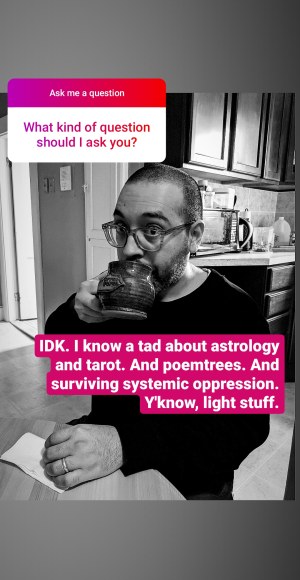
pop takeover 1

Image description: A man drinking coffee while sitting at a table with the following question and answer imposed: What kind of question should I ask you? Answer: IDK. I know a tad about astrology and tarot. And poemtrees. And surviving systemic oppression. Y’know, light stuff.
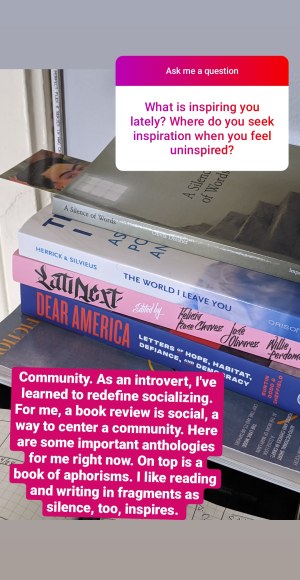
pop takeover 2

Image description: A stack of books with the following questions and answer imposed: What is inspiring you lately? Where do you seek inspiration when you feel uninspired? Answer: Community. As an introvert, I’ve learned to redefine socializing. For me, a book review is social, a way to center community. Here are some important anthologies for me right now. On top is a book of aphorisms. I like reading and writing in fragments as silence, too, inspires.
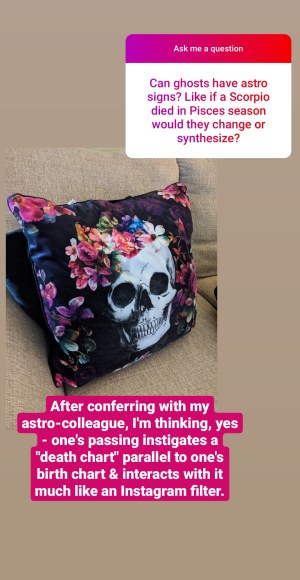
pop takeover 3

Image description: A couch pillow which features a skull wearing a flower garland with the following questions and answers imposed: Can ghosts have astro signs? Like if a Scorpio died in Pisces season would they change or synthesize? Answer: After conferring with my astro-colleague, I’m thinking, yes – one’s passing instigates a “death chart” parallel to one’s birth chart and interacts with it much like an Instagram filter.
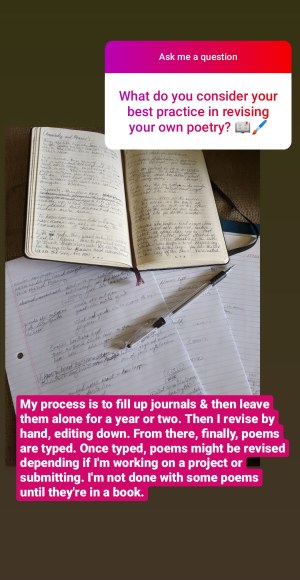
pop takeover 4

Image description: A journal set atop a set of loose pages with a pen laid across and the following question and answer imposed: What do you consider your best practice in revising your own poetry? Answer: My process is to fill up journals and then leave them alone for a year or two. Then I revise by hand, editing down. From there, finally, poems are typed. Once typed, poems might be revised depending if I’m working on a project or submitting. I’m not done with some poems until they’re in a book.
pop takeover 5

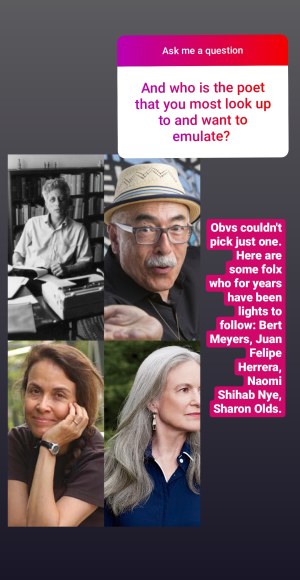
Image description: A collage photo of two men and two women with the following question and answer imposed: And who is the poet that you most look up to and want to emulate? Answer: Obvs couldn’t pick just one. Here are some folx who for years have been lights to follow: Bert Meyers, Juan Felipe Herrera, Naomi Shihab Nye, and Sharon Olds.
pop takeover 6

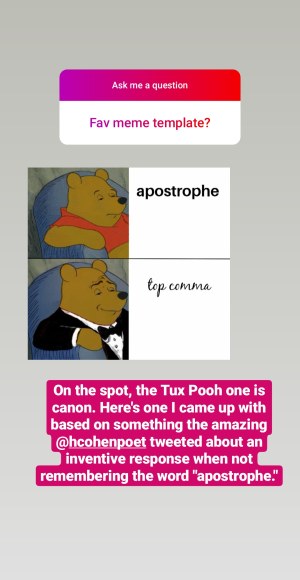
Image description: A meme half consisting of Winnie the Pooh in a red shirt next to the word “apostrophe” and the other half consisting of Pooh in a tuxedo next to the words “top comma” with the following question and answer:  Fav meme template? Answer: On the spot, the Tux Pooh one is canon.  Here’s one I came up with based on something the amazing @hcohenpoet tweeted about an inventive response when not remembering the word “apostrophe.”
pop takeover 7

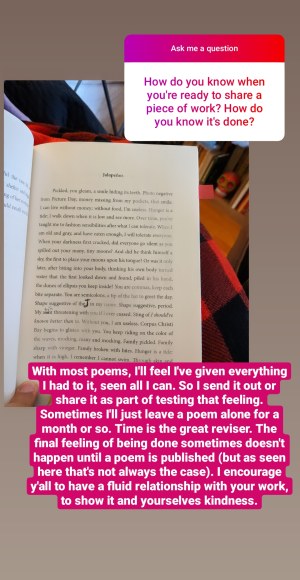
Image description: A book held open to a page where some pen marks have been made on the printed words with the following questions and answer imposed: How do you know when you’re ready to share a piece of work? How do you know when it’s done? Answer: With most poems I’ll feel I’ve given everything I had to it, seen all I can. So I send it out or share it as part of testing that feeling. Sometimes I’ll just leave a poem alone for a month or so. Time is the great reviser. The final feeling of being done sometimes doesn’t happen until a poem is published (but as seen here that’s not always the case). I encourage y’all to have a fluid relationship with your work, to show it and yourselves kindness.
pop takeover 8

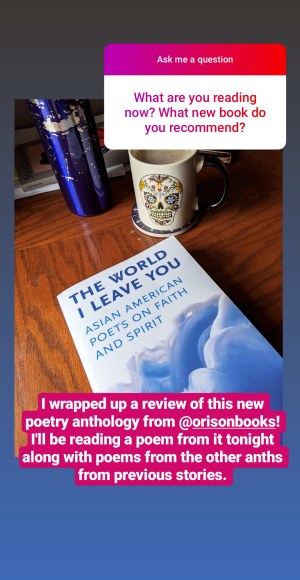
Image description: A book laid on a table next to a mug with a skull on it, all with the following questions and answers imposed: What are you reading now? What new book do you recommend? Answer: I wrapped up a review of this new poetry anthology from @orisonbooks! I’ll be reading a poem from it tonight along with poems from the other anths from previous stories.


microreview: Cenote City by Monique Quintana

review by José Angel Araguz

cenote city

Monique Quintana’s debut novel, Cenote City (Clash Books), is a stellar addition to the Latinx storytelling tradition of texts born out of exploring the intersections where folklore, politics, cultura, and literature meet. Told through fable-like short chapters, Cenote City presents the story of Lune whose mother, Marcrina, cannot stop crying to the point that she has become a tourist attraction, relegated to the nearby cenote, a natural pit or sinkhole that contains groundwater. In the character Marcrina, one can see a variation of the folklore figure of La Llorona (whose own tale has her become a ghost forever crying by the side of rivers after drowning her own children as an act of revenge due to her husband’s infidelity). Quintana draws from this connection and creates a character imbued with a similar sense of sorrow and mortality. What distinguishes Quintana’s Marcrina is the empathetic role she plays in the lives of the community of Cenote City as a deliverer of stillborns. Mediating the humanity of this motherhood experience in one role and serving as a human avatar of endless sorrow in another, Marcrina stands as a symbol of resiliency and depth against The Generales, the police force entity of Cenote City.

Marcrina is just one of a number of characters that inhabit the world of Cenote City; others include a clown able to make children disappear, and a “tiny coven,” one of whom’s members is able to set up a mannequin’s hair into a beehive style and then cast a spell that makes bees appear from it. With radical poetic impulses and flourishes reminiscent of Arthur Rimbaud, Quintana moves the narrative along mainly through the impressions evoked from images and the inner world of her characters. This approach allows her to make full use of the rasquachismo aesthetic, a Chicano sensibility that works to “[transform] social and economic instabilities into a style and a postitive creative attitude.” This aesthetic makes use of collage and places at the forefront the struggle of the oppressed. As a form of storytelling, rasquachismo offers Quintana the use of fruitful and evocative juxtaposition. While this approach at times leads to a dense prose style, the risk is ultimately worth it for how engrossing and captivating the reading experience becomes.

An example of what I mean can be seen in “The Daffodil Dress” (below). In this chapter, readers are presented with a memory of Lune finding Marcrina floating in a pool of water as well as the ensuing panic and recovery. One choice use of juxtaposition occurs around the images of insects coming out of the mother’s mouth. Having insects stand as words in the text lends the narrative a startling new understanding of language. Even when Lune cannot hear what her mother and father say between them, the presence of words is seen as alive and restless.

*

Monique Quintana

The Daffodil Dress

The spring after Lune’s father left them, she found her mother in the backyard of their house, floating in a plastic baby pool, her dress blooming around her body like a daffodil. Lune had been to a birthday party in Storylandia. She began to scream and tried to pull her mother out of the water. The warmth of the water was a shock to her hands and it soaked her party dress, making the skin on her legs burn and itch. She clawed at her own skin with her nails, painted pink by her mother with care. If the clouds could bear witness to that afternoon, they would say that Lune was a swirl of ribbons and brown skin, her kneecaps scraped by the sea of grass, bluish green and bleating, not willing to give up their secrets.

Lune’s screams were loud enough to bring the neighbors, to bring the ambulance, to bring the police, to bring Lune’s father. The paramedic, a young woman with slanted eyes and bright hair administered CPR, while the next-door-neighbor clung to Lune in the sway of bodies, and Lune held her hands in a fist, ready to curse anyone who would let her mother die. The red haired woman hovered over Lune’s mother like she was a kite, blowing the air, willing her to live. Lune’s mother had full round breasts buried under the daffodil dress, and her hair was matted to her mouth like clods of dirt. Lune thought she could see insects fly from her mother’s mouth and ears, when her father appeared and knelt beside her mother and the paramedics. The paramedic’s hands were shaking on Marcrina’s face when Marcrina began to cough up water, the baby pool tipped over and made a bigger pool in the grass, barely touching Lune’s toes again, the tight leather straps of her sandals burning her ankles. She clawed at her own ankles, pulling the sandals off her feet.

Lune thought that her mother had been dead and had been revived because her father had returned to them. There was a tourniquet wrapped around Marcrina’s arm and a stethescope placed at the rise and fall of her breast. Lune thought that her mother’s dying would make her skin turn blue, but it remained as brown as ever, and the daffodil of her dress lay shaking on her hips and her breasts. The paramedics tried to make Lune’s mother go to the hospital, but her father wouldn’t let them take her. He undressed her in the warm glow of the bathroom, the light of the ceiling, making new daffodils on her body. Lune saw her father put her mother in the bathwater, saw him pull her hair away from her face, her shoulder blades shuddered at the touch of the water. Lune could hear them whispering to each other and those whispers became the things that flew out of her mother’s mouth like insects. She tried to make out the lines of the wings and the plump black segments of their bodies, but the insects were hazy and only the buzz of letters could be recognized. No full words. Just moving mouths and shoulder blades and the slow crashing of bathtub water.

After he helped put her mother to bed, Lune’s father heated up cold cocido in a pot and they ate together in their kitchen nook. Lune’s father put his wife’s insects in his mouth and ate them. He ate the secrets and Lune and her father ate the soup together, and they were happy that she wasn’t dead.

*

To learn more about Monique Quintana’s work, visit her site.
Also worth checking out: Blood Moon Blog, where Quintana writes about Latinx literature.
Copies of Cenote City can be purchased from Clash Books.