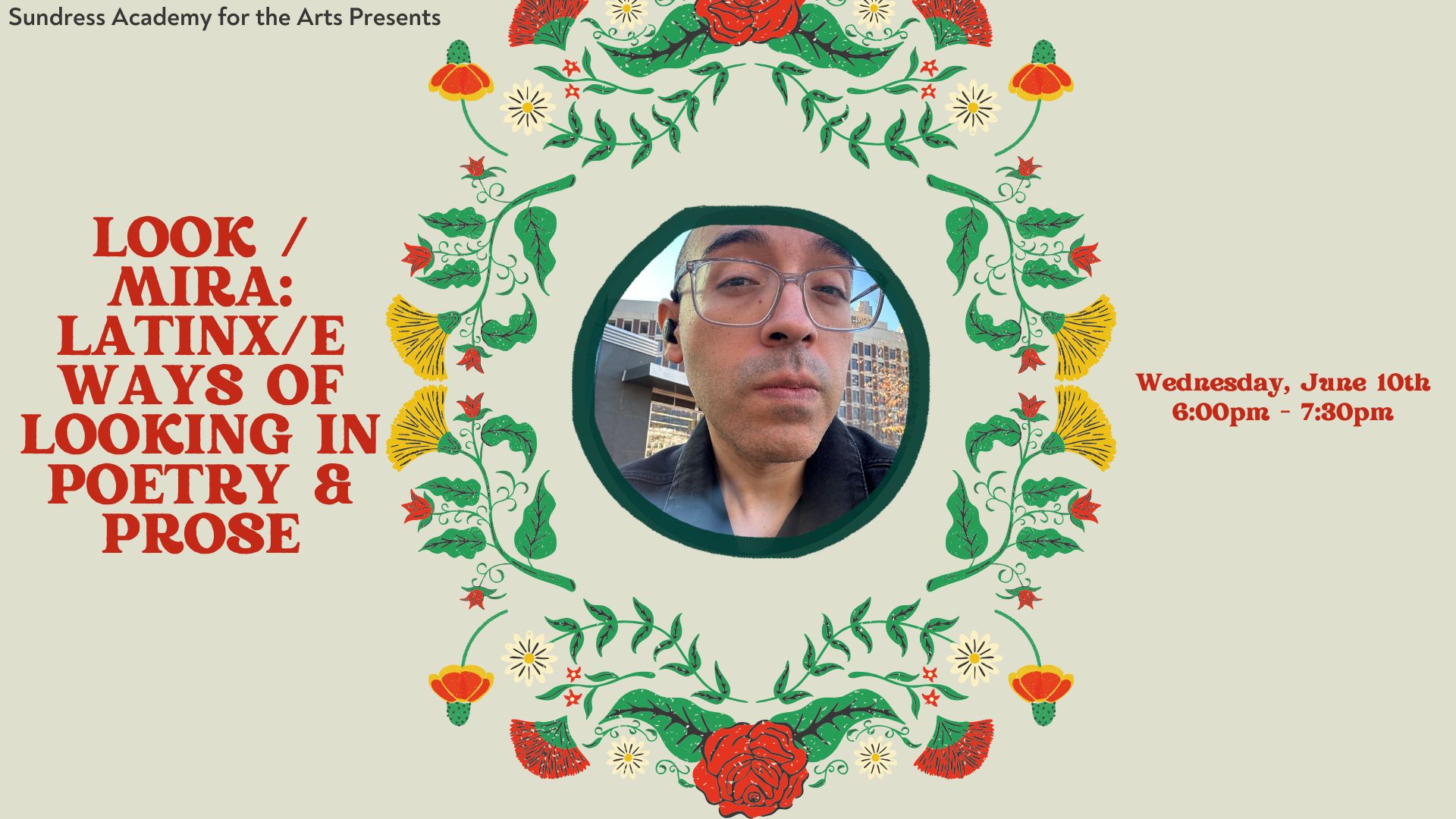
Next week, I’ll be teaching a virtual generative workshop on Latinx/e ways of looking in poetry and prose. In the spirit of the workshop, I’ve been thinking about looking as attention, inheritance, witness, and return. What it means to look with language. To look with the body. To look while carrying what family, place, fear, tenderness, and survival have taught us to notice.
The Spanish word mira carries both invitation and urgency. Look. See. Notice. Pay attention. It can be tender, corrective, playful, protective. It can also be a way of saying: something is happening here, and I need you to witness it with me.
That is the spirit behind my upcoming generative workshop, “Look / Mira: Latinx/e Ways of Looking in Poetry & Prose,” hosted by the Sundress Academy for the Arts on Wednesday, June 10, from 6:00–7:30 PM EST. This event will be held over Zoom. Participants can register and access the FREE event at tiny.utk.edu/sundress (password: SAFTA).
In the workshop, we’ll read brief excerpts from poetry and prose and use them as openings into our own writing. We’ll think about looking as inheritance, looking as refusal, looking through place, and looking toward what might still be possible. The goal is not to explain identity or experience, but rather to notice how writing can hold the layered ways we have learned to see and be seen.
Participants will be invited to write in response to low-stakes prompts. Poetry, prose, fragments, lists, memory, speculation, and hybrid forms are all welcome. Sharing will be optional.
I’m especially interested in the moments when the gaze shifts: from the self to the family, from the room to the remembered place, from the body to the ancestor, from what happened to what language makes possible.
What have you inherited as a way of seeing?
What have you learned not to look at directly?
What might become visible if you let memory, place, and language look back?
I hope you’ll join me.

 The Influence