For this week’s writing prompt, I’m revisiting my time presenting at and attending the Oregon Poetry Association conference in September. While I have devised mine own daily writing habits over the years, it was at this conference where I learned the practices of one of my go to poets, William Stafford.
Stafford’s son, Kim Stafford, was this year’s keynote speaker, and along with some compelling insights into his current poetic life, he shared with us his father’s daily writing practice. From my notes, here’s how he broke it down:
Four Elements of Daily Writing Practice
1. Write the date. Kim Stafford said this was simple enough, then quoted his father: “Once I write the date, I know I’m okay. “
2. Write a paragraph of boring prose. Stafford said this could be in the realm of “Dear diary…” language, straightforward observations from everyday life. He also framed this step as “writing before you have to write well.”
3. Write an aphorism. This step involves writing a one sentence observation on life or idea. Doing this also involves stepping back and seeing a pattern in your “boring prose.” In practice, if step 2 feels like boarding a plane, checking the luggage, etc., then this step is like taxiing on the runway.
4. Write whatever comes next, a poem, a story, etc. Having been warmed up by the previous steps, you’re ready to take flight.
While William Stafford himself was famous for his daily writing habits, seen with a kind of awe, he was also the first to point out that it was a humbling habit. I can verify that writing every day doesn’t necessarily lead to gold; more often, you have scratches and inklings. But, for me, it’s all about the attention to language, being able to stay close to the heat behind turns of phrase and word choice – that’s the value of daily writing.
However you choose to get into this process, be sure to make it your own. If not daily, weekly even. What matters is you and your words.
Here’s a blog post by Kim Stafford where he elucidates on the process further.
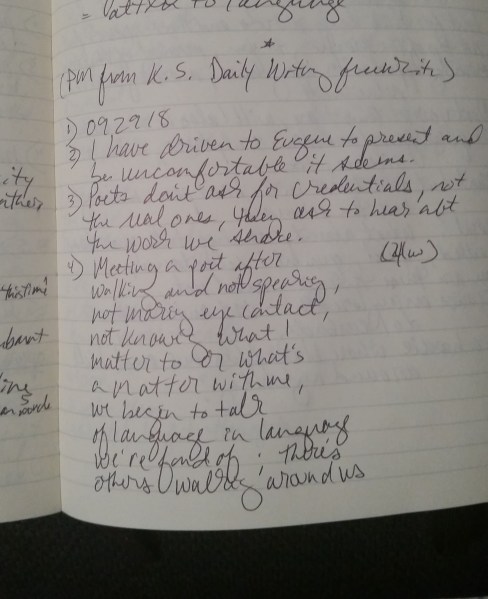 Below is my own first attempt at Stafford’s practice. Because this first attempt was written at the conference itself, my boring prose is short. As for the poem, I did what I often do, which is pick a number of words per line as a structural guide (here, it’s 4 words per line). I had in mind two new friends of mine that I had just met at the conference.
Let me know if you end up trying your hand at this practice. Would love to hear from y’all! [ thefridayinfluence@gmail.com ]
Daily Writing freewrite – José Angel Araguz
- 09/29/2018
- I have driven to Eugene to present and be uncomfortable it seems.
- Poets don’t ask for credentials, not the real ones, they ask to hear about the work we share.
- (Poem):
Meeting a poet after
walking and not speaking,
not making eye contact,
not knowing what I
matter to or what’s
a matter with me,
we begin to talk
of language in language
we’re fond of; there’s
others walking around us
but the words between
us, who has placed
these words between us?

 The Influence