Thank you to everyone who was able to show up for Wednesday’s virtual workshop, Look / Mira: On Looking as a Way of Writing. I’m grateful for the generosity and attention folks brought to the space as we moved through prompts on inherited ways of looking, the ways looking can be shaped by place and refusal, and, finally, speculative looking.
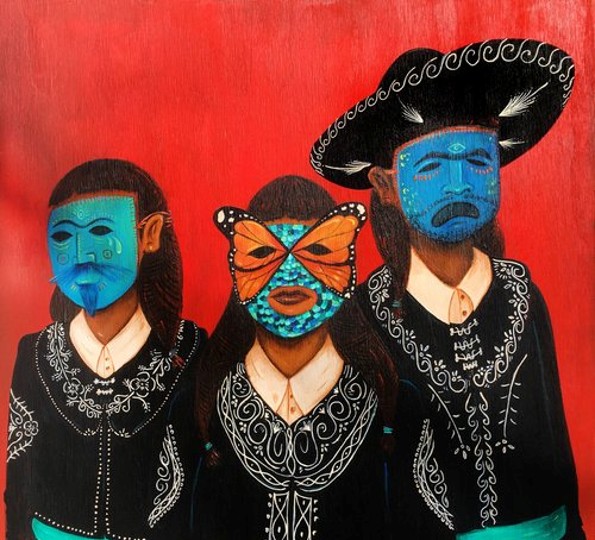
For that last prompt, I briefly shared Karla Rosas’s painting “Hijas sin padre o patria.” The title translates roughly to “Daughters without father or fatherland,” a phrase that I hear as carrying an intentional critique of gendered language and belonging. To name what one is “without” is also to name the structures that have claimed the power to define us: father, fatherland, nation, lineage, authority.
What moved me in the painting, and what I hoped might open something for the prompt, is the way absence does not remain empty. The figures are not diminished by what the title names as missing. Instead, they meet us through masks, color, pattern, and transformation. The masks suggest to me a necessary vigilance, the kind marginalized folks often practice in order to move through the world. But there is also beauty here: the vivid blue, the monarch wings, the ornate clothing, the bright red background. The painting represents lack while at the same time speculating into what can exist beyond (or despite) the terms of lack.
That was the invitation of the final prompt: to imagine a future self, ancestor, spirit, object, animal, place, or other presence watching over a moment from our lives. What might they see that we could not see then? What language might they use for our seeing? What might their gaze loosen, bless, protect, question, or refuse?
During the session, I found myself writing about the “birdbath” visible from our apartment balcony. I say “birdbath,” but what I really mean is the sizeable dip in the parking lot asphalt that becomes a watering hole after rain. Birds gather there for hours, splashing, pausing, lifting off, returning.
The prompts kept asking us to shift perspective, to let looking move from the self to elsewhere and back again. Here’s a haiku that came from that space:
robin in a puddle
my eyes from there
an afterthought
I like that the poem lets the looking happen away from me. The robin does not need to become symbol, messenger, or metaphor right away. It gets to be there first: in the puddle, in the after-rain, in its own attention. My eyes arrive later, almost beside the point.
That feels like one lesson I’m carrying from the workshop: sometimes looking as a way of writing means letting the self become secondary, decentered long enough for the world to look back.


