The cycle of being exhausted and exploited continues, but here are some updates:
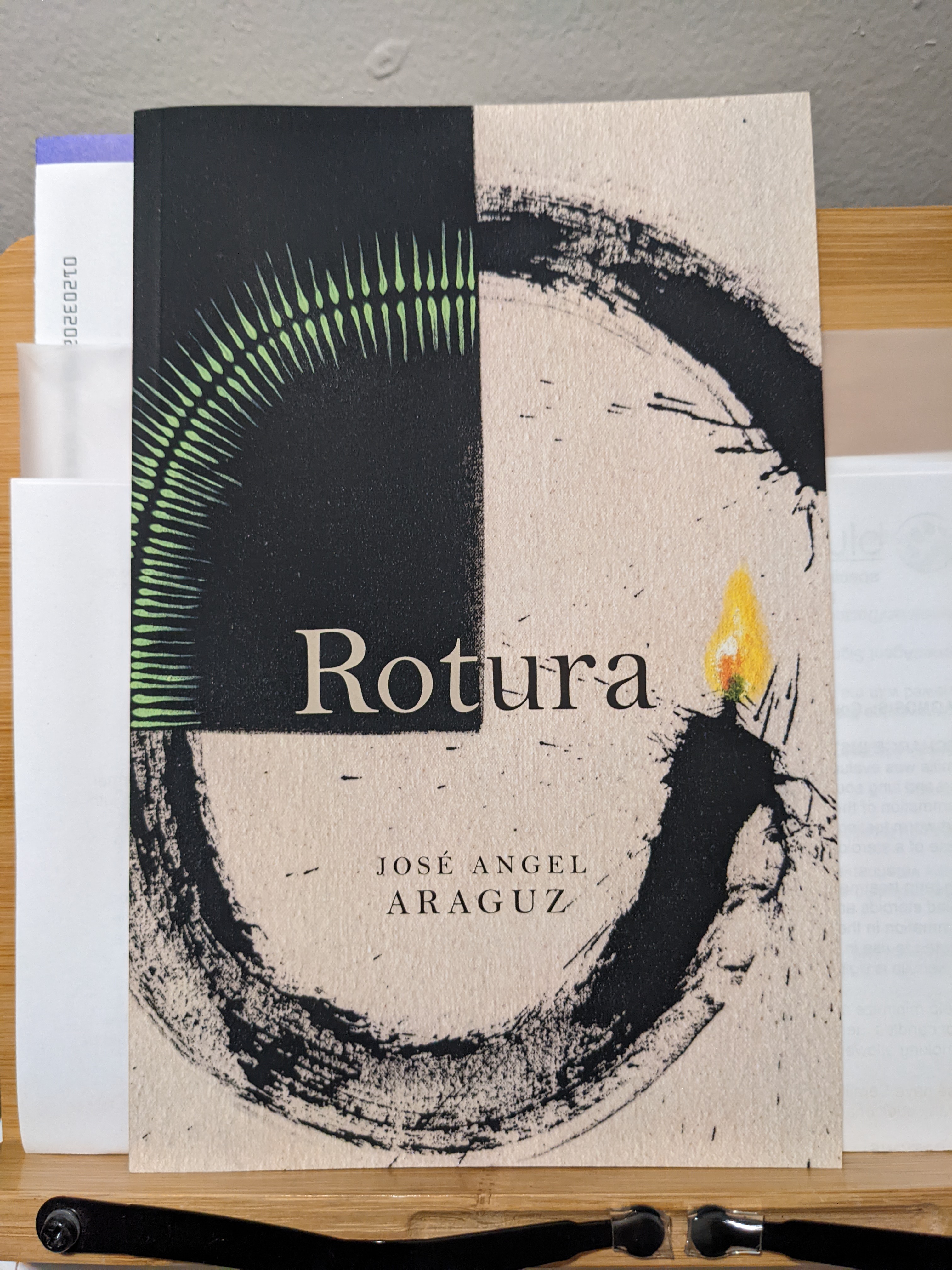
A copy of Rotura at my desk.
Starting off with the image above–happy to report that I received my author copies of my new book, Rotura (Black Lawrence Press), which is due out officially this Friday, March 18th. There’s still time to pre-order a copy.
Also, I will be doing an Instagram Account Takeover for Bear Review starting tomorrow. I’ll be posting and doing stories all week, so be sure to stop by their account and say hi 🙂
Also also, I am happy to share that my poem, “Mexican,” is included in the latest issue of THRUSH Poetry Journal. THRUSH has been a dream journal for over a decade, so excited to be a part of this issue including work by Deborah Allbritain, Carla Carlson, James Diaz, Tennessee Hill, Chisom Okafor, Doug Ramspeck, and Meg Thompson.
I’ve got a few more things in the works related to Rotura, but for now, thank you to everyone who has pre-ordered and/or who is reading this right now. I hope you are finding ways to find peace and compassion for yourselves and others.
As the title suggests, I have two things on my mind to share this week:
First, I want to spread the word of the upcoming deadline for the Andrés Montoya Poetry Prize, a no-entry fee competition which “supports the publication of a first full-length book of poems by a Latinx poet residing in the United States.” Find out more information here.
Photo of a woman holding the flag of the Dominican Republic by Josue Ladoo Pelegrin on Pexels.com
Second, the “thoughts” bit. This week in teaching my Latinx Literature class and discussing Rhina P. Espaillat’s poem, “Bilingual/Bilingüe,” I found myself musing briefly on how this poem is a microcosm of some of the controversies surrounding Latinx poetry and the different practices in publishing work in both English and Spanish.
Specifically, I have learned and seen over the years within the Latinx community arguments for and against italicizing Spanish words in a text; arguments for and against including definitions and/or translations with a bilingual text; arguments for and against even mixing the two languages. These arguments hold a nuanced weight and the conclusions are different for each writer because they strike at the core of one’s identity and agency.
In terms of identity, there is much to be said about representation, how having un poco de Spanish can make one feel seen, a little less alone among a sea of English. A decision to include or not include Spanish is often one that factors in audience. Who is this work for? Who has access to it?
In terms of agency, being able to represent one’s full authentic self on the page is essential. More importantly, having the power to make that decision is key to feeling respected as a writer. Often the decision to italicize Spanish used in a text is the choice of an editor or publisher; when this happens, a writer feels othered, made to feel different and exoticized. One need only look at the unquestioned, unothered use of Latin and French phrases in texts to see how these feelings naturally arise.
In Espaillat’s poem, there is a purposeful intent in the handling of Spanish words (something which she shares insights on in this lovely interview). This poem shares a narrative of a daughter being told not to speak Spanish at home while at the same time being encouraged to find a place in the world of English words. The Spanish early in the poem is intentionally kept in parentheses, a move that parallels the daughter’s need to separate her languages in order to obey her father’s wishes.
It is only at the ending couplet that both father and daughter–as well as English and Spanish–come together:
he stood outside mis versos, half in fear of words he loved but wanted not to hear.
This travel of Spanish down the poem from parentheses to taking up its own space proper had me going off a bit. I hope it made sense to my students. I hope it makes sense to y’all.

 The Influence