review by José Angel Araguz
One of the unique experiences of being a poet / poetry reader is becoming accustomed with the creature known as the “selected poems.” The closest equivalent from outside the poetry world comes in the form of the “greatest hits” album. Yet, the novelty and nostalgic flash of such an album doesn’t exactly feel right with poetry.
Perhaps a volume of selected poems allows us to tap into a similar experience Italo Calvino speaks about in his essay “Collection of Sand”:
“I have finally come around to asking myself what is expressed in that sand of written words which I have strung together throughout my life, that sand that seems to me to be so far away from the beaches and desert of living. Perhaps by staring at the sand as sand, words as words, we can come close to understanding how and to what extent the world that has been ground down and eroded can still find in sand a foundation and model.”
This idea of glimpsing “a foundation and model” for literary experience through engaging with a writer’s collected body of work is, for me, an apt guide into the selected poems experience. Just as Calvino invites his reader into a communal act of assessment and study, readers of poetry are invited into a similar communal act, only one that includes celebration as much as reckoning.
Which is another way of saying: selected poems allow us to catch up.
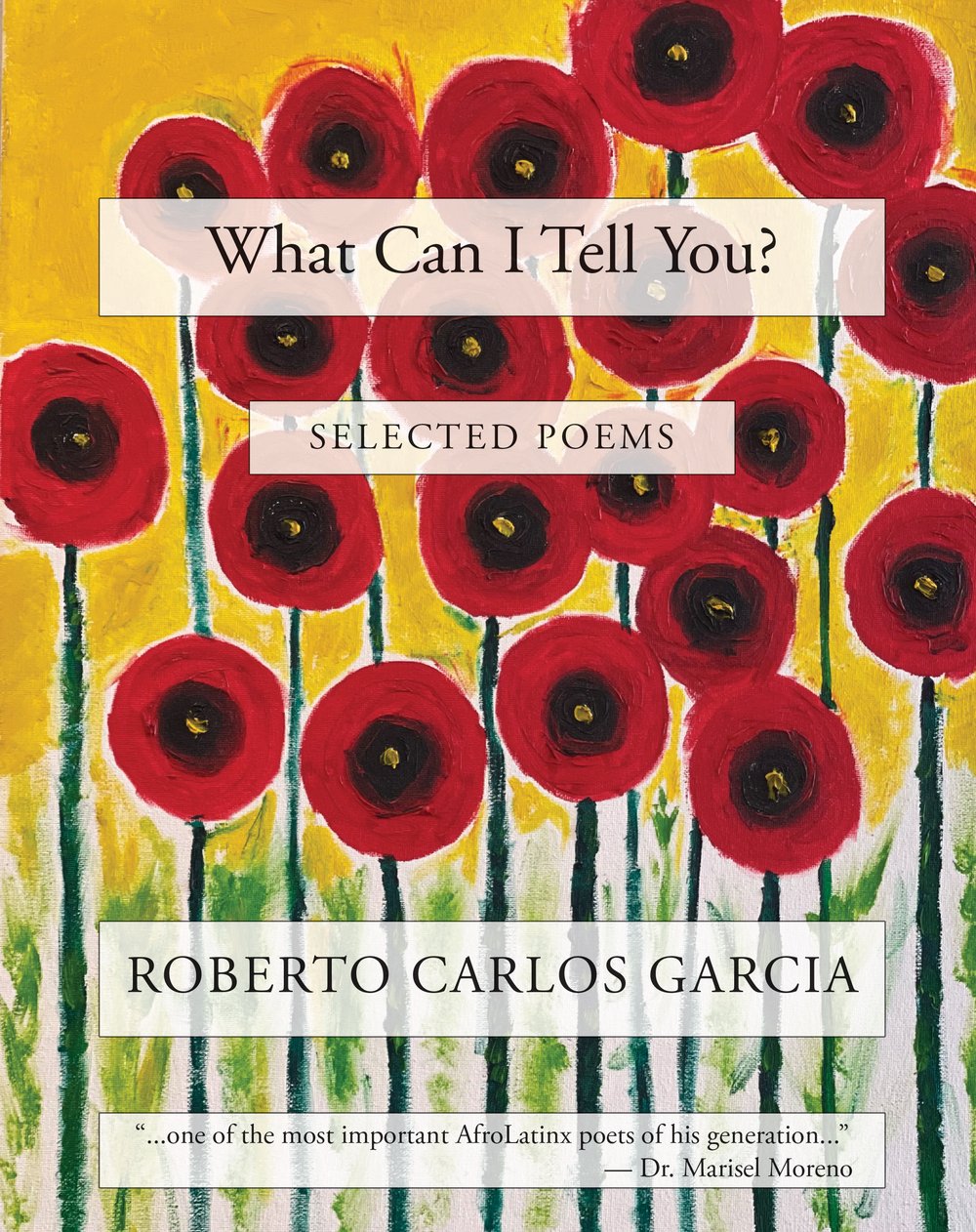
It is in the experience of catching up that I encourage readers to enter What Can I Tell You?: Selected Poems (FlowerSong Press) by Roberto Carlos Garcia. Across the three poetry collections gathered here in this volume, one can see Garcia establishing a foundation and model for poetic experience, meditation, and interrogation that ranges in depth and practice.
“Duplicity,” for example, has Garcia setting up the idea of subversive doubleness as it is experienced in the survival consciousness:
Hard truth:
First thing I do
as I breathe into a room
is search
for brown & black faces,
bobbing in America’s
post racial waters
Here, truth is experienced in the body, breathed as one enters a room and immediately seeks out the familiar. Before connection and presence, the speaker here admits to a need for safety. The phrase “post racial waters” also hits here and underscores the jarring contemporary moment for racialized peoples. This phrase gestures toward the systemic oppression behind that makes the negotiation being depicted here necessary.
This hard truth is followed by another hard truth toward the end of the poem:
Hard truth:
Light & Dark
sparkle the waters
like tinsel,
pretty chimera
No one really
has to
Does anyone really
have to?
Talk to me–
This move toward abstraction and image evokes the need for connection, fleshes it out into a need for beauty. The question “Does anyone really / have to?” is an interrupted one; it mirrors the opening of the poem (centered on an act of survival) and jars it, troubles it in an existential way. The move to end the poem with another interruption, the fragment “Talk to me–” is powerful for the way it simultaneously completes the question of the previous stanza while also serving as plea and demand.
This push and pull–from seeking to demanding–is similar to the push and pull experience the speaker is going through. Who is safe? Who is in this room with me? Who can I be in this room? These are questions that come readily to the minds of marginalized peoples navigating public spaces. In a way, what is being created here and in other poems throughout Garcia’s ouevre is a foundation and model for survival.
A similar drive can be found in the various “mixtape” poems in Garcia’s body of work. The mixtape is a form created by the poet themselves and “which resembles a cento in that it is composed of lines borrowed from other poets but also includes lines from fiction, non-fiction, rap lyrics, and other forms of literature…[and] is between 50 to 100 lines long and should have at least ten original lines written by the poet.” In “from Mixtape for City Kids from Dysfunctional but Happy Families, Kids Like Me,” one can see the payoff of such formal ambition:
Yes, you’ll survive. Look at me.
I’m shocked too, I’m supposed to be locked up too,
you escape what I escaped you’d be in Paris
getting fucked up too. My father said…surviving
one thing means another comes & kills you.
He’s dead, & so, I trust him. I know this isn’t much.
Here, survival as a theme appears again in the first line, and is given further depth by the interpolation of the Jay-Z lyrics in the second, third, and half of the fourth line. Survival leading to escape is a striking focus; the lines about the father take this focus to another level. And while the form brings together a number of borrowed voices, one can hear Garcia’s sensibility in the pathos of “I know this isn’t much.”
This latter sentiment can be found in several moments across Garcia’s poems. There’s this line from “Belief System,” a stunning poem of self-reflection that ends with “When I weep like this everyone hates me.” A hint of this dejected self-awareness can be found elsewhere in the ending of “Clean”: “I know the universe is within this body / & that somewhere along the way I forgot it.” Tracking this developing sensibility is just one of the thrills and rewards of reading What Can I Tell You?.
There are other formal experiments taken on by Garcia that are worth tracking and catching up on. These three poems published at The Acentos Review are good examples of Garcia’s ability to engage and trouble voice in inventive and dynamic ways. Across three poems, Garcia shows himself to have a distinct sense of line break as well as a clear understanding of the impact of visual presentation. Yet, with all this attention to craft, Garcia’s interrogation and reckoning with Latinidad in necessary and crucial ways remains consistent.
There was also, for me, the rare surprise of finding a revised version of a poem I was familiar with. This previous version of “Back to School” (second poem at the link) is one I’ve taught and connected with students on. In the version found in What Can I Tell You?, there is, among other changes, the move from third to first person. This move grounds an already powerful poem into a distinct presence. Within the scope of this selected poems, noting this revision feels like a distinct glimpse into a poet’s inner conversation and stakes.
The notes I made on the way to this review are messy and many. This messiness is perhaps another characteristic of reading and enjoying a book of selected poems. I haven’t even discussed Garcia’s facility with lyric prose; the title piece of his second collection black / Maybe: An Afro Lyric–a lyric prose piece honoring the complexity of the Afro-Latinx experience–this piece alone pays back a thousandfold the cost of purchasing this book.
I kept returning to the question of the title while reading. At times its question came off like a generous ask, an invitation; at other times, it reflected despair and persistence in the face of irrational, unforgiving systemic oppression. Throughout What Can I Tell You?, this title question is answered by the body of work Garcia has gifted us with here. Through this work, a foundation and model comes together and gives hope and direction for what poetry can name, reckon with, and bring light to.
*
What Can I Tell You?: Selected Poems can be found at FlowerSong Press.
Find out more about Roberto Carlos Garcia’s work, at his site.
 The Influence