review by José Angel Araguz

One of the first clues into the framing narrative of Dear Outsiders by Jenny Sadre-Orafai comes straight from its stunning cover. This image of two people blending into one only to reveal the sea, one learns through reading, works to evoke the experience of the two siblings who serve as the speakers for this collection. Sadre-Orafai makes use of the first-person plural throughout in ways that reflect the blurring of boundaries and experience.
The presence of the sea is a starker matter; its presence speaks to the death by drowning of the siblings’ parents. The other element to take note of is the title itself. The first-person plural “we” here often feels like it’s addressing the reader in a direct, intimate way, similar to a letter.
These elements come together in startling and powerful ways. In “Low Recitation,” for example, a scene of the two siblings looking over maps quickly devolves:
We try to see different pictures, but the blue is kudzu, silencing the land. Name the world’s seven continents. Name the world’s five oceans. We think we see our mother’s body shape there.
Here, note the way the first sentence describes a sensory conflict, the siblings unable to “see” the map as a map. This sensory conflict, despite the effort to focus and “name,” further develops, with the final sentence in this excerpt showing how grief is pushing through. This sudden impression of their dead mother brings to mind the way grief can be said to come in “waves.”
The image of waves is ideal in getting a sense of the accumulative reading experience Dear Outsiders invites. There are poems depicting memories, some light, some dark; there are recurring statements as well as rich evocations of sea and beach town life. There are also a number of list poems, each a catalogue of reflecting from the details of this world in a rich, revealing ways. In “Boat Call,” a list of boat names ranges from the expected (“Argo / Cheers / Anchor Boy”) and the humorous (“Knot From Around Here”) to the more emotionally charged (“Verdant Hope” “Don’t Panic”).
This sequence helps add a further depth to the narrative. Along with further details of the world of these poems, they also work to vary the tone. In fact, the range in tone across the collection is a revelation to itself.
Yet, even in this variation, grief is underscored. “Historical Overview” has the siblings sharing:
Our parents tell us that all the water in the world has been here forever. The world will never make new water. Don’t bother trying to ask in your baby song.
This sobering, stern tone alongside the more distant, objective tone of the list poems are moments in the collection that give a sense of the siblings as children “trying on” specific tones modeled by their parents. By varying between these “parent” tones and the list poems, the more intimate, mourning tone comes across all the more charged and urgent.
This mirroring of the parents becomes clear by the end of the collection when an earlier reference to the parents keeping an inventory of what the siblings wear each day (“in case we’re abducted”) is brought back to mind in the final list poem, “In Case of Abduction.” This list poem is made up of three columns: one column of dates faces two columns listing sets of clothes worn; the gut punch comes toward the end of the poem which is made up of a series of dates but nothing listed for them.
The visual of this last list poem–that of an incomplete list–drives home the distinct elegiac experience Sadre-Orafai has created here for us. The days keep going, while the one keeping track of them does not. At the core of this experience is family, those people in our lives whose presence point us to the past and future as much as the present.
The title, then, takes on another meaning in the face of these multi-layered relationship. When one close to us dies, they, too, become dear despite being outside this existence.
*
Dear Outsiders can be purchased from University of Akron Press.
Check out more poems from Dear Outsiders here.
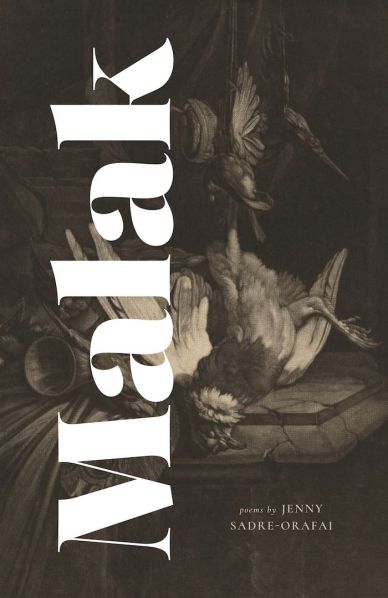
Here’s another microreview, this time of Sadre-Orafai’s Malak.
Find out more about Jenny Sadre-Orafai’s work, at her site.
 In my recent
  The Influence