review by José Angel Araguz
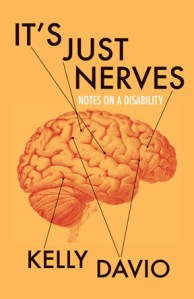
Kelly Davio’s It’s Just Nerves: notes on a disability (Squares & Rebels, 2017) is a collection of creative nonfiction essays that explore and report the inner and outer realities of living with myasthenia gravis, a “a chronic autoimmune neuromuscular disease that causes weakness in the skeletal muscles, which are responsible for breathing and moving parts of the body, including the arms and legs” (NINDS). The language of this definition, in light of its clarity and conciseness, or perhaps because of it, does little to bring the condition into human terms. One of Davio’s gifts is her ability to translate the complexities of her experiences into relatable moments via an authentic, engaging voice, a voice capable of insight and snark, as well as compelling honesty.
The opening essay, “Strong is the New Sexy,” for example, starts:
In the hospital complex, I sit in a room with a woman who plans to teach me how to swallow. Or, to re-teach me. I came into the world knowing how, born with the universal instinct to suckle and feed. I knew how to swallow just as I knew how to breathe. It’s just that, somewhere along the way, my body’s muscles have forgotten.
Here, Davio recasts her condition as a species of “forgetting,” a phrasing that would seem simple were it not also connected with “the universal instinct” mentioned earlier. This connection evokes the depth of vulnerability felt in this moment; the breaking down of the body means a breaking down of the self. This transition and necessary “re-teaching” doesn’t happen in a vacuum either, but rather in the public, fraught atmosphere of a hospital. The influence of the outside world is evident a little later in the same scene:
On the other side of the plate-glass window of the physical therapy room, hang gliders swoop down from the pine-covered mountainside. Their sails are the bright neon of 1990s fashion, and it’s impossible to miss the daredevils with their spectacular, spandexed bodies. I wonder whether the location of the window is intended to be inspirational: a call to the possibilities of good health, a motivation to perform one’s exercises well and get back out there. I have an impulse to drop the blinds over the window. I’d like to occlude the mountain.
In these opening paragraphs, we have a different kind of clarity and conciseness than that of medical jargon. There is the clarity of one’s thoughts and feelings during the awkwardness of physical therapy, but also the clarity of what colors the experience. The indirect violence and insistence on difference implied by most so-called “inspirational” posters is never more charged than in a medical setting. In a context where one is forced to question and doubt who they are bodily, posters like the one described here force an inner questioning of one ‘s attitude. For this reason, the sentence “I’d like to occlude the mountain,” is striking not only in its agency and defiance, but also because it comes from a speaker who themselves is feeling “occluded,” blocked and forgotten by their own body.
One of the questions I feel this collection of essays keeps asking and answering is: Who are we in the face of what we don’t know? This is engaged with in a dual manner throughout. Like in the above, the essay “On a Scale of One to Ten” presents a scene where outside pressure, this time in the form of a doctor’s question, forces a quick gauging of one’s self. In response to a doctor’s request to tell “what percentage [she’d] been debilitated by [her] neurological disease” during an assessment for surgical intervention, Davio experienced the following:
“What percentage?” I had prepared myself for all kinds of possible outcomes in this consultation. I was ready for anything, from him brushing me off to telling me that I’d need one of the more gross and undesirable procedures for which he’s known. One thing I hadn’t prepared for was performing quality-of-life math on the spot. I didn’t know how to put a number to the way I lived, or to the extent to which I’d adapted, year after year, to a new and inadequate set of circumstances.
I told him, “I have no idea.” He assured me that he just wanted an estimate, as though that clarified anything. At this point, I was emotionally exhausted, and I was frustrated. As I often do when frustrated, I said whatever came to mind.
“I haven’t been able to chew a salad for three years. I can’t teach a whole class anymore. I can’t walk anywhere without falling. I stop breathing sometimes. You tell me what percentage that is.”
He stopped typing away at his computer, swiveled around in his chair to look at me, and smoothed out his tie. “I think you answered my question.”
Here we again have a disconnect between the clarity and conciseness of the medical world versus the language of human experience. While the use of math terms to discuss one’s pain carries its own thwarted ambition, what stands out more in this scene is the disparity between Davio’s frustration and consequent edged statement “You tell me what percentage that is,” and the detail of the doctor “[smoothing] out his tie.” This latter detail symbolizes the discomfort, even on the part of the professionals trained and paid to treat patients with chronic conditions, feel in the face of said patients’ realities. Which is where the duality of the question, Who are we in the face of what we don’t know, comes into play. In this scene, Davio has to summarize an experience in an impossible way; in the process of giving an answer she doesn’t know how to give, Davio herself becomes something that the doctor doesn’t know how to respond to. At the end of this scene, she is frustration, he is a tie to be smoothed down.
What these essays make clear through scenes like this one is the range of things one has to reckon with as one learns to live with a chronic medical condition. From unpacking the shaming and misinformation about disability in mass media, popular culture, and writing conferences, to her experiences living and working in England pre-Brexit, Davio’s gift for writing relatable, unromanticized accounts of her life remains consistent. One thing that the trio I mentioned above – insight, snark, and honesty – do well in this collection is to keep things dynamic. Time and again, when the world shows itself as wanting to neglect, ignore, and not see her, Davio stares right back, answering the impulse to “smooth down” and look away with essays that are undeniable and unignorable.
*
Influence Question: Did your background as a poet come into play in any way as you put together this essay collection?
Kelly Davio: I think my work as a poet did play a role in how I approached the subject matter of this book. Poets have these great toolkits for examining the world indirectly; it’s as though the whole of our training is geared toward delivering ideas and information in the least likely way possible. If we can compare nonfiction to another medium, like photojournalism, then poets are probably the most like these intrepid photographers who take underwater portraits of people’s pet schnauzers. So yes, poetry taught me to come at my subject matter from unusual angles, and that has allowed me—I hope—to keep this fairly universal subject matter fresh for the reader.
But there’s another respect in which writing these essays was a new experience for me. When I write a poem, I’ve typically gnawed on the idea for some time before I put the text down on the page. I have an idea of what I want my underwater schnauzer portrait to look like. Essays turned out to be more exploratory for me; in my early drafts, I was writing to understand something, whether about myself or about the world around me, eventually revising down some more fully formed idea. That was a really exciting process for me as a writer, because I hadn’t really felt that same kind of freedom to wander around on these long, intellectual hikes before.
Influence Question: One of the great accomplishments of this book is your ability to write sober, unromanticized yet relatable accounts of experiences like being an American living abroad and engaging with the (mis)representations of disability in popular culture. What were some of the obstacles and/or lessons learned in evoking this hard-earned clarity on the page?
Kelly Davio: First of all, thank you for that! I think that the greatest challenge I had in writing these essays was getting past the stigma that exists around my subject matter in the literary world. I cannot tell you how many times I was lectured by other writers on the global truths that there’s no audience for books about illness or disability, that reading about other people’s pain is boring, that personal essays aren’t a legitimate thing to be publishing in the first place…you get the idea. For a long time, I bought into that stigma.
I got over it one morning as I sat in a panel discussion on the craft of essay writing at a literary conference. I had been hoping for a discussion of—oh, I don’t know—the craft of essay writing. But what I and the other attendees got was an hour or so of some hung-over looking guys I don’t think any of us had ever heard of roundly mocking the work of several well known women writers who publish personal essays. I left that room knowing exactly who my audience wasn’t. Who cared what those guys thought?
After that panel, I decided I to write whatever the heck I wanted. I wrote the kind of thing I wanted to read, and I trusted that there were other folks who might want to read the same kind of thing. Since the book’s come out, I’ve been enormously gratified to find that, yes, there is an audience for this work, and they’re much more pleasant people to hang around than those sour-grapes panelists, anyway.
*
 Special thanks to Kelly Davio for participating! To find out more about her work, check out her site. It’s Just Nerves can be puchased from Squares & Rebels.
Kelly Davio is a poet, essayist, and editor. She’s the author of essay collection, It’s Just Nerves and the poetry collections, Burn This House and The Book of the Unreal Woman, forthcoming from Salmon Poetry in 2019. She also writes the sometimes-column “The Waiting Room” for Change Seven Magazine, and her work has been published in a number of other journals including Poetry Northwest, The Normal School, Vinyl, The Toast, Women’s Review of Books, and others. She is one of the founding editors of the Tahoma Literary Review.


 Jennifer Met lives in a small town in North Idaho with her husband and children. She is a Pushcart Prize nominee, a finalist for
  The Influence