microreview & interview: Citizen Illegal by José Olivarez

review by José Angel Araguz

olivarez

The Latinx experience is often reduced to ideas of duality. There’s the phrase “ni de aqui, ni de allá” (neither from here nor from there). There’s Gustavo Peréz Firmat’s idea of “living on the hyphen,” which acknowledges the duality of having a hyphpenated identity, in his case Cuban-American. Even one of the more popular textbooks in Spanish classes across the nation is titled Dos Mundos, a nod to the narrative idea of living in two worlds.

This kind of phrasing and thinking is reductive when only one duality is considered. What I have found in my own experiences is that it is not only one duality that defines my own Mexican-American life, but a multitude of dualities. This thinking feels truer to the Latinx experience because while one duality implies a clean split into halves, multiple dualities implies a series of splits in one’s identity. One of the driving forces of José Olivarez’s Citizen Illegal (Haymarket Books) is an exploration of the complexity inherent in these kinds of multiple dualities and splits.

The opening poem “(citizen) (illegal)” begins this exploration in the subverted phrasing of its title, which takes the phrase “illegal citizen” and turns it via parentheses into two separate adjectives. The poem goes on to develop its narrative using the rhetoric of word problems:

Mexican woman (illegal) and Mexican man (illegal) have
a Mexican (illegal)-American (citizen).
Is the baby more Mexican or American?
Place the baby in the arms of the mother (illegal).
If the mother holds the baby (citizen)
too long, does the baby become illegal?

Here, the logic of words is placed against the logic of human laws. Having isolated (citizen) and (illegal) in the title, the two words begin to develop a life of their own as they move in their narrative placement. In the first line, (illegal) is strictly in the language of immigration law. Yet, the word is something different—and marked as such by the absence of parentheses—by the end of the stanza. This change occurs via the question asked in the last three lines of this stanza. This question’s narrative places the mother and child, one marked as (illegal) and the other as (citizen), in a familiar embrace between mother and child. Through context, the question parallels the proximity of this embrace with the proximity of words on a page, both the physical closeness but also the way the closeness of two words changes the meaning of both.

In bringing together word logic and law logic through this parallel, Olivarez evokes the fear immigrant parents live with, even in such innocent moments as holding a baby. By taking charge of these two words in an objective, logical way, the poem makes the humanity that is affected by them more evident and real.

One of Olivarez’s accomplishments in this collection is this ability to make present the humanity behind dualities in poem after heart-wrenching poem. In the aptly titled “Mexican American Disambiguation,” Olivarez works the duality of presence and influence through contemplation of American cultural staples:

everything in me
is diverse even when i eat American foods
like hamburgers, which to clarify, are American
when a white person eats them & diverse
when my family eats them. so much of America
can be understood like this.

Here, we have another moment of closeness, of something being embraced out of need. While the stakes are albeit different than the closeness between a mother and her baby, the meaning remains the same: words and ideas are affected by the human presence behind them. Even a hamburger, which here is at first taken as an American symbol, can become politically fraught when put in contact with the narratives of the Latinx experience. This poem quickly shifts to higher stakes as the speaker takes note of his family’s effect on the idea of the American Dream:

my parents were
undocumented when they came to this country
& by undocumented, i mean sin papeles, &
by sin papeles, i mean royally fucked which
should not be confused with the American Dream
though the two are cousins.

Within the complexity of the wordplay here, which moves between English and Spanish as well as between the metaphor of the American Dream and ideas of family, lies the conscience of this speaker. It is identity, ultimately, that the speaker is seeking to make clear by working through the ambiguity of symbols and ideas of America. Yet, clarifying one’s identity isn’t as simple as noting the right words; one must work through what the words mean. From “sin papeles” to “royally fucked” to “American Dream,” the poem seeks to understand each word through correlation, ending at “cousins,” a word that means family, but not immediate family. In Citizen Illegal, readers are invited to slow down and dwell on such distinctions for what they say about connection as well as for what is missed.

This navigation through distinctions of duality is consistently reckoned with in this collection on a personal scale. In “my therapist says make friends with your monsters,” the speaker delves into the context of therapy, where “monsters” are self-created; yet, within the greater context of the collection’s Mexican-American narrative, the speaker’s monsters are as double and duplicitous as the two countries themselves. The lyric sequence “Mexican Heaven,” braided throughout the collection, reimagines heaven as a source of respite but, as the following excerpt shows, tinged with familiar mistrust:

all of the Mexicans sneak into heaven.
St. Peter has their name on the list,
but the Mexicans haven’t trusted a list
since Ronald Reagan was president.

Movement is the common thread of this meditation on multiple dualities. In the most compelling moments of this collection, Olivarez presents to us poetic spaces where one dwells alongside the speaker on the elements in motion around him. The poem below, “I Walk Into Every Room & Yell Where The Mexicans At,” is a good example of what I mean. Within the context of a problematic conversation at a party, the speaker navigates beyond the good intentions of the conversation and unravels the meanings and memories at play in his mind. In this space, one sees not only what it feels like to be seen in a distorted manner, but also what it is like to survive it.

*

I Walk Into Every Room & Yell Where the Mexicans At – José Olivarez

i know we exist because of what we make. my dad works at a steel mill. he worked at a steel mill my whole life. at the party, the liberal white woman tells me she voted for hillary & wishes bernie won the nomination. i stare in the mirror if i get too lonely. thirsty to see myself i once walked into the lake until i almost drowned. the white woman at the party who might be liberal but might have voted for trump smiles when she tells me how lucky i am. how many automotive components do you think my dad has made. you might drive a car that goes and stops because of something my dad makes. when i watch the news i hear my name, but never see my face. every other commercial is for taco bell. all my people fold into a $2 crunchwrap supreme. the white woman means lucky to be here and not Mexico. my dad sings Por Tu Maldito Amor & i’m sure he sings to America. y yo caí en tu trampa ilusionado. the white woman at the party who may or may not have voted for trump tells me she doesn’t meet too many Mexicans in this part of New York City. my mouth makes an oh, but i don’t make a sound. a waiter pushes his brown self through the kitchen door carrying hors d’oeuvres. a song escapes through the swinging door. selena sings pero ay como me duele & the good white woman waits for me to thank her.

*

Influence Question: How would you say this collection reflects your idea of what poetry is/can be?

José Olivarez: For me, poetry has been most powerful in shared experiences. The moment that made me want to write poems was seeing my peers, teenagers at the time, perform poems that spoke truthfully about their own experiences to an audience full of rapt teenagers and adults. My favorite past time is getting drinks with friends and then reading them my favorite poems (Ada Limón’s Glow, all of Lucille Clifton’s poems, Aracelis Girmay’s On Kindness, Patrick Rosal’s BrokeHeart: Just Like That). I believe that poetry is communal. I wanted to write a book that people would want to share with each other. I wanted to write a book that people could laugh to and cry to and feel all the feelings to. I wanted to write a book that young poets would want to read and rewrite and challenge and remix. I wanted to write a book that could belong at the library and on public transportation and in the park. I wanted to write a loud poetry. An impolite poetry. A poetry that asks you to reimagine the world.

Influence Question: What were the challenges in writing these poems and how did you work through them?

José Olivarez: One of the challenges in writing these poems early on was that the poems were fitting too neatly into already established narratives about Latinx people and immigration, things like the sense of belonging neither here nor there, the arc of the American Dream, the othering gaze of whiteness. Where did these ideas come from? How could I complicate and destabilize them? I tried to rewrite the poems with an eye towards mischief and subverting those tropes. When I finished a poem, I tried to rewrite it to see what other possibilities existed. That’s how poems like “Poem to Take The Belt Out of My Dad’s Hands” were made. I didn’t want to write poems that fit too neatly into what was already expected of me.

*

Special thanks to José Olivarez for participating! To learn more about Olivarez’s work, check out his site! Copies of Citizen Illegal can be purchased from Haymarket Books.

*
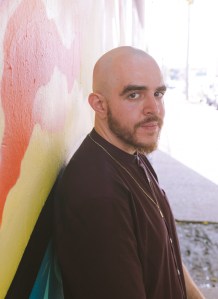
JoséphotobyMarcosVasquezJosé Olivarez is the son of Mexican immigrants and the author of the book of poems, Citizen Illegal. Along with Felicia Chavez and Willie Perdomo, he is co-editing the forthcoming anthology, The BreakBeat Poets Vol. 4: LatiNEXT. He is the co-host of the poetry podcast, The Poetry Gods and a recipient of fellowships from CantoMundo, Poets House, the Bronx Council on the Arts, the Poetry Foundation, & the Conversation Literary Festival. His work has been featured in The New York Times, The Paris Review, and elsewhere.  In 2018, he was awarded the first annual Author and Artist in Justice Award from the Phillips Brooks House Association. He lives in Chicago.
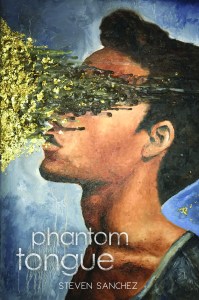
microreview & interview: Phantom Tongue by Steven Sanchez

review by José Angel Araguz

phantomtongue7

Phantom Tongue (Sundress Publications) by Steven Sanchez begins with “On the Seventh Day,” a poem depicting the speaker poring over images of male models in the Sunday ads—”glossy men” that “look like my G.I. Joe / if his clothes weren’t painted on”—then cutting and pasting body parts, fashioning ideal versions of attractiveness. This act is narrated in a compelling and telling manner; as the speaker notes that “These paper men / are caught inside words / they don’t even know exist,” it is hard not to notice the parallel with the speaker himself, a youth whose burgeoning sexuality is manifesting outside of words through this play with images. The poem ends with a similarly telling image:

I’ve learned to hide these men inside
the pages of my dictionary,
where words always cling
to their wet curves
like the newspaper ink
on my hands, headlines
and stories staining my skin.

This final image is charged with guilt and self-consciousness. Unlike the title’s reference to God resting after the creation of the world, this speaker is far from being able to rest or feel settled. In fact, his act of creation leaves him scared and with an impulse to hide his fascination.

This tension between fascination and self-consciousness lies at the center of Phantom Tongue. Starting with this poem about bodies, the collection begins to explore ideas of breaking—how bodies break, and what breaks with them—balanced by meditations on what is not broken. One can see this balance in the sequence “Passing.” In the section One of the Guys, the speaker is asked on the playground “Are you white or a wetback?” and responds with “I’m just like you.” The speaker is then told to grab a rock and join in the taunting and assault of another child. Unable to find a rock, or unwilling to, the speaker picks up a “large dirt clod” and is commanded to throw it at the head of the other boy. When he moves to do so, however, the speaker ends up only feeling how the dirt clod “explodes in my raised hand.” This closing image implies not only the futility of violence, but also the speaker’s discomfort in participating. It is almost as if the dirt clod breaks apart in empathy with the speaker.

This scene of coerced action resulting in futility skillfully leads to the second section of this sequence, Boy Scout. In this poem, the speaker is out fishing and reels in a brown trout, the experience bringing him closer to a growing sense of mortality:

I feel the rest of his life in this wire, taut
like string between two plastic cups.

Does he hear my heart tightening its pace,
a fist that will not let go?

The feeling of life on the wire compared to a childhood makeshift telephone drives home what is being communicated through this experience to the speaker. Viewed within the context of a conversation, the speaker is aware that he is at fault for the breaking from life that is going on at the other side. This awareness becomes a new knowledge in the form of the final couplet where the speaker’s heart becomes “a fist that will not let go.” Even the breaking life of a fish holds its fascination and lesson.

Sanchez’s attention to and facility with empathy is also present in the poems about his complicated relationship with his father. In “La Llorona,” for example, we are given an imagined origin story that is braided with the Mexican folktale. As the speaker tells us “My father’s forgotten / who brought him / to America,” the poem sets its license for this braiding as being grounded in the father’s absence of details. We further learn:

Somebody found him
when he was a boy
walking in the streets

of Tijuana, his mother
absent. The jagged
remains of his living

room window
cut his hands
when he reached

one more time
toward his own father,
dead for three days.

From here, the poem enters the speaker’s dreams where he tries to comfort the father. Where in reality the speaker’s father reached to the dead father, in dream he reaches toward the speaker. In this parallel, death and dream frame the speaker’s father with absence. This absence then becomes a space where the poem can explore the story of La Llorona and braid it to the father’s via imagery:

I can never touch him,
always my reflection
in water. A woman

emerges and slides
her finger across
his navel

where kelp grows
like an umbilical chord
inching toward his neck

Comfort exists in these stanzas edged with threat, as it does in life. The uncertainty of water—a realm of intangible reflections and unperceivable depths—makes a suitable parallel to the life of the father, who, through his own absences, lives an uncertain life. As the poem’s dreamscape baptism comes to a close, La Llorona holds the father and prays. In this way, braiding the narrative of La Llorona with that of the father redeems both troubled figures.

In “Approaching El Arco / Reloj Monumental,” redemption is explored in a way that allows for complication and doubt. As the poem moves through its crushing depiction of the speaker being questioned by border patrol while walking near the entrance of Tijuana, there comes this moment:

A gull walks

in circles a few feet away, his left wing
broken, upside down; his white

remex makes a path in wet sand
that three offspring follow. I could

hold the gull, stroke his sleek back,
and make a purple sling from my shirt.

But I wouldn’t know what I’m doing,
how to reset or mend his bones.

I would just break another one
I try to convince myself, even though

I know what happens if I do nothing.

This act of pausing, of acknowledging what’s in front of the speaker and each possible course of action, of lingering over meaning, speaks of the great empathy at the heart of this collection. By considering the broken wing of the bird, the speaker goes through the motions of feeling something (not quite innocence, but like it) break inside himself. Moments like this one showcase Sanchez’s gift for dwelling in complexity.

While the collection begins with a fascination with the body, this fascination quickly becomes an unflinching awareness of what is at stake within a body. Along with the physical breaking possible, there is the body as the house of what is broken and what continues to break. In the final poem, “What I Didn’t Tell You” (below), an address to a younger brother begins as advice and quickly shifts into regret and apology. Sanchez’s ability to look deeply within his own breaking—the physical and emotional, as well as the breaking that makes up memory—is illuminating. Throughout this collection, worlds that have gone neglected and unseen are made visible and granted the rich and transformative acknowledgment of poetry.

What I Didn’t Tell You – Steven Sanchez

for my brother

You can ask me anything,
Even about my first kiss,
which was at your age
and tasted like stale beer.
I used to feel guilty swallowing
the pulse of another man,
but now I know there are many
ways to pray. There’s a name for
that most intimate prayer:
la petite mort—the little death.
If, when your lover rakes
your back, you recall
the flock of worshippers
surrounding you like raptors
when they learned you’re gay,
clawing at your shoulders,
squawking for salvation,
remind yourself you have to die
before you can be resurrected.
Never forget what the Bible says:
when two people worship together,
they create a church
no matter where they are—
which must include
the backseat of a car
or the darkest corner
of Woodward Park.
These are some of the things
I wanted to tell you
that night in April
you called me for help
with your history report
about the gay rights movement.
Neither of us admitted
what he knew about the other.
Instead I started
with the ancient Greeks,
told you it was normal for them,
that for one brief moment
they were allowed to shape
their own history and religion,
organizing the stars, forming
Orion, for example,
flexing in the sky, arms
open in victory, belt
hanging below his waist.
But he was punished
for his confidence,
a scorpion’s hooked tail
piercing his body
like a poison moon.
When I see Orion,
I think of you and remember
what it felt like
for my knuckles to sink
into your stomach,
for my fist to collide
with your face. Your voice,
your walk, your gestures
reminded me of myself,
your figure bright and fluid,
creating a reflection
I wanted to break.
And now I see
your body spill open—
Big Dipper hooked
to your ribs, North Star
nestled in the middle.
I reach for that ladle
and drink.

*

Influence Question: How does this full length relate/grow out of your chapbooks?

Steven Sanchez: The earliest draft of Phantom Tongue came first, followed by my chapbooks: To My Body (Glass Poetry Press) and Photographs of Our Shadows (Agape Editions). While my two chapbooks have a lot of thematic overlap (in terms of Queerness, internalized oppression, and Pocho-ness, among others), the image systems and tones between each chapbook felt different. Despite these differences, or probably because of them, I was able to figure out how to meet Phantom Tongue on its own terms.

Originally, Phantom Tongue had three sections, and the differences between the first two sections reflected the differences between the two chapbooks. The third section tried to reconcile those differences, but, like a bad sewing job, the thread was visible and didn’t match. I expressed my concerns to Sara Henning (my wonderful editor at Sundress) and she encouraged me to remove the sections and see what happened.

Reading through it without sections, I still saw significant shifts that reminded me “oh, we’re switching between chapbooks now,” so I tried out an organization strategy I used in my first chapbook—begin the book with a poem centering the body and end the book with a poem centering the body. If I could begin and end with a body, Phantom Tongue could tell the story of that body.

However, the final poems in Phantom Tongue had tones that clashed with each other. The title poem itself comes relatively late in the book and is a poem of witness (sort of) where the speaker lacks agency. But I wanted the end of the book to acknowledge and challenge what happens in the title poem. I turned to the poems from my second chapbook for help and found the poem I wanted to close on—What I Didn’t Tell You. When I found that poem, I realized a few of the poems in that chapbook had a similar tone and pacing; I realized that Phantom Tongue needed those poems near the end.

Ultimately, I found that my first chapbook seemed to privilege the physical, lived experiences of a body, while the second chapbook seemed to privilege the ways bodies get read as texts and assigned meaning. While those chapbooks can be their own entities, I realized Phantom Tongue felt clunky because the physical body and metaphysical body inform each other and cannot be so easily separated (if at all). My chapbooks were so helpful in my revision process, sort of like a phoropter in an optometrist’s office—sometimes one chapbook made an aspect of Phantom Tongue super clear, sometimes that same chapbook made me lose focus; toggling between the two helped me hone in on the smaller details I couldn’t see on my own.

*

Special thanks to Steven Sanchez for participating! To learn more about Sanchez’s work, check out his site! Copies of Phantom Tongue can be purchased from Sundress Publications.

*

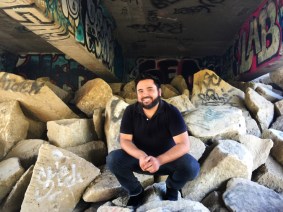
1888_sanchezSteven Sanchez is the author of Phantom Tongue (Sundress Publications, 2018), selected by Mark Doty as the winner of Marsh Hawk Press’ Rochelle Ratner Memorial Award and a finalist for the Andrés Montoya Poetry Prize & the Four Way Books Intro Prize. He is also the author of two chapbooks: To My Body (Glass Poetry Press, 2016) and Photographs of Our Shadows (Agape Editions, 2017). A recipient of fellowships from CantoMundo and the Lambda Literary Foundation, his poems have appeared or are forthcoming in Poet LoreNimrodNorth American ReviewMuzzleCrab Creek Review, and other publications. He holds a B.A. in Philosophy and an M.F.A. in Creative Writing from California State University, Fresno.