review by José Angel Araguz
Stray – Robin Carstensen
She came howling for food
on the porch in June — tufts
of gray-white hair sprung from her
birdlike strut — huffing a claim
for herself, as if she could
conjure the rain in this brown
drought-struck town, boarded up
houses marked Foreclosed.
On this small plot of land
I’d come back to save, books
in my heart with my name on them,
on these sun-baked planks
on this yellow-scabbed yard,
I’d watched her streak across
the street, tomcat tearing up
her dust. Her screech had stiffened
the humid night. She’d come
for three seasons, gulp my leftovers
beneath the red hibiscus, swish
her smoky plume of tail, brush
by me like a petal, be gone.
In early April, I found her
under the moonlight, her right eye
gouged and black-encrusted,
draining green as if the moon
had wept. Hard news struck
morning: the vet showed a pellet
lodged in her thin neck,
the entrance wound — her blown
eye. As I buried her that night,
children played in the yard
next door. Her milk had been dry.
The litter likely starved to death.
I couldn’t hear myself think
about them. Just the children’s
voices scratching the hot air,
loud and bored, my turn, my turn,
bouncing on the trampoline,
their big, thin skulls bobbing
on their string-bean bodies
soon to be loose on the planet,
roaming beneath the faint
moon bearing earthshine.
*
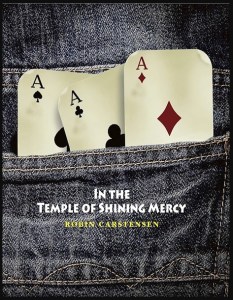
One of the things that immediately struck me about the poems in Robin Carstensen’s chapbook In the Temple of Shining Mercy, is the way poetic language is placed at the service of empathy. In “Stray,” for example, the speaker meditates on the final days of a stray cat whose life is cut short due to an act of violence. The speaker’s tone throughout conveys a sober wistfulness, able to lay out the details in a direct manner. The phrasing of “as if she could / conjure the rain in this brown / drought-struck town” both paints a picture of the speaker’s surroundings but also implies a certain hope.
This dual turn of imagery and phrasing occurs again at the end of the poem in the imagery of children on a trampoline. As a pellet was found to be the cause of the stray’s death, there’s a slight implication the cat was shot by neighborhood kids. This implication is furthered by the phrasing of “their big, thin skulls bobbing / on their string-bean bodies / soon to be loose on the planet.” The use of the word “loose” is crucial here: there is the loosing of the possible threat the children could grow up to be, but also the loosing from the safety of home and childhood, of children growing up and becoming strays themselves “roaming beneath the faint / moon bearing earthshine.” The poem ultimately empathizes with the speaker’s understanding of mortality, that all — stray cat, children, and self — are loosed awaiting their mortal “turn.”
Throughout the chapbook, Carstensen shows herself as able to lift everyday experience and evoke a bit of the mystery beyond it. From a magazine advertisement imploring the would-be consumer to “Explore This,” to a game of poker, the range of material Carstensen writes about is given the same multivalent empathy and consideration, each subject seen for what they are and what they mean and might mean. In this work, the poet is less mystic and more like the envisioned gardener of “The Master” (below). In this poem, the speaker describes growing a “garden in my next life” where:
My next-door neighbor will be a woman
who will not ask me to confess
my failures, nor by tongue, eye, sleight-
of-hand, ask whom I’ve betrayed or who
betrays me and themselves.
Instead of this human interrogation, the speaker’s imagined neighbor will:
offer cuttings, give easy
watering tips: aim for the roots
on lamb’s ears, not the leaves, or they wilt.
The fire witch like their drink in the morning;
Astoria soak the live-long day in sun.
This exchange of one kind of wisdom is rich with meaning, namely that of moving through the world in a way that helps others become themselves. Part of that work seems to be learning how to approach things (aim for the roots) or seeing them for how they work. The purpose of this work and consideration is evident in a final scene between the neighbor and the speaker:
Behind her rosebush, beneath her straw hat,
she will wave to me, no small occasion
tender things, our radiance, and our laugh.
The phrasing of this “no small occasion” reflects the lessons learned from this “master.” Being able to show consideration and empathy for other beings can teach one how to be considerate to one’s self. Yet, the poem is masterful in its own right in that it avoids speaking in the high terms I speak of it; that is to say, in handling the narrative through direct details, the poem develops such meanings subtly, so that both reader and speaker simultaneously experience the revelation of seeing the “tender things” before them in a clear light.
The Master – Robin Carstensen
I want to grow a garden in my next life
and watch a spotted toad beneath the rain.
My next-door neighbor will be a woman
who will not ask me to confess
my failures, nor by tongue, eye, sleight-
of-hand, ask whom I’ve betrayed or who
betrays me and themselves. Nor will she
insinuate how on Earth do I not know
how to trim a rosebush. She’ll know
I’ve learned perfectly well how to ask
such questions of myself. Behind her
fence, she’ll offer cuttings, give easy
watering tips: aim for the roots
on lamb’s ears, not the leaves, or they wilt.
The fire witch like their drink in the morning;
Astoria soak the live-long day in sun.
My neighbor won’t ask me over for tea,
so I will never be late or anxious
about presentation. She won’t press
her weight over the fence or plant
herself in my yard inch by inch, tell me
wistful stories of sons who never call
or of poor souls besodden, stricken down.
I won’t tell her how I blew it again at work,
let someone get my goat. All that meditation,
awareness of ego, and for what? I won’t
tell her how I try to wean it, though it keeps
me up at night, how I’ve been too kind
or not kind enough, how much I know
about a womb and the way it can embody
hollowness, the way it echoes fears, mothers’
and daughters’ fears and envies and more fears.
My neighbor will observe these shadows
and leave them wordlessly to ebb and flow.
We’ll revel in the lizard, the red-tailed
hawk, the pink-fleshed mice they both devour,
and my face lit up upon the green shoot
in my garden, my first seed come to light.
Behind her rosebush, beneath her straw hat,
she will wave to me, no small occasion
tender things, our radiance, and our laugh.
*
 Influence Question: What were the challenges in writing these poems and how did you work through them? What do you feel poetry can do/be?
Robin Carstensen: Restraint is one of my biggest challenges. It took many years reading, studying, and practicing poetry’s craft to learn this fine art of suspension and release. For this, I’m grateful for my graduate experience with such teachers as Lisa Lewis and the late Ai. While I needed encouragement and validation, I also needed someone willing to tell me to hold back, to work harder at precision and clarity as I ventured with the reader into uncharted territory. My early drafts are often journal entries over-steeped in the sensory, emotional world. I work to chisel the poem down to the sharpest, most resounding images and sounds. I want to cut but not drown the reader or myself. I’m thinking of my poem, “Stray,” for example, my outrage at the violence perpetrated against a neighborhood cat. The challenge in this and so many poems was to express the outrage, to question unnecessary violence, to discover its connection to all of human violence, without the overbearing polemics or the sermonizing that surely makes the reader run for the hills.
I enjoy the long adventure, the slow promenade. Perhaps this mirrors how I move my body in my daily life—I hate to rush. The challenge for me in life as in the poem is to bring the reader along with me, to hold steady at my pace and length, to trust we’ll arrive somewhere, if not spectacular and breathless, perhaps intriguing or quietly special. I discovered help and pleasure in received forms and the innovation of form in containing and shaping ambling, cumbersome drafts. In particular, the incantatory ghazal and villanelle as well as the sonnet’s iambic beats help me hold the reader in a mutual descent or ascent into terror, ecstasy, meditation and all the valleys and rivers between. The question remains: How can I keep the reader with me—my companion, my lover, and my friend—as we reach into human violence, loneliness, or the depths of eros and love? The first reader, friend, lover is myself, and if I can be very still and honest with myself, the poem might expand to invite others to hold the tension with me. In the stillness, the imagery, sound, and form radiate and bubble forth.
Like James Baldwin in his writing habits, I found the stillness for writing most of these poems long after everyone else had gone to bed. Whether living alone or with someone, I mean a kind of quiet when the world and all our clamoring subsides. In her dialogue with Jane Hirschfeld and Juan Filipe Herrera on the “Poet’s Civic Responsibility,” Naomi Shihab Nye refers to this “muchness” we are all experiencing. We’re living among heightened, intersecting tensions locally and globally, as well as increased demands personally and professionally. While technology and social media offer more avenues to connect, imagine, and share, we are inundated with stimuli, information, private lives overshared and overexposed. Writing and reading a poem is an opportunity to bring us into stillness and the depths of feeling, thought, connection we hunger for. It’s one of my greatest challenges and pleasures to write poetry that reaches for this depth and for the impossible beauty between mystery and revelation.
*
Special thanks to Robin Carstensen for participating! To find out more about Carstensen check out this announcement by Iron Horse Literary Review. In the Temple of Shining Mercy can be purchased from IHLR here.
 review by José Angel Araguz
 Influence Question: How does this collection reflect your relationship/history with the short lyric?
 The Influence