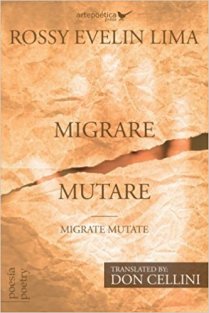
This week’s microreview & interview features Rossy Evelin Lima’s Migrare Mutare ~ Migrate Mutate (artepoética press, 2017) whose poems are presented below in the original Spanish first, followed by English translations by Don Cellini.
review by José Angel Araguz
Hacia el sur – Rossy Evelin Lima
En la frontera hay letreros
que señalan con una flecha
hacia dónde está México: hacia el sur.
Yo siempre corro a ponerme atrás de ellos
esperando que esa flecha
se clave en mis pasos
esperando que esa flecha
me haga una marca en el rostro
mientras me traspasa para seguir su rumbo: hacia el sur.
Corro a ponerme atrás de cada letrero deseando que la flecha
sea un arpón y mi pecho cristal,
que se divida en mil estelas,
esperando tragarme esa flecha
como un espina,
como un ancla.
Hacia donde está México: hacia adentro.
*
Headed South – Rossy Evelin Lima translated by Don Cellini
On the border there are signs,
an arrow that points
the direction toward Mexico: south.
I always run to put myself behind them
hoping that this arrow
fixes my steps
hoping that the arrow
will imprint itself on my forehead
while it runs on continuing its route: south.
I run to put myself behind every sign hoping that the arrow
will harpoon my crystal chest,
shattering it into a thousand trails,
hoping to swallow the arrow
like a thorn,
like an anchor.
Which direction is Mexico: within.
*
One of the things I admire most in a poet is their ability to make their obsessions and themes their own. Rossy Evelin Lima’s Migrare Mutare ~ Migrate Mutate makes the themes of her collection evident in the dichotomy of the title. Following suit, the poems are presented in two sections, each taking a word from the title. The “Migrare/Migrate” section is rich in variations on the theme of migration, here specifically between Mexico and the U.S., via poems that place the lyric self right into the drama of (re)defining ideas of migration.
In “Hacia el sur (Headed South),” for example, the reader is presented with the image of signs along the border whose arrows point “the direction toward Mexico: south.” The speaker then riffs on the implications of arrows. In the lines that follow, one can see how this symbol of direction is also a symbol of threat and action, especially when the speaker hopes “the arrow / will harpoon” into her chest, “shattering it into a thousand trails.” Far from being “shattered,” however, the speaker reclaims the arrow through this image of putting themselves “behind every sign” by stating “Which direction is Mexico: within.”
This conflux of images sets the poetic ambition of the collection. In reading the “signs” of her world, Lima presents the lyric self as interpreter. The image of the speaker’s chest shattering “into a thousand trails” can be seen as the urgency with which this poet writes about the costs and stakes of migration. That what the lyric self’s chest shatters into are “trails” is telling; the drive to write poems carries a purpose beyond expression. The poems in this first section point to the practical way “migrating” one’s inner world outward can help others travel within themselves. Through innovative associations (thorn/espina, anchor/ancla), the arrow becomes something singular in this poetic world.
This (re)defining of symbols and images continues in the second section, “Mutare/Mutate.” The poems in this section use the lens of mutation to lyrically evoke the way elements, animals, and other voices change and complicate themselves and the world around them. In “Agua que se rinde (Water That Surrenders),” for example, we find a speaker contemplating how:
Hasta el agua se rinde,
cierra su boca de océano, calla,
se reviste de raíces
se esconde en el centro oscuro
y se empodrece,
se torna esmeralda y carbón y desarraigo.
Even water surrenders.
It closes its ocean mouth, quiets,
searches among roots,
hides in the dark center,
and becomes putrid,
becomes emerald and coal and exile.
This travel of shape is also a travel of meaning; the lyrical ambition of this and other poems in this section is to encompass and face both the light and dark of their subjects. This lyrical ambition is also at the heart of the book’s closing poem, “Mariposa (Butterfly).” Here, the speaker departs from typical ode territory and clearly states the ambition to “conjure” all sides of a butterfly. The repetition of the line
eres la única muerte que promete alas,
you are the only death that promises wings,
does the work of conjuring. Each repetition is a dip forward, charging the poem with mortal awareness. Yet, despite the gravity of such a gesture, the poem keeps its momentum. Mid-poem, we find the speaker “living like a poet / between the canyons of the present.” This direct statement on the poetic act brings back the ambition of the book to present a specific poetic presence. This poem about a butterfly whose “death…promises wings” brings together the two words of the title, and evokes how the reading of a poem can mutate into a presence that keeps the mind and heart in motion.
Mariposa – Rossy Evelin Lima
Transparente presencia rutilante,
eres la única muerte que promete alas,
el despertar negro y naranja de la emigración,
te conjuro, en esta jaula de soles y lunas,
en esta jaula forjada con franjas azules y rojas,
eres la única muerte que promete alas,
eres la firmeza de un vuelo libertario,
mujer Monarca,
vienes cada año para llevarme contigo,
y sin saber por qué me ves cerrar los ojos y los puños.
Eres la única muerte que promete alas,
voy viviendo como poeta
entre los cañones del presente,
voy viviendo como larva
enterrándome el camino como daga,
voy soñando con el néctar de las flores
que crecen al otro lado de la frontera,
eres la única muerte que promete alas.
*
Butterfly – Rossy Evelin Lima translated by Don Cellini
Translucent shining presence,
you are the only death that promises wings,
the black and orange awakening of migration,
I conjure you, in this cage of suns and moons,
in this cage forged with red and blue stripes,
you are the only death that promises wings.
You are the strength of your free flight,
Monarch Woman.
You come each year to carry me with you,
and without knowing why, you see me close my eyes and fists.
You are the only death that promises wings.
I go on living like a poet
between the canyons of the present,
living like a larva
burying the road like a dagger.
I dream of the nectar of the flowers
that grow on the other side of the border.
You are the only death that promises wings.
*
Influence Question: How would you say this collection reflects your idea of what poetry is/can be?
Rossy Evelin Lima: Poetry is not an instrument but a force. In that sense, I think that in poetry, I am the poem’s purpose: I allow it to excavate, to reveal itself, layer by layer, to find in me the path towards a piece of paper. Like Abigael Bohorquez wrote in his poem Exordio “Poesía, desembárcame, échame a tierra y léñame; como a candil de sangre, enciéndeme…”
I can’t do anything if I don’t empty myself and allow Poetry to bury me, to ignite me with purpose, I willfully accept to be a vessel Poetry can guide ashore. I am not the weaver, I am the thread and the poem is the fabric. As a result, Migrare Mutare, opened my heart to the situations I faced as an undocumented immigrant in the US, a subject I struggle to talk about because in order to talk about it I must relive it, revive it. Nonetheless, poetry condenses my emotions projecting my core to the exterior, exhuming these sentiments in a liberating pull outward.
Influence Question: What were the challenges in writing these poems and how did you work through them?
Rossy Evelin Lima: The challenge I faced when writing these poems was that all the words wanted to come out at once. The first portion of the book, “Migrare,” was written within a day. I could not stop. The words had been roaming around for quite a while, and in all honesty, I was trying to hold them back. Like in Plato’s cave, I would see the shadows of these poems dancing, but I didn’t want to reach out. In an ordinary day, I went to a coffee shop to work on my dissertation, nothing unusual. I had been working for a couple of hours when I found myself staring at a blank page in my notebook. I felt what Lorca would call, the Duende, and began with the line, “en la frontera hay letreros…” I wrote twenty-three pages that day, which were later divided into poems.
I didn’t revisit “Migrare,” until three months later, only to be taken by the same force. I had felt it coming, a very similar feeling to when you are preparing to take a very long trip. I didn’t offer any resistance this time. I noticed that the second portion of poems had much to do with water, an element I identify with, but differing from the rest, these talked about change. As if coincidences exist, a couple of days before, my mom had told me about a phone call she had with a very old friend from when we lived in Mexico. She told me, very preoccupied, that her friend said she “sounded” different. “Well, you are older, you’ve been exposed to a new language…” But no explanation would ease my mom’s mind. “What if I changed?” She asked, “We all change, we are in constant change.” I replied, as my mom looked straight at me and said “What if it really changed me?” I knew what “it” meant, and in that moment it made perfect sense: adaptation. In order to survive we adapt, most of the times unaware of the changes we have to make in order to do so. As immigrants we encounter situations that force us to change with an impact; we move, in Latin expressed by the word Migrare, and we change, expressed by the latin word Mutare. In that moment I was able to see where the poems I had written belonged.
*
Special thanks to Rossy Evelin Lima for participating! To find out more about Lima’s work, check out her site. Migrare Mutare ~ Migrate Mutate can be purchased from artepoética press.
 Rossy Evelin Lima (born August 18, 1986 in Veracruz, Mexico), is an international award-winning Mexican poet and linguist. Her work has been published in numerous journals, magazines and anthologies in Spain, Italy, UK, Canada, United States, Mexico, Venezuela, Chile, and Argentina. She has been awarded the Gabriela Mistral Award by the National Hispanic Honor Society, the Premio Internazionale di Poesia Altino in Italy, the International Latino Book Award, and the Premio Orgullo Fronterizo Mexicano award by the Institute for Mexicans abroad, among many others. She is the president and founder of the Latin American Foundation for the Arts, the founder of the International Latin American Poetry Festival (FeIPoL), as well as the co-founder of Jade Publishing. In 2015 and was invited to speak at TEDxMcallen to talk about her experience as an immigrant writer in the U.S.
 Tina Cane is the founder and director of Writers-in-the-Schools, RI and is an instructor with the writing community, Frequency Providence. Her poems and translations have appeared in numerous publications, including The Literary Review, Two Serious Ladies, Tupelo Quarterly, Jubliat and The Common. She also produces, with Atticus Allen, the podcast, Poetry Dose.
 The Influence