One Night – C. P. Cavafy
The room was cheap and sordid,
hidden above the suspect taverna.
From the window you could see the alley,
dirty and narrow. From below
came the voices of workmen
playing cards, enjoying themselves.
And there on that common, humble bed
I had love’s body, had those intoxicating lips,
red and sensual,
red lips of such intoxication
that now as I write, after so many years,
in my lonely house, I’m drunk with passion again.
translated by Edmund Keeley/Philip Sherrard
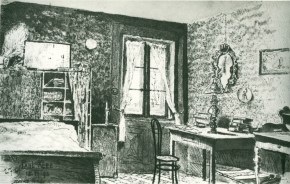 Continuing in the short lyric vein of last week’s post, the poem above handles several worlds in twelve quick lines. I’m moved by the pace of the poem. The first stanza sets the tone of the outside world, a world dark, “dirty and narrow.” Then the second stanza opens up the world of tryst and memory. If, as Jürgen Becker says, “The memory does not exist, you have to create them,” then Cavafy creates a memory of “intoxication” and “passion” that is as alive in the speaker’s present as it was in his past. This turning over of thought and confession makes of memory a talisman against a “lonely house.”
Thinking up possible poems to share this week I was suprised to find that I hadn’t shared any poems by Cavafy. To make up for that, I also share “Ithaca” below. Its incorporation of Homer’s Odyssey into an allegory for living with awareness (or, in another light, a reflection of the adage: Life is a journey, not a destination) ranks highly with me on a personal level. I read the poem first in my early twenties, at a time when I was headstrong on purpose. Poems like this one guided me toward slowing down.
 Cavafy’s poem also brings to mind Tennyson’s “Ulysses,” another poem incorporating the story of the Odyssey. The following lines from “Ulysses” compliment the spirit of the above short lyric in their human/emotional momentum:
I am a part of all that I have met;
Yet all experience is an arch wherethro’
Gleams that untravell’d world whose margin fades
For ever and forever when I move.
Leaving Texas, and then learning to leave other places after that, I worried I carried little along with me inside. Poems like these showed me otherwise.
Ithaca – C. P. Cavafy
As you set out on the way to Ithaca
hope that the road is a long one,
filled with adventures, filled with understanding.
The Laestrygonians and the Cyclopes,
Poseidon in his anger: do not fear them,
you’ll never come across them on your way
as long as your mind stays aloft, and a choice
emotion touches your spirit and your body.
The Laestrygonians and the Cyclopes,
savage Poseidon; you’ll not encounter them
unless you carry them within your soul,
unless your soul sets them up before you.
Hope that the road is a long one.
Many may the summer mornings be
when—with what pleasure, with what joy—
you first put in to harbors new to your eyes;
may you stop at Phoenician trading posts
and there acquire fine goods:
mother-of-pearl and coral, amber and ebony,
and heady perfumes of every kind:
as many heady perfumes as you can.
To many Egyptian cities may you go
so you may learn, and go on learning, from their sages.
Always keep Ithaca in your mind;
to reach her is your destiny.
But do not rush your journey in the least.
Better that it last for many years;
that you drop anchor at the island an old man,
rich with all you’ve gotten on the way,
not expecting Ithaca to make you rich.
Ithaca gave to you the beautiful journey;
without her you’d not have set upon the road.
But she has nothing left to give you any more.
And if you find her poor, Ithaca did not deceive you.
As wise as you’ll have become, with so much experience,
you’ll have understood, by then, what these Ithacas mean.
translated by Daniel Mendelsohn
*
Happy Ithaca-ing!
José


 The Influence